

George Rebane
We have heard about recovering from the ‘Great Recession’ since the summer of 2009. Politicians of the Left have been conducting a painful national celebration of how their Keynesian stimulation policies have saved and then recovered our economy. But what no one tells us is that recoveries come in various flavors, some of which, as we are experiencing, are very bitter to swallow. RR readers should understand some basics of what is a recovery, and this post will attempt to contribute to that understanding.
In the figure below we see a standard garden variety, or nominal, process (green line) that starts at 100 and grows at an average 4% rate per time period. Here we have shown time divided into 100 numbered periods – i.e. t = 1, 2, 3, …, 99, 100. Everything seems to be going along normally or nominally until t = 40 at which time the recorded amount has climbed to about 225 (blue dotted line). Then something goes wrong, the process falters and plunges about 40% (red line) over the next ten time periods such that at t = 50 it is at around the 130 level at which time a ‘recovery’ begins.
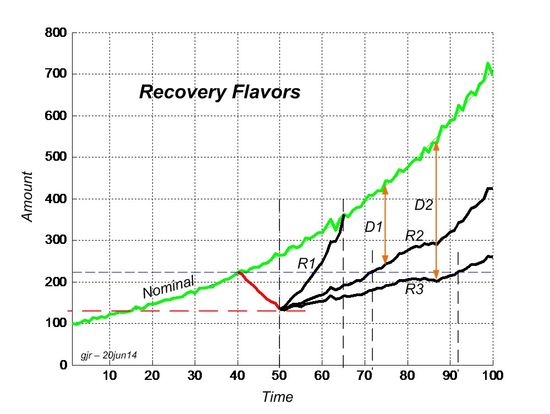
The figure illustrates three kinds of recoveries shown as black traces labeled R1, R2, and R3, all starting from the same amount at t = 50. The R1 recovery takes off at a 6% rate and catches up with where the original nominal process (green line) would have been at about t = 65. From there the process resumes its original 4% rate of climb as shown.
R2 starts its climb from the low point at the original 4% growth rate of the nominal process. In other words, the process has resumed or recovered its nominal growth rate before faltering (e.g. before, say, a recession). Having recovered only its nominal growth rate dictates that R2 will never catch up with what the nominal process would have been before the 40% plunge. In fact, it’s even worse than that. The deficit between the nominal and R2 processes, shown as D1, will widen as time goes on even though both are growing at the same 4% rate.
R3 shows a recovery at a rate, here 2%, that is less than the 4% rate of the original nominal process (green line). It, of course, will also never catch up with the nominal process, and its deficit, shown as D2, will continue to grow at an even faster pace than will D1 for the just described recovery R2.
The bamboozle comes in when people begin hyping R2 or R3. This is done with loud celebrations that start when either of these ‘recoveries’ again climb to the level at which the recession began (blue dotted line). For R2 we will break out the champagne at about t = 72 while telling everyone that not only have we recovered to the 225 level where the recession began, but we are now again growing at the pre-recession rate of 4%. Happy dancing all around.
The exact same celebration will be held when R3 reaches 225 at around t = 92. The emphasis here will be that “we’re back to where we were before the trouble began”, and few will say anything about R3’s growth rate being an anemic 2% that spells a worsening future compared to what an untrammeled nominal growth path (green line) would have provided us.
The takeaway here is to understand that recoveries R2 and R3 are systemically deficient. The old process (green line) has not been recovered. Each of these ‘recoveries’, no matter the amount of confetti, defines the start of a new epoch in which we permanently fall short in both time and amount from what the nominal process would have provided. And R3, in which the ‘recovered’ growth rate (2%) is less than the previous nominal rate (4%), is a disaster in the making. Why so?
Well, if the nominal process is something like a nation’s GDP, that before t = 40 was considered to adequately provide for private and public budgets and an acceptable quality of life (QoL) in general, then when those budgets can no longer be funded as expected under R2 and R3, we can expect that ultimately QoL will suffer. Because other concurrent processes in the system, say, the working age population and retirees, will continue to grow unabated. In the face of this unemployment grows, cutbacks in investments and public spending programs will be necessary, and/or companies and governments will have to borrow to keep the rigmarole of state going for as long as possible. This most certainly as long as such recovery promoting politicians have banked their retirement sinecures and are safely out of office.
In the final analysis, when people hear of a recovery, they expect that R1 – i.e. recovery of the original nominal process – is happening or has already happened. Yet in almost every case this is far from the truth. Nevertheless the R2 and R3 recovery bamboozles can always be pulled on a nation that is grossly innumerate. Nothing described here is rocket science, yet for an overwhelming fraction of a generally innumerate public – e.g. America’s electorate – to grasp these fundamentals is indeed rocket science (here and here). However, to politicians playing to this widespread ignorance is part of their bag of tricks for a successful career at the taxpayers’ trough.


 rebanesruminations.com
Leave a comment