

As democracy is perfected, the office of the President represents, more and more closely, the inner soul of the people. On some great and glorious day, the plain folks of the land will reach their heart’s desire at last and the White House will be occupied by a downright fool and complete narcissistic moron. – H.L. Mencken, in the Baltimore Evening Sun, July 26, 1920
George Rebane
Let me start by describing the longstanding debate by nationally known, Northwestern economists Drs Robert Gordon and Joel Makyr. These academics have views of the future which are erroneously reported to be in conflict. Gordon argues that the best days of America are behind it, citing factors like stagnant growth, national debt, aging population, and income inequality. Makyr responds with the marvels of technological advancement that began 250 years ago, is accelerating today, and will bring everything from new life extending medicines to drought resistant crops to feed an ever hungrier world. (more here)
They don’t seem to realize that their arguments are orthogonal – both prognoses can be concurrently correct. This marriage of factors has been my own view of the most likely future in store for America (cf. systemic unemployment and Singularity Signposts). But when respected academics cannot connect such obviously related dots, the national debate suffers. Their focus should acknowledge that both descriptions can hold, and then proceed on how wealth can be productively transferred to the redundant without enlarging government and the welfare class while keeping the wealth generating machinery intact and growing.
This brings us to the Great Divide that is obvious daily in the growing polarization of main street America. RR’s position (most recently here) that the grassroots’ ideological divide is real has been long pooh-poohed by the Left. But it turns out that there really is a chasm between people who see a place for themselves in a technology driven future, and those who literally have no clue how they will fit into such a world. All these people know is that they don’t understand 99% of what’s going on, their circumstances are no fault of their own, and that they deserve to be cared for by others.
The non-partisan Pew Research Center has just concluded an extensive research project – ‘Political Polarization of the American Public’ – on the depth and extent of the country’s polarization, asking whether the dysfunction of Washington is reflected across the land, and what has become of the usually functional ‘center’ that has directed the nation’s governance. Well, it turns out that the percent of voters who are consistent and adamant about their political views has more than doubled during the last 20 years – from 10% to 21%. And more than twice as many in each of the two parties believe the other party is a salient and destructive force taking the country in the wrong direction while “posing a threat to the nation’s well-being.”
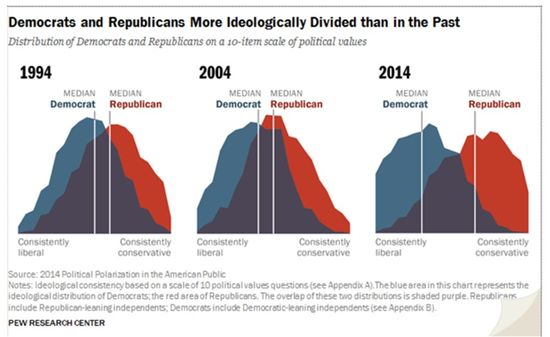
As the comment streams in RR have witnessed over the recent years, people of the Left and Right don’t agree on much of anything that has occurred, is going on right now, and will likely come to pass tomorrow. I would not be surprised if one cannot make book on the difference in time of day reported by both sides.
The Pew study also destroys the belief – aka “asymmetrical polarization” – held by the Left and independents that it is the Republicans who have caused this division. Alan Murray, president of the Pew Research Center, reports “our research shows that liberal thinking has coalesced at least as much as conservative thinking over the past two decades.” More specifically, “Broad shifts in opinion on homosexuality and immigration, which used to divide the Democratic base, have helped cause the share of Democrats who hold consistently liberal views to more than quadruple, to 23% from 5%. The share of Republicans with consistently conservative views has increased less dramatically over the same time period, falling from 13% in 1994 to 6% in 2004, before spiking to 20% this year.” The rapid ‘recovery’ of strong conservative beliefs during the recent ascendancy of the Left in Washington and coastal state governments is not a coincidence.
In addition to these major shifts in strong beliefs, folks holding them don’t very much like each other, frequent socially with each other, and feel uncomfortable having the others as neighbors. This again corroborates what I have reported about people wanting to live with people who share their values, culture, etc, and even more so when the other side is perceived as intent on destroying what you and yours hold dear. (more here)
Pew is continuing the study, probing more deeply into the causes of this great ideological divide. As with the results of this study, many of us have known the answer to these ‘deeper questions’ for some time now and will not be surprised by the next tranche of reported results. Definitely stay tuned, as ultimately these are the most profound and disturbing issues that will determine the future of the Great American Experiment. And as Mickelthwait and Woolridge of The Economist report in The Fourth Revolution: The Global Race to Reinvent the State, the world is watching America, even as countries encounter and seek to solve similar problems with various degrees of violence.
America’s attempt to find a peaceful solution has been asymmetrically impeded by the Left, first by diminishing the problem as being temporary and topical, and second through a rush of public policies (e.g. environmental to immigration) that are rapidly creating an economically and militarily weakened socialist autocracy based on reapplication of misapprehended tenets of human nature. As Will Rogers advised, “It ain’t what you don’t know that worries me, it’s what you know that ain’t so.”


 rebanesruminations.com
Leave a comment