

George Rebane
People who have trouble connecting the dots are often missing some dots.
WSJ’s Kimberley Strassel has shined a light on ‘Big Labor’s VA Choke Hold’ – an aspect of the scandal not yet exposed. She lists a series of audacious malpractices that have become embedded in the VA, and presumably across the federal bureaucratic terrain since the same public service unions (e.g. American Federation of Government Employees and the SEIU) are ensconced throughout.
Byzantine union work rules have helped create VA’s huge treatment backlogs and long waiting times. The AFGE and SEIU attack every initiative to increase internal productivity or outsource work that the VA healthcare system can’t or won’t provide since it may diminish the VA’s union workforce or work hours. As a result veterans suffer and have done so for years. (See also ‘The VA Fiasco – some thoughts’)
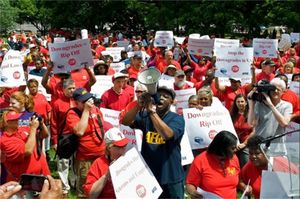 The government unions’ response to non-performance is singular and uniform – ‘give us more money.’ That is the essential substance of union promoted reforms in the government when another agency has been shown to go rogue or become dysfunctional. (Photo from Strassel’s piece with caption “A rally of VA workers, members of the American Federation of Government Employees, near the White House, June 13, 2012. Getty Images/The Washington Post)
The cause for such behavior and performance has been obvious for decades and was anticipated by FDR when he opposed the onset of public service unions in the 1930s. Public service unions construct dysfunctional feedback paths in the bureaucracies they dominate – the agencies’ faces are turned from serving the veterans or taxpayer, and toward union bosses and disconnected management that is further disconnected from elected officials. Poor service can get worse for decades before someone notices, publicizes it sufficiently, and then attracts temporary palliatives which are soon forgotten as the next cycle of disservice starts.
Private industry unions have much ‘tighter’ and functional feedback paths to the real world, paths that have a modicum of self-correction built into them. If a private sector union decides to disrupt the operation of the company, they know that this could cost the business customers, market share, increase costs, and ultimately reduce union jobs. The public sector union has no such considerations when they ‘negotiate’ while threatening to disrupt or mangle the operations of their agency. The outcome becomes just an added inconvenience to citizens whose only recourse is through infrequently re-elected politicians. (Another strong argument against government providing services that can be provided by the private sector.)
In the meantime, if the disruption becomes a public issue, then any and all fixes are delayed or denied by the political parties pointing fingers at each other, launching drawn out investigations, and diverting attention from what might have caused the problems in the first place. In short, the public again has essentially no recourse – it was ever thus and the cycle of pain will grow along with the leviathan in which the metastizing cancer resides.
Ultimately big government creates zombie agencies that are unresponsive to Congress or any form of public oversight, structure themselves to first serve the interest of their unions, naturally create problems hard/impossible to discover let alone fix, and ultimately become rogues that are impossible to kill. The EPA has been the current poster child of such an agency, a position that the VA may again claim as the ongoing scandal unfolds.
But the bottom line here, dear reader, is that our focus should always be wider than just the latest scandalous agency in the current ‘limelight’. What the EPA, DHS, Dept of Energy, Dept of Education, … are doing is essentially the same as now being discovered of the VA were they to respond to congressional demands for information as required by law. Today all we can say for sure is that the zombies are multiplying (e.g. tens of them are spawning from Obamacare alone), and they do mean to do us harm.
[update] A reader sent us a heads-up on how the application of Seattle’s $15/hr minimum wage will impact the region when it is fully applied in 2020. SeaTac International Airport (a government enterprise) unionized employees demanded and got their $15/hr minimum wage right away. Is anyone happy about that? It doesn’t look like it, but don’t expect to hear about any of this wonderful benefit in the lamestream. (more here)


 rebanesruminations.com
Leave a comment