
George Rebane
[This is the addended transcript of my regular KVMR commentary broadcast on 25 April 2014.]
Some years back the National Governors Association, realizing that America’s workforce was rapidly losing out in the global job markets, concluded that the country needed a new approach to K-12 education. Its efforts to that end produced what today is known as the Common Core national educational standards (more here). By educational standards they mean to prescribe a common basis for what things a kid is supposed know when they complete each grade.
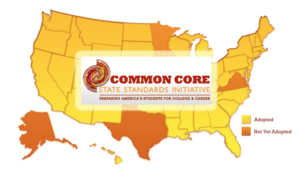 Since the old wasn’t working all that well, these new standards began to catch on with certain politicians and educators. Then the federal government threw its weight behind Common Core, identifying its adoption by a state as having qualified for new No Child Left Behind grants. And before most people knew it, Common Core standards were quietly taken up by most states in one form or another. Today only five states have not signed up.
But that is just the beginning of the story. Academic standards make up only one leg of the three required to complete what we might call an educational system. The other two are the curriculum that would support achieving the standards, and the assessments and evaluations, or standardized testing for short, that would tell us how well the students were meeting the standards. Initially, the curriculum remained for each state to draw up as they saw fit, and most left it to local school districts.
However, that hasn’t worked out well for a number of reasons. The first being that no one knew what to teach because the tests for the various reading and math subjects in the various grades had yet to be drawn up. That was a harder problem than anticipated because Common Core also prescribed computer grading of tests, which suddenly presented technology and cost issues in addition to the academic ones.
The second problem about adopting local curricula to satisfy a one-size-fits-all national standard is that our K-12 teachers, as a group with exceptions, are not drawn from the brightest bulbs on the nation’s academic tree. And a lot has already been said about that with more to come. Nevertheless, the bottom line about curriculum is that people are beginning to realize Common Core will ultimately wind up specifying a national curriculum as soon as the testing part of the overall program is completed and stabilized.
Those who have been critical of teaching to a test have seen nothing yet to compare with the Common Core curriculum to come (more here). To date states like California, one of the most enthusiastic adopters of Common Core, have struggled with patchwork curricula applied by various school districts, and evaluated by tests still in their trial phase before being judged ready for prime time.
The remaining big problems facing individual school districts are cost, technology infrastructure, and teacher qualification. The Pioneer Institute of Public Policy has estimated that the added cost of adopting Common Core will be about $16B nationally. Teachers will have to be sent to school, new computers bought and school networks installed or upgraded. And when available, the new curricula and testing procedures integrated into the workings of established school districts.
To date no one knows whether Common Core will work or not, let alone be better than what we now have. Early results have been all over the scale with many states becoming critics, devising ways to limit or even withdraw from the dictates of Common Core (more here). The importance of Common Core to our nation cannot be overstated. If adopted as planned, it will determine the competency and competitiveness of at least the next generation of American workers, and all of which that impacts. Nationwide more people are becoming aware of Common Core as they gather to have the debates that were somehow overlooked before the standards were adopted and distributed.
One of these Common Core ‘townhall meetings’ is coming to Nevada County. The local Tea Party is co-sponsoring a gathering to examine and discuss the requirements and impacts of Common Core this coming April 29th at the Grass Valley Elks Lodge. Featured speakers will include Brad Dacus of the Pacific Justice Institute and Professor Sandra Stotsky who served on the Common Core Validation Committee. Tickets for the event are available online, and at the local Briar Patch and Gold-N-Green.
My name is Rebane, and I also expand on this and related themes on georgerebane.com where the transcript of this commentary is posted with relevant links, and where such issues are debated extensively. However my views are not necessarily shared by KVMR. Thank you for listening.
[Addendum] I should perhaps expand on my own view of how the federal government should be involved in the country’s educational systems. The punchline here is that the feds should pull in their horns on all programs that fund and deliver instruction to students and trainees. The only success that the feds have had in education has been in the military which marches to a different drummer than the hidebound, ideologically tortured, and overlapping bureaus/agencies that are in charge of their civilian programs. The latter programs share the common fate of having contributed to a uniform history of abject failures and the squandering hundreds of billions of dollars.
So here is a first cut at my druthers for federal involvement in the nation’s education –
- The several states should each be in complete charge of their own educational systems. There they can experiment with teacher education, curriculum, testing, school infrastructure development, special needs (both ends of ability) programs, local control, public/private education alternatives, etc.
- The Department of Education should be abolished and in its place a more broadly chartered Department of Skills Assessment and Certification (DSAC) established whose charter is to work with America’s business and academic communities to develop and administer a catalog of tests that not only covers K-12, but also other academic, professional, and commercial areas that require specialized and evolving skill sets.
- DSAC’s work would involve being in constant touch with the skill testing and certification requirements of America’s job markets. As new requirements arise from the business sector and academe, DSAC would act as the clearing house for cataloging such skills and the requirements for their assessment and/or evaluation. From such publicized requirements DSAC would develop the necessary tests for validating various skill levels.
- DSAC would have no power to impose its testing products on anyone, but would make such tests and the procedures for their proper administration available to all requesting parties for nominal fees. Upon request, and perhaps for an additional fee, it would provide some pre-determined level of oversight in the administration of its tests.
- Depending on then available technology and the logistics involved, DSAC could also provide for the grading of its tests. In any event, DSAC would provide multi-level certifications of test taker performance on its various tests. Such certificates would then become the ‘gold standard’ of vetting that an individual has demonstrated the possession of specific knowledge bases and/or skill sets. Employers in all sectors of society can then use these certificates to vet candidates and prospective employees using a uniform nationwide metric as a means of reducing the risk in bringing on someone new.
- In such an environment hiring and personnel managers in all kinds of enterprises could also specify which certifications would be required for bringing someone on or promoting an existing worker/staffer. However, I emphasize that none of this would be mandatory from the federal level. Nevertheless, states and private organizations could, at their pleasure, mandate that people possess such certification for performing certain jobs.
- In these pre-Singularity years with the dynamism of man-machine working relationships now being a constant in the job markets, DSAC would serve a very useful function by always providing a current and relevant testing and certification program.
- Since DSAC is not a conduit for federal monies, and since it has no legal muscle to impose its test/certification products, it would have to compete with other testing services that may or not arise in such a marketplace. However, acting as a national job skills clearinghouse, DSAC would have a distinct advantage if it did its job properly. An important byproduct from DSAC would be a constant and timely stream of test result datasets and reports on the performance of test takers. This would form an important feedback channel to school systems, corporations, institutions, and all other organizations that take advantage of DSAC’s test and certification products.
- Finally, the existence and functioning of such a federal DSAC will definitely affect how the nation’s population will acquire and maintain its skills as technology continues to accelerate and globalism prevails.
Thoughts?


 rebanesruminations.com

Leave a comment