

George Rebane
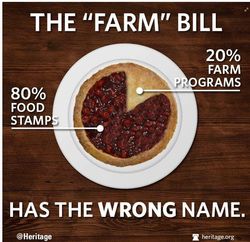 I don’t even want think about Obama’s SOTU speech last night, it was a five star non-starter that served only one purpose, to act as cover for the Republicans’ caving on the 2014 farm bill that will soon become law of the land for the next five years. The bill came out of the joint Senate/House conference, and Speaker Boehner rushed it through a vote less than 48 hours after the ‘conference report’ was issued – thus exposing his lie that all House legislation will enjoy a 72-hour period that would let all House members read legislation before being asked to vote on it.
The bill demonstrates the strength of the progressive Democrats, and the commensurate desperation of the congressional Republicans. In conference the Left got literally everything they wanted, throwing the conservatives a zit on the butt of an elephant as cover with their constituents. Re-election is the strongest bipartisan motivator, and the Repubs could not see their way clear to defend a principled opposition with the country’s electorate, especially given the level of national dumbth which draws its ‘truth’ from supremely effective Democrat demogauges and their lamestream echo chamber.
The ‘Farm Bill’ label is cynical cover for one of the most damaging welfare programs we have – food stamps that now are used to buy the votes of over 48M Americans. Four out five dollars of the bill’s almost $1T spending is slated for food stamps, with the remaining left over for mostly misguided farm subsidies. The Heritage Foundation summarizes it correctly as –
The “farm bill,” is a multi-billion-dollar tangle of welfare payments, agriculture subsidies, and environmental patronage. While called the “farm bill,” nearly 80% of the costs are for a program called SNAP, better known as food stamps. This program has grown dramatically in recent years. Most of the remaining provisions of the farm bill address agriculture policy and are a costly collection of farm subsidies, price controls, and tariffs that do more harm than good.
More details on how the Left nailed the Right on this “bipartisan taxpayer raid” can be found here. To me the biggest loss to Americans was the recoupling of the farm subsidies with food stamps. In past weeks the Republicans were hailing the new farm bill as bringing honesty and clarity to these subsidies by containing a provision that would limit food stamp spending to only three out of the five years of farm subsidies. This would give the conservatives and opportunity to separate these two welfare programs and allow debate on each to proceed on their merits, instead of continuing the losing bamboozle of ‘I’ll vote for your buying votes from dumb, if you’ll vote for my buying votes from clever and conniving.’
Well, the Repubs were just bullshitting their constituents on that one. When it came time to compromise in committee, they compromised away the only part of the reform that could actually, albeit eventually, benefit the country. It is clear that both sides saw the separation of farm and food as exposing both programs to scrutiny neither could stand in the public forum. And so ‘Party and Purse over Patria’ won out again (more here).
As I wipe the egg off my face, I am doubly disappointed because our congressman Doug Lamalfa voted for that piece of legislative legerdemain. Our former congressman Tom McClintock again stayed on principle and voted against it.
[update] I just received an email from Ms Allison Cooke, Senior Legislative Assistant to Congressman Lamalfa. These are the ‘Farm Bill Conference Talking Points’ that the congressman’s office is putting out pursuant to his support of the bill. The content follows –
This morning, the House passed the conference committee version of the Farm Bill, negotiated between the House and Senate. Rep. LaMalfa voted in favor of the bill, and it passed on a 251-163 vote with bipartisan support.
The bill definitely does not go as far as we had hoped to reform and reduce food stamp spending. Notably, it reduces ag spending (20% of bill’s cost, 2/3rds of cuts) far more than food stamp spending (80% of bill, 1/3rd of cuts), both in hard numbers and proportionally. We believe that food stamp spending can and should be reduced far, far more than it was.
However, he decided that this was the best product we could achieve in negotiating with the Democratic Senate and, importantly, California agriculture is facing a very difficult drought situation and needs the market stability this bill provides.
Rep. LaMalfa supported the bill for a number of reasons, including the following:
• The bill ends direct subsidy payments to farmers, saving about $16 billion. Rep. LaMalfa voted today to end the crop subsidies that we’ve received so much criticism about from the left. This is the fourth time he’s voted to end the program (3 times on the floor, once in committee).
· Reforms crop insurance, making Farmers have “more skin in the game” while still offering protection.
· Provides major reforms to current dairy policy without instituting supply management which Rep. LaMalfa voted against twice. Instead we offer dairy producers a new, voluntary, margin protection program. Speaker Boehner called supply management “soviet style government”.
· This bill consolidated 23 duplicative conservation programs down to 13.
· Provides certainty to the forest products industry by clarifying that forest roads and related silvicultural activities should not be treated as a point source under the Clean Water Act.
· Creates a permanent subcommittee within the EPA Science Advisory Board to conduct peer review of EPA actions that would negatively impact agriculture.
· Enhances coordination between USDA, EPA, U.S. Fish and Wildlife Service (FWS) and the National Oceanic and Atmospheric Administration (NOAA) regarding the conflict between laws governing pesticide use and the Endangered Species Act.
• It reduces SNAP (food stamp) spending by $9 billion by closing eligibility loopholes, thanks in large part to the added amendment language that Rep. LaMalfa sponsored in the Committee. While we would have preferred higher savings (the House version would have reduced SNAP by $40 billion over ten years), the unfortunate reality is that we needed to negotiate with the Democrat-led Senate, which refused any further reductions beyond this level. We will continue working to reduce food stamp spending which, at about $80 billion annually, is over 200% of 2008 food stamp spending.
• Establishes a 10-state pilot to empower states to engage able-bodied adults in mandatory work programs.
• Prohibits USDA from engaging in SNAP recruitment activities, and advertising SNAP on TV, radio, billboards and through foreign governments.
• Ensures illegal immigrants, lottery winners, traditional college students, and the deceased do not receive benefits.
• Ensures SNAP recipients are not receiving benefits in multiple states.
• Demands outcomes from existing employment and training programs.
• Prohibits states from manipulating SNAP benefit levels by eliminating medical marijuana as an allowable medical expense.
• Allows states to pursue retailer fraud through a pilot investigation program and crack down on trafficking through data mining, terminal ID, and other measures.
• Increases assistance for food banks.
• The bill also includes Payment In Lieu of Taxes (PILT) funding, which the federal government pays to counties when land if taken off of local tax rolls – for example, when a National Forest expands. This amount to almost $45 million for California counties, mostly in rural areas, and the amounts some counties receive would be budget-busting if the program was not funded (Lassen is a great example; $1.5 million is a huge portion of its budget). Here is funding our counties will receive:
– Butte $127,774
– Glenn $333,144
– Lassen $1,549,332
– Modoc $575,467
– Nevada $277,934
– Placer $502,776
– Shasta $1,274,337
– Sierra $150,729
– Siskiyou
$848,643
– Tehama $426,069
[30jan14 update] And then as if the above talking points needed a direct response – which they do – WSJ‘s Kimberley Strassel up and presents us with ‘So God Made a Farm Bill’ that opens with, “And on the eighth day, God looked down on his planned paradise and said, ‘I need a caretaker.’ So God made a farmer.” Enjoy.


 rebanesruminations.com


Leave a comment