

George Rebane
Fair warning, this little critique of the hit movie ‘Gravity’ will greatly reduce your enjoyment of it, especially if you recall your high school physics. Based on the rave reviews it has been getting (I read Joe Morgenstern in the WSJ), we and another couple went to see it last Sunday. The saving grace of our double date was the dinner afterwards at the Northridge.
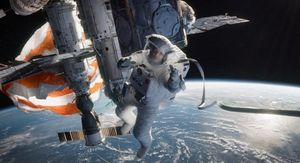 The movie deals with the aftermath of an irresponsible Russian satellite intercept test that creates a debris field of satellite and missile pieces which happen to be co-orbiting with the Hubble telescope, the International Space Station, and China’s space station. The movie’s two astronauts (its only characters) undertax the talents of George Clooney and Sandra Bullock; but hey, they had to cast some names to carry a story line that suffers as much damage as do the shuttle, space stations, and the Hubble telescope during this explosion riddled space thriller.
The astronauts perform feats of stabilization from uncontrolled rotations in freefall that would put a gravity savvy cat to shame. They effortlessly solve orbit matching and rendezvous problems without a second thought. They flawlessly transit great distances in a matter minutes, close and collide with huge space stations at impact speeds that would either crush or dismember mere mortals. And then, and then …
And then when finally, albeit awkwardly, tethered to the ISS, veteran space pilot Clooney forgets Newton’s laws of motion, bravely unhooks from Bullock and needlessly sacrifices himself, purportedly to save Bullock’s life. After that he rapidly drifts away powered by some mysterious force (dark matter?) that seems to be the kin of the one that kept pulling them away from the ISS.
In the meantime, danger lurks in the orbiting debris field which they together, then she alone, must encounter every 90 minutes or so, dictated by some equally mysterious orbital mechanics that included the Russians having apparently launched their target satellite in the wrong direction. But the real mystery is again that mystical force field which has also kept all the space junk tightly bunched. The Russian interceptor’s explosion or impact should have dispersed the pieces over half a continent in less than 30 minutes, yet there they come again, all together like buckshot from a shotgun – no lateral motion, all headed for our intrepid astronaut(s).
More unbelievables happen when in turn Bullock goes into the abandoned space stations. You’ll also be surprised to see that in freefall they use the same kind of fire extinguishers that we use here on earth, but that may be getting too technical. Bullock does take one of them along to use as a thruster on an intrepid feat of orientation while covering impressive distances ‘space walking’ in orbit.
In the climactic finale, everything up there somehow decides to deorbit and start plunging to earth. Maybe they were slowed down by the horrendous impacts every 90 minutes with the tightly bundled space junk, or maybe it was another manifestion of that pesky non-Newtonian force field. It doesn’t matter, because through another series of improbables Bullock is able to land herself in the remaining Soyuz re-entry vehicle still attached to the abandoned Chinese space station. She manages to undock the capsule and separate it for re-entry as everything in orbit around her starts heading down for a spectacular flaming end. Her own Soyuz is spinning out of control in the middle of another awesome field of space station parts all beginning to glow and burn in the thickening atmosphere. Clooney is now long gone, and clearly there is no hope for Bullock as her capsule is not correctly oriented on its descent trajectory. In another few seconds she will be crisp toast, actually a cinder.
And then, true to all that is Hollywood, out of nowhere the marvelous self-stabilizing design of the Soyuz capsule asserts itself. In the final moments we witness a triumph of Soviet engineering as the capsule quits wobbling, and then orients itself properly with heat shield forward to save the day, bringing Bullock safely to a parachute descent into a shallow bay somewhere on earth. We all resume breathing.
OK, so the story was implausible and not so captivating – with no time wasted in extensive character developments, we get right down to the impacts, explosions, and other exciting stuff. But all that aside, what the audience actually buys is one hell of an experience in orbit 400 miles above earth with panoramic well-rendered views of the earth going by down below. I’m not sure how much the 3D (glasses) experience added overall. The fuzzy edge effects of objects floating toward you near the sides of the screen were noticeable, but I guess you’re supposed to keep your attention fixed in the center. Having said that, all the special effects capturing the visual experience of weightlessness (save the mysterious force fields) were done very well, and do advance that part of film story telling. Go see it for yourself.


 rebanesruminations.com
Leave a comment