

George Rebane
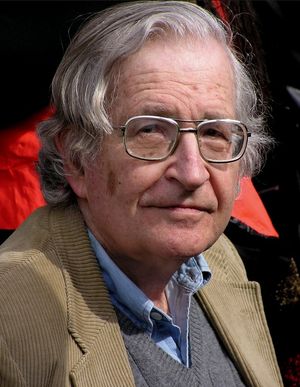 In a private communication an RR reader brought up Noam Chomsky and his views on the Singularity. It appears that the world famous linguist does not believe that the Singularity is possible. I was not aware of that, since in his 60 years at MIT he has been credited with making contributions to computer science. The reader included the link (here) to an extremely revealing interview that Dr Chomsky gave to an interviewer who operates a website that belongs to the halo of sites that report on the doings in the Singularity community and comment on these pre-Singularity years (perhaps even RR is one of those sites).
For me, as a former worker in the fields of machine intelligence, the interview revealed a chasm in the knowledge base of an individual who has been in daily elbow rubbing distance from some of the world class AI researchers. I comment on this chasm here to illustrate its ‘black swanness’ and shudder to think how pervasive such chasms are throughout the fields of technology and science. The most telling example of that is the deep ignorance of the tools of systems science evinced by so many scientists established in fields such as climatology and meteorology when they attempt to understand the modeling and behavior of large scale dynamic systems in the context of manmade global warming. (RR readers will recall that I have been the first to admit that no one today can be an expert familiar with all of the long and convoluted shoreline of Man’s expanding island of knowledge.)
But getting back to the good Professor Chomsky and the Singularity (see also RR‘s Singularity Signposts). I do hope that the reader will take the twenty some minutes to view the video. There he will discover that Chomsky still believes that machine intelligence is being pursued through “brute force” programming, and therefore peer or superior to human AI is “beyond the limits of contemporary science” or even a fool’s errand.
Computer scientists gave up trying to program higher levels of machine intelligence in the 1970s which in the field saw a sea change in AI research. We came to realize then that peer intelligence in machines would arise along the same line as it has in critters, as a learned emergent property in a sufficiently complex system that is exposed to the world (experience, data, and information). We switched from trying to program intelligence to creating learning machines.
We now know that smart machines must be able to deal with uncertainty and causality. They must be able to internally fashion and maintain computational structures that can calculate useful measures of uncertainty, and go on to think subjunctively in order to successfully construct causal nets from which plausible causal basins can be abstracted and compelling causal beams identified. That is what we know that humans can do, and we know that such processing is done by ‘hardware’ with a handful of specific neuronal structures that are joined in gazillions of repetitive and recursive arrays in our brains. The links between these structures are dynamically established, pruned, strengthened, and weakened as we go through life. And now there is evidence that brain cells can even grow anew in our noggins.
Dr Chomsky’s insistence that attempting AI is limited to remain a ‘programming problem’ on an essentially von Neumann (i.e. garden variety architectural) computer is diametrically opposite to what is happening in the real world.
(My humble contribution to the field is the discovery of what is now known as the Rebane-Pearl Polytree algorithm (q.v.) of machine learning. I showed that even today’s computers could be exposed to data from which they can autonomously develop Bayes nets to capture the uncertain information content of that data in a computable form – i.e. generate knowledge from data. The field of Bayesian learning has exploded since those days 25 years ago. Subsequently, Judea Pearl has developed causal calculus (q.v.) that has enabled a quantum leap in machine intelligence in these pre-Singularity years.)
As the video demonstrates, Chomsky himself is quite adamant that the entire effort of developing peer intelligence in machines is a fruitless enterprise. For example he holds that Turing asked a “meaningless question” when he wrote his epochal 8-pager ‘Can Machines Think?’ and gave rise to the now famous Turing Test. Dr Chomsky implies that ‘true thinking’ is some as yet mysterious process that is unique to humans and totally impossible for other computational structures which may (and will!) exceed the complexity of the human brain. One wonders, why take such an intellectually ephemeral stance?
In the same way Chomsky denies the possibility of machines truly ‘understanding’ anything. Since, in his world, these machines are just running programs which are axiomatically incapable of understanding, regardless of the intelligent behaviors they emit. But again, no one has defined what understanding means absent its subsequent demonstration in observable behavior – i.e. only operational definitions of understanding are available to us. But such verification involves Skinnerian observation, and Chomsky is known for rejecting BF Skinner’s work in operant conditioning and behaviorism. (We recall that Skinner did not care what was in the ‘black box’ of a critter’s brain, only in developing reliable input/output relationships for that black box. Chomsky is a cognitive scientist who definitely posits the inner workings of all the black boxes that make up sentient cum sapient brains, even though he can offer no working definitions for such functions.)
Finally, Professor Chomsky still labors under the belief that AI workers are continuing in their effort to come up with a “theory of being smart”. I’ve been privileged to know and have had extensive conversations with some of the leading lights in this field, and no one nor nowhere have I run across anyone who is wasting time on such a pursuit. So I finished watching that interview video shaking my head and asking how can that be possible. The man has spent the last 60 years steps away from the bleeding edge of machine intelligence research and continues to harbor views that were abandoned almost two generations ago.
My most recent readings of Chomsky come from the neo-communist website truthout.com where he is a regular contributor. Chomsky also has a long history of social activism and has self-identified as a ‘libertarian socialist’ and an ‘anarcho-syndicalist’, both belief systems worthy of future comment. Through his day-to-day prosaic offerings, Dr Chomsky can be put into the far left ideological camp with little error in predicting his attitudes and reactions to current events and public policies.
A brilliant man, yet living at the edge of a chasm; it should give all of us, especially those who deal in the arena of ideas, pause.


 rebanesruminations.com
Leave a comment