

George Rebane
On Wealth – First create, then spread.
[This is the addended transcript of my regular KVMR commentary broadcast on 13 September 2013.]
As promised, this commentary continues the examination of a new class divide in America that has arisen over the last 50 years. The supporting data for this comes from multiple institutional and government studies done in the last decade or so, and is compiled in Coming Apart: The State of White America, 1960-2010 by the country’s preeminent sociologist and author Charles Murray.
Last time we looked at the rise of a new upper class, its characteristics, and how it has sought to separate and stabilize itself in a transforming America. You can review that commentary on KVMR’s website archives, or be linked to its transcript from my website Rebane’s Ruminations. Today we turn our attention to the more worrisome component of our dividing society – the newly emerged lower class.
Murray identifies this lower class as characterized by “differences that affect the ability of people to live satisfying lives, the ability of communities to function as communities, and the ability of America to survive as America.” In his book he compares and contrasts the classes in terms of two synthesized American communities – Belmont and Fishtown. The upper class, who live in the country’s Belmonts, comprise about 20% of the population. The lower class, who live in the Fishtowns, comprise about 30% of the population. The remaining 50% is somewhere in the middle and shrinking in size, currently losing most of its members to the lower class.
To make the analysis manageable, Murray’s residents of Belmont all have at least a BA degree, make good money working as managers, are in the professions or science/technology, or media content production, and so on. Or they are married to such a person.
In contrast, no resident of Fishtown has more than a high school diploma, makes a modest income at best, and is a blue-collar or service worker, or has a low-level white collar job. A goodly portion of them derive at least some of their income from government welfare.
Were these the only aspects that characterized class differences, America’s future would not have to look much different than its historical past. But it doesn’t stop there, because Fishtown has changed markedly over the last 50 years. America always had a poor class, but they almost always lived in tightly knit communities in which they had and expended what is called ‘social capital’. That means they helped and looked out for one another, worshipped together, married each other and raised families, celebrated family milestones and holidays together, and so on.
They gathered into enclaves that were ethnically and culturally more uniform. They were able to understand each other and reliably predict each other’s behavior. They belonged to the same churches, temples, service organizations. Overall, this engendered a feeling of mutual trust that made a community able to function, to take pride in self-reliance, and withstand the misfortunes of life.
Murray cites study after study of the changes that became noticeable in the 1970s, and then apparent to all by the 1990s. During the last half century in Fishtown every laudable social metric took a marked turn downward. A major contributor to the measured collapse of communities has been ascribed to the loss of ‘religiosity’. This along with the breakdown of the family as more and more Fishtown males rejected the responsibility of marriage and family, leaving single mothers to function both as bread winners and raise their children. The result is that today the Fishtowns have lost their sense of traditional community, and irretrievably so according to most sociologists.
The concluding punch line to this segment is that when the data on whites was expanded to include blacks and Hispanics, the major characteristics of work, community, religion, and values did not change across racial lines. Both of these new upper and lower classes are strongly differentiated along socio-economic lines, but very weakly so along genetics and genealogy.
There is much more to this important story which I will cover in the future editions of this series. In the meantime I urge you to read Charles Murray’s Coming Apart that, according to critics, today “describes the most important trends in American society.”
My name is Rebane, and I also expand on this and related themes on georgerebane.com where the transcript of this commentary is posted with an addendum and relevant links, and where such issues are debated extensively. However my views are not necessarily shared by KVMR. Thank you for listening.
[Addendum] There is more to be said about the Fishtown whites who not only no longer work, but are no longer seeking work. That cohort is growing, and it is not limited to only whites. Murray cites the research of economists Mark Aguiar and Erik Hurst and their work on ‘time use surveys’. Over the last half century, it turns out, that there has been a marked “increase in ‘leisure’ that primarily affected men with low education.”
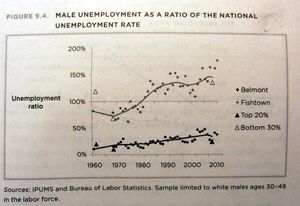 In 1985 leisure hours spent by Fishtown and Belmont males were about an hour apart. Then something changed. Aguiar and Hurst report that “between 1985 and 2005 men who had not completed high school increased their leisure time by eight hours per week, while men who had completed college decreased their leisure time by six hours per week.” And the “worst results” were among those without jobs.
And what filled the increased leisure hours of the under-educated? Did they involve themselves in more charity work, community activities, exercise, sports, hobbies, …? Not at all. The increased leisure time was allotted to extra sleep, television watching, and generally hanging out. Murray sums it up with “white males of the 2000s were less industrious than they had been twenty, thirty or fifty years ago, and that decay in industriousness occurred overwhelmingly in Fishtown.” Even “employed men with no more than high school diplomas also goofed more in 2003-5 than in 1985”.
This trend in our society is having a marked effect on our economy during these pre-Singularity years as reported by academics Paul Peterson and Eric Hanushek in the 12sep13 WSJ (‘The Vital Link of Education and Prosperity’). They cite the overall poor performance of our high school students – fewer than one third of them are proficient in math – and relate data from the National Assessment of Educational Progress showing the impact of demonstrated smarts on lifelong earnings.
And as often noted here, Peterson and Hanushek remind us that “economic gains will come many years after school improvement takes place”. All of which explains away why the “political class” is reluctant “to commit itself to genuine school reform” because “confronting the power of teacher unions and other vested interests is politically costly.”
And what are our socialists in government doing about this? They are implementing tax and wage policies that defy reason and logic, most certainly conservetarian reason and logic. An insurmountable principle for collectivists is that increasing the price of something causes less of it to be consumed. People begin looking for cheaper alternatives when things start costing too much. You’d think that a light would go on and everyone would instantly pick up on that. Not a chance.
Such illuminations occur seldom and in only special areas for the liberal mind – intellectually they are not able to generalize them across the field of human economic behavior. It’s as if they learned their economics from the Hogwarts School of Witchcraft and Wizardry of Harry Potter fame. Take the exception of California’s Democrats arguing the benefits of increasing taxes on cigarettes because (seatbelts please) it will make them more expensive and therefore reduce smoking because fewer people will buy them. Well fine enough, maybe there is hope for such intellects.
Not a chance. In the next breath the same pinheads turn around and submit legislation to increase California’s minimum wage by 25% to $10/hr so that it will become among the highest in the nation. And all of this for the sake of helping the poor. Go figger, because it’s for sure no progressive in Sacramento is capable of understanding the John Henry Law of labor. (more here and here)
Whenever humans insisted on competing with advancing technology, they lost out big time. And if they did that as a society, their society (tribe, kingdom, nation) lost out. Millennia ago laborers who dragged or put rolling logs under platforms to transport heavy objects were fired when the wheel came along. They had to go find something more productive to do. So did laborers who operated foot powered water pumps when wind was harnessed to do the job, so did workers who pushed the grinding wheel around in circles to grind grain. They were all fired when cheaper means came along.
And so difficult for limited liberal thinking is that making anything more expensive motivates those not so limited to seek and find cheaper means of doing the same thing, or even doing away with it completely. For example, we have reported on new robot hamburger machines being introduced because people who can only ask ‘would you like fries with that?’ are being paid too much. And yet the political hacks, demagogues, and others similarly afflicted are militating such wage increases under the rubric of ‘workers rights’. But rights to do what? – to continue competing with cheaper available means of doing business.
Finally, returning to Fishtown and the education riven class divide that has now settled in across the country, we again see that much of it is systemic. In short, it is baked into the social aspect of our economy. Because of inherited cognitive deficiencies, more and more of the population is becoming permanently sidelined under the current collection of collective public policies. These unfortunates are denied modern means of retraining and education made possible by new technologies because entrenched progressive interests refuse to submit to progress. Time is short, and democracy is fragile.
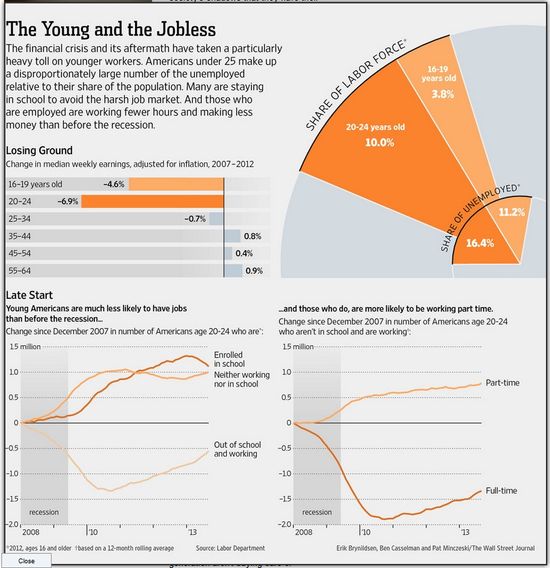
[14sep13 update] Today’s WSJ had an article – ‘Wanted: Jobs for New Lost Generation’ – and a graphic on the employment picture for the young that adds to this piece on the class divide.


Leave a comment