

George Rebane
Our long lament with America’s education systems continues. I was reminded of it again by a report on the entrepreneurial approach to teaching students that is rampant in South Korea. There kids go to school during the day, and at night after coming home they go back to school, alebeit of a different type. South Korean students are world class top performers (#2 after Shanghai), and are nudged into that status by parents who pay extra for extra tutoring for their little darlings.
 South Korea is full of private tutoring academies (hagwons) run by entrepreneurs and master teachers. Because of that South Korea is a literate and numerate nation – 93% high school graduation rate, ours is 77% – this means their high schoolers can read and cypher, while a good half of ours fall short.
The hagwons are highly competitive, they advertise and publish their students’ test score averages and college admission rates. Private teachers are continually rated by their students whom they correctly treat as their customers. But even with higher ratings, most private teachers still strain to make as much as public school teachers, however many of them do make goodly fortunes. The outstanding teachers are treated as we would treat rock stars, using online technologies they know how to leverage their talents.
The country’s leading private teacher is Mr Kim Ki-Hoon who runs a 30 person teaching and publishing company. Most of Mr Kim’s lectures are delivered online, and he supplements these lectures with his own texts that he self-publishes. His personal income is about $4M annually. Neither Mr Kim nor his thousands of colleagues/competitors are certified by the state. The hagwons are run as a pure meritocracy in a free market with the non-performers being ruthlessly weeded out. (more here)
Our pedagogical entrepreneurs have been keeping an eye on South Korea, and we are beginning to see more private tutoring services open up in local strip malls, especially in California (where we need it most). In the competitive global job markets readers know that the STEM capable students and graduates are the most in demand. But in that department we still have a long way to go to catch up with South Korea. For example 47% of South Korea’s eight graders ranked ‘advanced in mathematics’ compared to 7% of ours. In ‘advanced science’ we fared better, 20% of South Korea’s eight graders qualified compared to 10% of ours.
It should be obvious to the casual reader that such performance differentials in a population will result in highly uneven distributions of income and accumulated wealth. And the more our socialist cadres in government seek to stifle that result, the fewer competitive workers the country will produce. We are already behind the power curve in educated workers as I have been reporting over the life of RR. It is time to turn our educational systems loose from the cold hand of central government.
Were I king, control of K-12 education would revert to local school boards supported by local taxes that would be augmented by state funds on a per student basis. The Dept of Education would become toast and tossed into the dustbin of history. The states would enforce quality control through its own testing program (whether bought from a central test maker like The College Board, or home brewed), and providing a statewide comparative rating service that incorporates student and parent feedback. Private and charter schools would be deregulated, and all schools would be able to develop/adopt their own curricula. Private tutorial services would be operated as simple fee-for-service businesses under minimal oversight that primarily involved sunshine codes under which such services would be required to publish their aggregate scholastic performance statistics. Anyone could post online tutorials and charge for their access. Teachers unions would be banned along with the concept of tenure. Parents could send their kids to any school for which they qualify.
Post-secondary education needs total reform so that their massive bureaucracies can be relegated to repositories in where society stores the hind tits of boar hogs. Restructuring the entire teaching organization to run on the basis of meritocracy as determined by student performance and feedback. Incorporate a massive infusion of online instruction delivery as are already implemented through MOOCs. Added to the well-known degree programs would be uncounted levels of certification in the various skill sets required by employers. Such certifications would necessarily be dynamic to keep up with accelerating technologies in the job markets. Again, private tutors and tutorial services would be operated as described above. And again, there would be no federal involvement in these state-run higher education systems. The federal influence would only be felt through the funding of research programs that involves a competitive process among the colleges, universities, and trade schools. No unions. Tenure offered on a per institution basis.
[4aug13 update] In America we are having what can arguably be called a ‘higher education bubble’. While that may sound good in light of the educational standing of our workforce, it really isn’t because the bubble is misguided. Russ Steele has commented on this below; he also sent me an email that expands on the notion of “alternatives to costly degrees” much discussed on RR. The email follows –
HIGHER EDUCATION BUBBLE UPDATE: The Rise Of Competency Testing.
Testing firms are offering new ways to measure what students learn in college. Their next generation of assessments is billed as an add-on – rather than a replacement – to the college degree. But the tests also give graduates something besides a transcript to send to a potential employer.
As a result, skills assessments are related to potential higher education “disruptions” like competency-based education or even digital badging. They offer portable ways for students to show what they know and what they can do. And in this case, they’re verified by testing giants.
More significantly, they mean that someone other than the degree-granting institution is certifying competence. Institutions have incentive to be lax regarding their students; external certifiers not so much. Then, at some point, people might start asking why you need the degree, when you’ve got the certification.
[7aug13 update] From the Mercatus Center we get the latest stark picture of Obamunism is full stride. This has to be understood in terms of thousands of more Americans leaving the nation’s workforce every month. Meanwhile the shills in Washington crow that they have “created 7 million new jobs” since the spring of 2009. They have done nothing of the kind when we consider the millions of jobs that they have prevented from being created during such a recovery.
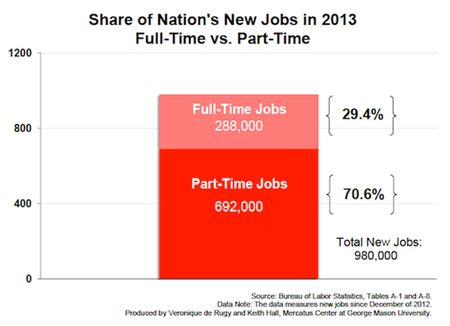
And on the education front Obamunism with the help of the teachers unions have taken the appropriate steps to insure that minority blacks and Hispanics are kept in their place as ignorant and compliant voters. Professor Paul Peterson of Harvard reports in ‘The Obama Setback for Minority Education’ that under Obama’s gutting of No Child Left Behind, those he promised to help have taken a significant backward step in their abilities to read and cypher, especially in closing the gap with whites. But again, dear reader, as Occam advised, all this has been easily predictable and explained away by Obama’s promise to fundamentally transform America into global peerage. More devastation to come.


 rebanesruminations.com
Leave a comment