
Rebane's Ruminations
July 2013
S M T W T F S
 123456
78910111213
14151617181920
21222324252627
28293031  

ARCHIVES


OUR LINKS


YubaNet
White House Blog
Watts Up With That?
The Union
Sierra Thread
RL “Bob” Crabb
Barry Pruett Blog

George Rebane

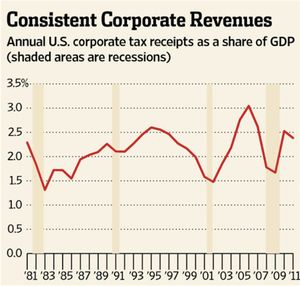
CorporateRevenuesA major teaching point of RR over the years has been that corporations pay no taxes.  Corporate taxes are another preferred ruse of world governments to enable them to take more out of the pockets of real taxpayers.  Now we hear that the OECD is doubling down on the bamboozle with something called the “base erosion and profit shifting” (BEPS) project.  BEPS is supposed to stop corporations from paying lower than their ‘fair share’ of taxes.  However, as the nearby chart shows, this is a smokescreen since corporations have been doing anything but paying a lower share of the GDP in taxes.

As the 23jul13 WSJ points out, what BEPS promises to do is to make corporate tax planning more complex and in the end raise corporate taxes.  The oblivians of the world will raise their voices in another chorus of huzzahs as they promote one more round of slow growth and auto-impoverishment.   In reality and “for all the huffing and puffing, there is no crisis of corporate tax collection. The deficits across the developed world are the product of slow economic growth and overspending, not tax evasion. But none of this has stopped the OECD from offering its 15-point plan to increase the cost and complexity of complying with corporate-tax rules.”

The real solution is “everyone (moving) toward lower rates and simpler tax codes, with fewer opportunities for gamesmanship and smaller rate disparities among countries”.  But socialism never takes that kind of enlightened view of economic behavior or economies – after all, it smacks of the Laffer curve.  But none of these international machinations would be possible if people wizened up and understood the nature and purpose of corporate taxes.

“Whisper it, but corporations don’t pay taxes anyway. They merely collect taxes—from customers via higher prices, shareholders in lower returns, or employees in lower wages and benefits.”

Posted in , , ,

13 responses to “Corporate Taxes – One more time”

  1. fish Avatar
    fish

    “Whisper it, but corporations don’t pay taxes anyway. They merely collect taxes—from customers via higher prices, shareholders in lower returns, or employees in lower wages and benefits.”
    Feature not a bug!

    Like

  2. Ben Emery Avatar
    Ben Emery

    George,
    Your whisper is right on the mark. Actually it is over $100 billion in lost corporate tax revenue annually to the federal government. I would say a trillion dollars of lost revenue in a decade is pretty significant.
    Here is a link to somebody else Great Divide.
    http://www.globalpost.com/dispatch/news/business/global-economy/130115/great-divide-gini-coefficient-methodology

    Like

  3. fish Avatar
    fish

    Actually it is over $100 billion in lost corporate tax revenue annually to the federal government.
    So there is an upside then. Whew!

    Like

  4. Russ Steele Avatar

    Yes, a $100 billion that was not taken from our pockets by corporations, and passed to the government. Corporations do not pay taxes. We do as a pass through. Ben E need to retake take Econ 101.

    Like

  5. Ben Emery Avatar
    Ben Emery

    Russ,
    So those corporations use the commons like roads and education that we all pay into at a much higher rate, especially the court system but they aren’t expected to pay back into the infrastructure/ system that allows them to make those profits? Or even exist for that matter. Interesting take you have on how a nation works Russ.

    Like

  6. Joe Koyote Avatar
    Joe Koyote

    I never thought of it that way, but you are right (no pun intended), it is a pass through. Senator Bill Bradley once described elections as a pass through from contributors to television stations.
    So if corporate taxes are lowered, one would assume prices would go down because costs would go down. Any proof of this over time?
    Correspondingly, if corporate taxes are lowered and profits go up, do prices go down or does the price stay the same, thus putting the tax savings into investor’s pockets? Then is it a pass through to the investors and a diversion from the public?

    Like

  7. George Rebane Avatar

    All you folks have to concentrate on is that whatever taxes corporations pay comes out of your pockets. Whatever you leave them as reward for their risk taking, if it becomes excessive, their competitors will lower prices, pay bigger dividends or whatever that brings the reward down to commensurate with the risk.
    As a thought experiment, if your business produced no profits but just barley paid its expenses, would you be able to lower prices or raise wages. Now consider if your business profited $10 out of every $11 of revenues, and you wanted to increase market share or raise the barrier to entry to potential competitors, would you lower prices or increase the wages of your key employees, or boost the price of your stock by paying higher dividends. Of course you would. So if you are able to grok this, the correct answer lies somewhere in between. But now you should understand the forces at play. Or maybe not.

    Like

  8. Ben Emery Avatar
    Ben Emery

    George,
    Here is the thing about corporate profits at the moment. Almost all foreign trade is a facade and is actually intra-corporate/ company trade. Walmart China trades with Walmart US making sure the profit stays with Walmart China so the money avoids US taxation and is stored in tax shelters. Right now there is $3 trillion sitting offshore and that is a huge part of why our economy is so stagnant.

    Like

  9. George Rebane Avatar

    BenE 756pm – stipulate that you are correct. Then why maintain policies that keep those profits offshore? On the other hand with these internal shifts of profits that you see, let’s make sure you’re not describing a perpetual profit machine. Walmart has to sell something somewhere to generate those profits. And they are not being made in the US using the ruse of non-profit Chinese Walmarts as a means of those transfers under the table. Your charge is beyond audacious, and I venture that were you to reveal this to our IRS, they would surely cut you in for a significant share of such recovered taxes on those hidden profits. They have done that before.
    So go for it, launch a discovery company that would have a most promising future bringing multi-national corporations to heel. And I guarantee you that Sand Hill would even finance you if you were able to keep them from bursting into laughter before you got five minutes into your VC presentation. Your faith could make you unbelievably rich.

    Like

  10. fish Avatar
    fish

    Right now there is $3 trillion sitting offshore and that is a huge part of why our economy is so stagnant….
    Well anything that keeps it out of congresses (and would be members of congress) grasping paws.

    Like

  11. Ben Emery Avatar
    Ben Emery

    George,
    When our legislatures and political parties are bought off to make the rules and tax law so they can keep the money away from paying back into the system we then find ourselves in the condition we are in today.
    Intra-trade is very real and is going on at disastrous levels. I was wrong with saying “almost all trade”, I should have said almost all of our trade deficit is due to intra- corporate/company trade. The only deficit we should be worried about is our trade deficit. I cannot remember the name of the economist/ article that dissects the intra-trade deficit.
    U.S. Trade Deficit Largely Due to “Intra-Firm” Trade
    http://angrybearblog.com/2012/08/us-trade-deficit-largely-due-to-trade.html#sthash.TA96UdVG.dpuf

    Like

  12. George Rebane Avatar

    BenE 726am – Thank you for bringing intra-corporate trade into the discussion. The author of your cited piece confabulates trade deficit accounting, off-shoring policy, and tax code, but does manage to give a cogent argument for the possible error in how we view trade deficits.
    Unfortunately, economist Robert Giffin’s work on intra-corporate trade has turned out to be a lion’s roar without the lion. It is the case that when a US division of a multi-national trades with its overseas division, then real money goes from the US to the overseas unit to pay its employees, buy materials, and pay its bills. That money actually gets spent in another economy, not ours. Were intra-firm trade a monetary reality, then trade deficit metrics would have been altered over a generation ago (for it would have benefited both political parties), and earned Giffin the Nobel prize – neither of which happened.

    Like

  13. Gregory Avatar

    “So if corporate taxes are lowered, one would assume prices would go down because costs would go down. Any proof of this over time?”
    JK, corporations, like homeowners, find it easier to raise prices than to lower them, but if you’re selling your widgets or your house, if the price is higher than the competitions, you lose out until you adjust to the market and decide a sale with a lower margin is more advantageous than no sale.
    More important to the corporation income tax is who owns the corporation. If a dollar is returned to the owner as profit, and the owner is a Teresa Heinz Kerry, THK will pay taxes on it. If the dollar goes to a 401k or CalPERS/STRS, it should remain untaxed until it is retirement income, and IIRC most of the capital on wall street is retirement savings of the working middle classes.
    The corporate income tax skims money off the top for the gov’mint, away from retirement accounts.

    Like

Leave a comment