
Rebane's Ruminations
July 2013
S M T W T F S
 123456
78910111213
14151617181920
21222324252627
28293031  

ARCHIVES


OUR LINKS


YubaNet
White House Blog
Watts Up With That?
The Union
Sierra Thread
RL “Bob” Crabb
Barry Pruett Blog

George Rebane

A fundamental tenet on RR has been that as government grows in size and scope, it also grows in becoming intrinsically evil through the conduct of its mega-monied politicians and recourse proof bureaucrats.  Here are some current observations that bolster that argument.
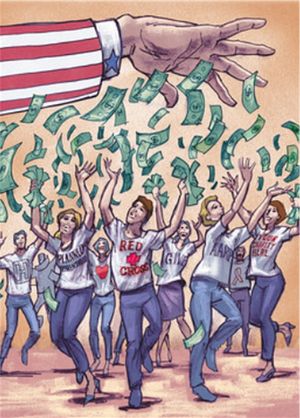

CharitiesCooptedCharities have become fiefs of big government
.  How?  First, they take the money from those who would give more to charities, then they invite the charities to beg for the same funds.  But first the charities have to satisfy certain government agendas, and not the requirements of the people who would freely give.  Almost every charity of any size now expects to receive a sizeable portion of its funding from the state after submitting appropriate proposals and bona fides attesting to their politically correct disbursal of funds received.  In the 18jul13 WSJ James Pierson makes the case that “Much of the not-for-profit sector has become a junior partner in administering the welfare state.” (more here)  And that’s the point of it all, is it not?  – all benefices will henceforth flow from government to which all homage and glory belong.

Eritrea and the United States are unique in that they shamefully share what here is called the Foreign Account Tax Compliance Act (FATCA).  This piece of obamunism became law in 2010, and as most of this grandiose socialist’s other ideas, it has turned into a monster.  First, it has made living abroad for Americans an expensive accounting hell, and then it piles on by creating bad will between countries that asymmetrically enforce FATCA-type policies on their expatriates.  Professor Colleen Gaffy (Pepperdine University) demonstrates that “the core injustice in America’s tax policy is that it is based on citizenship rather than residence.  You ask what could possibly be wrong to pay taxes in two nations concurrently.   The answer (here) will surprise you.  But ultimately FATCA is a sure sign that we are now acting like a descending autocracy desperately attempting to control and milk our citizens wherever they may be found.

Agenda21 marches on.  The latest involves the “U.S. Fish and Wildlife Service proposal to declare two million acres in the Sierra Nevada Mountains as “critical habitat” for the Sierra Nevada Yellow Legged Frog and the Yosemite Toad under the Endangered Species Act.”  And the consequence will be another constraint added to the long list that already prohibits Americans the use of their public lands.  And the telling part is that these critters aren’t even being endangered by humans, but other critters.  But that don’t make no never mind when Americans need to be herded and corralled into their sustainable smart growth stack&pack future.  Congressman Tom McClintock recently summarized an excellent appeal to sanity on the floor of the House in a short speech titled ‘The Real Endangered Species: The Sierra Nevada Hard Working Family’.


And, of course, the sorry trail of socialism in America continues to be littered with destitution, bankruptcy, and dependency.  Breaking news yesterday was that Detroit has filed for Chapter 9 bankruptcy – the biggest municipality in the country to do so.  And the horrifics of Obamacare are sweeping the land as the Pelosi Principle continues to reveal the contents of that monstrosity.  Unions large and small, all dedicated disciples of the messiah, are now screaming bloody murder and are demanding to be protected from the law’s job killing, wallet busting mandates.  (Latest from Teamsters’ Hoffa is that Obamacare is a “perverse” law that is creating “perverse scenarios”, as was reported on RR since day one.)  The remaining supporters of the nationalizing healthcare law will be able to hold their next convention in something we used to call a phone booth.

[update]  Obama gag orders Benghazi survivors.  Did you hear that the WH has ordered all Benghazi survivors to sign non-disclosure agreements?  According to Congressman Frank Wolf (R-VA) that is the apparent reason why Congress can’t get any of these people to come and tell the real story at a public hearing.  I recall the continuing drone of local liberals here telling one and all that Benghazi was a non-event of no enduring consequence.  Now why doesn’t Obama want the story to get out?

The only prominent benefit of Obamacare is from some of the levity that it has generated in the Saturday night shows and emails.  Here’s a typical offering –

Top Ten Indicators That Your Employer Has Changed To The
Obamacare Health Care Plan.
(10) Your annual breast exam is done at Hooters.
(9) Directions to your doctor’s office include “Take a left when you enter
the trailer park.”
(8) The tongue depressors taste faintly of Fudgesicles.
(7) The proctologist in the plan is “Gus” from Roto-Rooter.
(6) The only item listed under Preventative Care Coverage is “an apple a
day.”
(5) Your primary care physician is wearing the pants you gave to Goodwill last
month.
(4) “The patient is responsible for 200% of out-of-network charges,”
is not a typographical error.
(3) The only expense covered 100% is…”Embalming.”
(2) Your Prozac comes in different colors with little M’s on them.
(1) You ask for Viagra and they give you one of their tongue depressors and
duct tape.

Posted in , , , ,

134 responses to “Ruminations – 19jul13 (updated++)”

  1. Russ Steele Avatar

    WALTER RUSSELL MEAD: Obama To Detroit: Drop Dead.
    This is where blue governance has brought Detroit in the end: not even a liberal Democratic administration will step in to save the pensions of thousands of public workers and African Americans, condemning countless innocents to having their pensions and health benefits gutted in bankruptcy court.
    Blue model defenders will point to the cruel exodus of General Motors, the unjust outsourcing of American manufacturing, and the general unfairness of life in the big city as the culprits in the slaying of Detroit. But these champions of the marginalized should keep a few facts in mind.
    Detroit has been spending on average $100 million more than it has taken in for each of the past five years. The city’s $11 billion in unsecured debt includes $6 billion in health and other retirement benefits and $3 billion in retiree pensions for its 20,000 city pensioners, who are slated to receive less than 10 percent of what they were promised. Between 2007 and 2011, an astounding 36 percent of residents lived below the poverty line. Last year, the FBI cited Detroit as having the highest violent crime rate for any major American city. In the first 12 years of the new century, Detroit lost more than 26 percent of its population.
    And now Detroit’s desperate request for a bailout has been turned down by the Obama White House.
    Progressive politicians, wonks, and activists can only blame big corporations and other liberal bogeymen for so long. The truth is that corrupt machine politics in a one-party system devoted to the blue social model wrecked an entire city and thousands of lives beyond repair. The sooner blues come to terms with this reality, the greater chance other cities will have of avoiding Detroit’s fate.

    Yep. Sooner or later, you run out of other people’s money.

    Like

  2. Ben Emery Avatar
    Ben Emery

    Since the privatization of public services has become the course we have seen our national debt, size and scope of government, and corporate control get way out of hand.
    Want to shrink government,
    1) End Corporate Personhood and Money is not Speech it is property (Slavery was human beings as property Corporate personhood is property becoming human beings)
    2) 5 year moratorium on lobbying and public service
    3) Public financing of all public campaigns (investment in our democratic republic)
    Get the bribes out of our government and the return favors disappear. This would probably shrink our federal government by 50%.

    Like

  3. George Rebane Avatar

    BenE 758am – Money is not speech, but money does fund speech – e.g. paying for busses and posters to get people to a mass protest. I assume that your prescription is symmetrical wrt union expenditures.
    I agree that to “probably shrink government”, reducing bribes would be one way. But it is the indirect and historically difficult way. The opposite approach to certainly shrink government, long argued by many on these pages, is to legislatively reduce the number of functions government can perform and services it that can render. It is the exercise of those that draws in the corrupt money and outputs corrupt governance. The latter approach would also be a sunshine act visible to all. The former would require an increased enforcement bureaucracy putting in place even more monitoring and snooping practices than already exist today. Look at the 16K new IRS employees required to start monitoring adherence to Obamacare.

    Like

  4. fish Avatar
    fish

    Since the privatization of public services has become the course we have seen our national debt, size and scope of government, and corporate control get way out of hand.
    Want to shrink government,
    1) End Corporate Personhood and Money is not Speech it is property (Slavery was human beings as property Corporate personhood is property becoming human beings)
    2) 5 year moratorium on lobbying and public service
    3) Public financing of all public campaigns (investment in our democratic republic)
    Get the bribes out of our government and the return favors disappear. This would probably shrink our federal government by 50%.

    See….all reasonable topics for discussion (you left out the audit the FED from the campaign website though which would have fit in here nicely)….and none require “the blood sacrifice” from yesterdays thread.
    See how much clearer life appears are when you stay on the medication.

    Like

  5. fish Avatar
    fish

    See how much clearer life appears are when you stay on the medication.
    Eeew bad sentence! Proofread….always proofread!

    Like

  6. Ben Emery Avatar
    Ben Emery

    George,
    You know I place unions into the bribing category.
    Fish,
    Having a private banking cabal controlling our currency is absurd and needs to end. I would like to abolish the Fed but auditing it first to expose how corrupt and they really are is the key. Sanders and Paul pushed to get the fed audited for a small window which uncovered $16 trillion basically given out during the banking crisis in 08′. Where did it go the same banks that caused the crisis. It went to other central banks around the globe and into the bank accounts of wealthy business women and men.

    Like

  7. Ben Emery Avatar
    Ben Emery

    Getting non profits on the grant and public funding train means they are less likely to bite the hand that feeds them with outing what is actually going on in their respective fields. I have been involved in to many groups who have expertise that contradicts the way things are being done but don’t want to rock the boat because of fear of losing the funding and tax exempt status. It is a power tool and ultimately a tool in class warfare.

    Like

  8. George Rebane Avatar

    BenE 1131am – I presume that you also put funding through the government grants tit on par with being funded by corporate interests. If so, I welcome it.

    Like

  9. Russ Steele Avatar

    Detroit is liberalism’s showcase. We should never let anybody forget that.
    The DiploMad 2.0

    Like

  10. Ben Emery Avatar
    Ben Emery

    George, 19 July 2013 at 01:04 PM
    I do.

    Like

  11. Paul Emery Avatar

    Let us not forget that we being represented in Washington by two Congressmen one (McClintock) a professional politican already receiving government pensions and farm subsidies welfare recipient Doug LaMalfa. Not particularly good examples of citizen politicians independent of government interests.

    Like

  12. Ben Emery Avatar
    Ben Emery

    Paul,
    One of the main reasons I challenged McClintock. He represents his own interests first and the republican party’s second and maybe his republican supporters third and those who don’t agree with his ideology virtually never.

    Like

  13. Todd Juvinall Avatar

    Yeah PaulE, maybe we should get that commie Barbara Kee to represent this district. Or maybe that liberal from Martinez, career politician George Miller, who took his career daddy’s place in Congress.I guess we just need you to pick our guy from now on. What a hoot@

    Like

  14. Paul Emery Avatar

    Todd
    You have to admit though McClintock is a career politician and LaMalfa is on the subsidy dole. Do you think someone receiving millions of taxpayers money for doing nothing should be allowed to vote or be elected to congress? Seems like a conflict of interest to me.

    Like

  15. Scott Obermuller Avatar

    Paul – please name the person who is “doing nothing” and getting millions of the taxpayers money. I agree with the statement and I’m not saying that person doesn’t exist, but I’d like an idea of what you are talking about. Do you think sex pervs should serve in elected office? We can make high sounding, but empty statements all day long. You might be interested that La Malfa did vote to end farm subsidies. I don’t always agree with McClintock but he is probably one of the most honest and cleanest politicians we have today. After all of his years in the legislative branch his net worth is far below most Dems with an equal number of years of service. He certainly represents my family well on almost every single issue.

    Like

  16. stevenfrisch Avatar
    stevenfrisch

    Here is the record of crop, environmental and disaster subsidies in the 1st Congressional District from 1995-2012
    http://farm.ewg.org/region.php?fips=CA01
    Here is a good article from the Redding Searchlight on the LaMalfa recipients:
    http://www.redding.com/news/2012/feb/18/lamalfas-47-million-in-farm-subsidies-draw/
    I might note, it is easy to vote against something you know is going to fail! If I were LaMalfa I would have voted against them as well, knowing full well that Congress would re-authorize them anyway. Good way to inoculate yourself from the critic in the next election cycle.

    Like

  17. George Rebane Avatar

    Stevenfrisch 716am – Knowing that farm subsidies did not start with Lamalfa, and that to remain competitive in commercial farming every farmer must dip into the established federal commons to reduce his costs, how would you advise Lamalfa? How would you behave given that you had to operate a family farm (business) that you inherited? (BTW, interesting mistake embedded in the URL.)

    Like

  18. Ben Emery Avatar
    Ben Emery

    George,
    Your question about what should LaMalfa do about the subsides is what I talked about with my mom and my aunt and uncle. Rural poor and Urban poor. Subsides are a welfare program but rural folks have grown to feel entitled. But are quick to judge those who collect welfare in the city. I will paraphrase my mom “If you don’t need it you don’t take it, the money isn’t free”
    Here is the solution, if we had any reasonable import tariff on agriculture we could use the money collected to fund the subsides like we did for much our nations history. Promotes US grown food and funds the subside program.

    Like

  19. stevenfrisch Avatar
    stevenfrisch

    Posted by: George Rebane | 20 July 2013 at 08:03 AM
    Wow, a good question George.
    First I should note that I am not against farm subsidies. I believe that in certain circumstances some subsidies might be beneficial, if they open and expand new markets for American products, if they respond to legitimate one time disasters, or if the environmental benefit of the investment provides a social good that could not be as efficiently obtained under other circumstances. Second I must note I provided information above and commented on the political ramifications for Mr. La Malfa, not the efficacy of the specific subsidy.
    If the fact that farm subsidies did not start with Mr. LaMalfa, that they started to address the ‘social goods’ I described above regardless of our personal opinions about whether or not they provide those ‘social goods’, is a rationale for continued support to remain competitive, then the same could be said of any market that is subsidized, such as energy, timber harvest (where we impose tariffs on imported softwood) or mortgages (where we provide tax deductions and guarantees for mortgage backed securities). I’m pretty sure you don’t want to set that precedent considering your general objection to subsidies.
    In the specific case of Mr. La Malfa’s position on the Ag bill I would recommend an approach pretty close to the Cato recommendation to phase down and eventually terminate crop subsidies, continue to provide insurance and to protect against adverse prices and weather events, eliminate producer cartels in such markets as dairy, sugar, cotton, rice (and I might add corn based ethanol).
    The place where I differ from CATO is on trade protections for certain agricultural products. I believe there is an inherent good from maintaining agricultural production of food, fiber and certain commodity products in the US, such as products that take a long time to come to production level or products that have strategic importance.
    In addition, I believe that there is an inherent benefit from de-centralizing our food systems to create resilience in the face of natural disaster, climate change and price shocks. A valuable co-benefit from decentralizing our food systems would be that locally grown food has a tendency to be healthier and better for the environment because it relies less on pesticides, herbicides, fungicides and other chemical treatments to maintain shelf life. (This may be a rare area of agreement between Mr. Shea and me on a public policy issue).
    I believe that Mr. La Malfa’s position should be that producers should be protected from natural disaster and unfair trade practices, but the price of their product should not be protected by subsidy. The shift to this would likely take 20 years in order to safeguard against economic dislocation in the agricultural industry, and I would robustly support a gradual rather than a radical shift, in order to protect consumers from rising prices (similar to my nuanced position on energy).
    It is important to note that in the end consumers would pay more…Americans spend on average 6% of their household income on food, in the UK it is 9%, in France 14%. The question would be “would paying more for food lower costs in other areas”. Americans spend more than 17% of GDP on health care, compared to about 7% in EU countries (many of whom have longer life expectancies). Not to devolve into a health care debate, but could a less subsidized and healthier food system lower health care costs MORE than the increase in food cost? or environmental cost? or could it provide for more stable local economies with local agricultural opportunities?
    I think these are question Mr. La Malfa should be asking.
    Doug La Malfa actually has an opportunity akin to Nixon going to China; because he lives it, like Nixon lived the Cold War, he can put these question on the table. In the end what is public service if not the opportunity to grapple with issues like this. If one wants to represent the people in Congress they should be the ones asking the tough questions and promoting innovation to find solutions. It is a good think that he voted against ag subsidies, but will he take them when they are available, or use the opportunity to highlight the big questions and solutions?
    (By the way, is the error the ’47 million’ versus ‘4.7 million’? Isn’t that a function of how people can construct html?)

    Like

  20. stevenfrisch Avatar
    stevenfrisch

    Posted by: Ben Emery | 20 July 2013 at 08:40 AM
    Now we get to the slippery slope so to speak.
    Ben–“Here is the solution, if we had any reasonable import tariff on agriculture we could use the money collected to fund the subsides like we did for much our nations history. Promotes US grown food and funds the subside program.”
    Generally tariffs increase prices–we could debate who is affected–and tariffs are imposed for one of three main reasons, 1) protect domestic industry from foreign competition, 2) protect inefficient industries from foreign competition, or 3) temporarily protect industry from dumping. In essence a tariff is no different than using a tax to support a subsidy, as Ben points out, it is merely a different collection mechanism, either way the consumer pays.
    So the slippery slope is who gets the subsidy.
    Simply imposing tariffs is not the answer if you don’t address the underlying cause of the problem: special interest agriculture using political power to create subsidies for favored industries.
    Subsidies, whether derived from general taxes or tariffs, should be focused on the life cycle analysis of the effect, if they are provided at all.
    If reducing prices on sugar lowers other costs we should do it; if it does not, we should not. OR WE SHOULD LET THE MARKET DO ITS JOB. Sugar would be three times more expensive and producers would reduce the level of sugar in their products to save money. Clearly we have ample evidence that subsidies on sugar have adverse health effects, we eat more sugar because it costs less, we increase triglycerides and we pay for it by treating diabetes, heart disease, and the side effects of obesity.
    La Malfa could be THE powerful voice questioning these policies (or perhaps Heidi Hall could be;)

    Like

  21. George Rebane Avatar

    stevenfrisch 916am++ – An excellent dissertation, and one that fully and reasonably answers my question. While I may differ with you on some details, your position is cohesive and coherent. I will bring this conversation to Congressman Lamalfa’s attention.
    In the interval, you should be pleased to know that Doug Lamalfa fundamentally supports the systematic reduction/elimination of such farm subsidies, especially to large ag businesses. The question remaining is well brought out in your Nixon analogy – should Lamalfa use his unique position to spearhead a new and reasoned position to restructure farm subsidies that clearly spells out what national interests are served in retaining which specific subsidies. I have also advised the congressman to take a lead in reforming ag subsidies exactly because he is in the most powerful position to make the needed persuasive arguments.
    Again, thanks for the well thought out response.

    Like

  22. stevenfrisch Avatar
    stevenfrisch

    By the way, it is also my contention that eliminating commodity agricultural subsidies would inherently favor more localized food networks. Small farmers by and large do not receive subsidies, so increasing prices of commodity Ag products by removing subsidies would reduce the delta between ‘big’ Ag and ‘small’ Ag. This could lead to the creation of tens if not hundreds of thousands of jobs in rural areas and begin to reduce the gap between urban and rural wages. This should be a key rural economic development strategy.
    Thanks for the positive response.

    Like

  23. Paul Emery Avatar

    George
    Either way you’ve got to admit there’s a bit of hypocrisy here. Can you find me a policy statement by LaMalfa that supports your statement that “Doug Lamalfa fundamentally supports the systematic reduction/elimination of such farm subsidies, especially to large ag businesses?” Has he actively proposed that in Congress? Should he be allowed to vote on the farm bill or whatever that authorizes taxpayers subsidies to struggling farmers that his family receives? Are you willing top give the same slack to other businesses that cannot survive without government support?

    Like

  24. Gregory Avatar

    The Feds mucking with agriculture markets dates at least to FDR; getting rid of the Byzantine rules governing fiscal pain and pleasure would take a grand bargain that isn’t likely any time soon.

    Like

  25. Gregory Avatar

    From a National Review article that Steve F can google for if he wants the link:
    “If farmers on their own are making handsome profits, why, with a $1.6 trillion annual federal deficit, is the Department of Agriculture borrowing unprecedented amounts to subsidize them?
    At least $5 billion will be in direct cash payouts. Yet no one in the USDA can explain why cotton and soybeans are subsidized, but not lettuce or carrots. In fact, 70 percent of all subsidies go to corn, wheat, cotton, rice, and soybean farmers. Most other farmers receive no federal cash. Yet somehow peach, melon, and almond growers seem to be doing fine without government checks in the mail.”
    It would take a a very silly local scale farmer to try to grow corn, wheat, cotton, rice or soybeans, and it would take a profoundly stupid farmer to grow corn, wheat, cotton, rice or soybeans while bravely refusing to take the money being pushed at them.

    Like

  26. George Rebane Avatar

    PaulE 139pm – Did you pay attention Paul? The conclusion from the above dialogue (e.g. 1001am) is that he has not. Both SteveF and I would want him to take a leadership (Nixonian?) position on reforming ag policy. And I have already made clear that my support of any government subsidies should be made on the basis of an explicit statement of national interest, not only the interest of private individuals or giant ag corporations. An example would be that we cannot have our national defense armaments infrastructure be farmed out to the lowest bidders worldwide. And there are other examples that could be cited pursuant to a statement of national interest in light of geo-political realities.

    Like

  27. Paul Emery Avatar

    George
    One one hand you say that LaMalfa “fundamentally supports the systematic reduction/elimination of such farm subsidies, especially to large ag businesses.” However you also say he has not taken taken a leadership position in the matter. 2:02 20 July. ” The conclusion from the above dialogue (e.g. 1001am) is that he has not.” Help me out with this. Yes, members of congress should not be allowed to vote on subsidy programs or government spending of any kind that benefit themselves or their families.

    Like

  28. George Rebane Avatar

    PaulE 250pm – how would you enforce such an attempt to eliminate conflict of interest in Congress since the proposed legislation is 1) never clean or single issue, and 2) national laws have wide ranging halos that effect many other facets of access and/or the economy? How would such a stricture work? Who would be able to sue whom for violations of what strength (causality is a complex matter)?
    Your apparent suggestion would have laws that are then voted on by a total of perhaps three squeaky clean senators in one case, and, say, five on another bill. But I have long supported single issue bills construed as narrowly as possible (with sunset provisions).

    Like

  29. Paul Emery Avatar

    George
    Yes it can be complex but in this case it’s pretty simple. LaMalfa will be asked to vote on whether to support a bill that will grant hundreds of thousands of dollars of subsidies directly to his family business. It’s simple just to voluntarily recuse yourself from the vote because of a conflict of interest. What is your view on that?

    Like

  30. Gregory Avatar

    Paul, I think it’s pretty simple… you want the LaMalfa farm subsidy issue for purely political purposes. Like a boxer concentrating on opening up that cut above his opponent’s eye rather than fighting a clean fight.

    Like

  31. Paul Emery Avatar

    No Gregory, I get a bit sick of hearing about the evils of Socialism from this crew and here’s a direct subsidy to private enterprise paid by the taxpayers to enhance the income of wealthy land owners and all I hear is excuses when the question is asked. Food stamps to poor people bad, farm subsidies to so called Conservatives OK. Believe me if LaMalfa was a Democrat you (they) wouldn’t give him a pass.

    Like

  32. stevenfrisch Avatar
    stevenfrisch

    Posted by: Gregory | 20 July 2013 at 01:57 PM
    “Yet no one in the USDA can explain why cotton and soybeans are subsidized, but not lettuce or carrots. In fact, 70 percent of all subsidies go to corn, wheat, cotton, rice, and soybean farmers.”
    I am surprised no one at USDA could answer that question. I have been involved in farm bill legislation and negotiation going back more than 12 years now and I have heard the answer from producers for years. According to the producers corn, wheat, cotton, rice and soybeans can be stored and exported easily, thus they are global commodities. Most other row crops, like lettuce, carrots, cabbage, tomatoes, cucumbers, and beets, must be used relatively quickly or they go bad, thus they are primarily for domestic consumption. Many growers contend that the subsidies should go to global commodities to reduce risk of loss for the government providing the subsidy. Rice doesn’t get used, no problem, we have a surplus of dried rice. Lettuce doesn’t get used it rots. I am wondering if the author of the National Review article just failed to ask the right question when researching their article. (By the way, we eat local corn in season all the time).
    “It would take a a very silly local scale farmer to try to grow corn, wheat, cotton, rice or soybeans, and it would take a profoundly stupid farmer to grow corn, wheat, cotton, rice or soybeans while bravely refusing to take the money being pushed at them.”
    I agree with Gregory that it would be hard to domestically produce and use all of our wheat, rice, corn and soybeans, we produce a huge surplus annually; however cotton is an other story. It is one of the most heavily subsidized commodities and huge part of that subsidy is cheap water used to grow cotton in places like the southern Central Valley and mid-Texas where cotton really should not be grown. If we factored in fair market value of the water we use for cotton, we should be growing cotton in the areas where cotton thrives under natural conditions, the southeast and mid-south. and the Mississippi River delta region.
    Cotton takes about 3 times more water than most other row crops. If we used half the water we use for cotton in California on other row crops for domestic consumption the prices of those crops would fall. If we used the other half for urban water purposes we would not need a peripheral tunnel at a cost of about $35 billion and Southern California would have the water it needs for the next 75 years.
    This is how totally screwed up the subsidy system is.
    Finally, there are companies looking at more sustainable cotton production, like Patagonia. The Patagonia cotton story (and some fun data on cottons impacts) is found here:
    http://www.patagonia.com/us/patagonia.go?assetid=2077
    Now I am not saying that everyone can afford Patagonia clothes, they are twice as much as cheap Bangladesh produced commodity cotton products even though they last three times as long…..hey wait a minute, perhaps if we acted rationally everyone could afford Patagonia?
    Well we are never going to totally eliminate market distortions based on subsidies are we. I guess some people will keep buying ‘blood cotton’. 🙂

    Like

  33. stevenfrisch Avatar
    stevenfrisch

    Posted by: Gregory | 20 July 2013 at 04:19 PM
    “Paul, I think it’s pretty simple… you want the LaMalfa farm subsidy issue for purely political purposes. Like a boxer concentrating on opening up that cut above his opponent’s eye rather than fighting a clean fight.”
    Paul responded to this appropriately above…but I will too.
    I don’t want this issue for a political issue, but if Mr. LaMalfa fails to lead, it is inherently a political issue. His family is a huge beneficiary of agriculturally subsidies, thus who is in a better position to lead from a moral position of sacrifice and try to solve the problem? I could really care less if my Congressman is a Republican or Democrat, I want them to lead. If I could see eye to eye with Mr. LaMalfa or Mr. McClintock on an issue I would support them, happily, and have.
    By the way, an even bigger consumer of California water, with little return on investment, is alfalfa. You crack the cotton and alfalfa nut and you solve California’s water problem for the next 150 years.

    Like

  34. Gregory Avatar
    Gregory

    Frisch, if perishability was the issue, almonds would get the same treatment, and hops, subject to New Deal era marketing orders that iirc are still in effect, wouldn’t.
    Nice try. I believe it has more to do with what the major crops were 80 years ago.

    Like

  35. Paul Emery Avatar

    Yes indeed Stephen. The meat industry is a huge consumer of resources of all kinds. If we didn’t enjoy gobbling animals there would be a lot more food and water to go around. I’m a carnivore but I can’t ethically support that behavior. Whoops-got to go. I’m off to the 5 Mile House to eat a critter for dinner.

    Like

  36. stevenfrisch Avatar
    stevenfrisch

    To be fair George you really should be titling the segment below; “The Federal Endangered Species Act Marches On”.
    “Agenda21 marches on. The latest involves the “U.S. Fish and Wildlife Service proposal to declare two million acres in the Sierra Nevada Mountains as “critical habitat” for the Sierra Nevada Yellow Legged Frog and the Yosemite Toad under the Endangered Species Act.” And the consequence will be another constraint added to the long list that already prohibits Americans the use of their public lands. And the telling part is that these critters aren’t even being endangered by humans, but other critters. But that don’t make no never mind when Americans need to be herded and corralled into their sustainable smart growth stack&pack future. Congressman Tom McClintock recently summarized an excellent appeal to sanity on the floor of the House in a short speech titled ‘The Real Endangered Species: The Sierra Nevada Hard Working Family’.”
    The federal Endangered Species Act (7 U.S.C. § 136, 16 U.S.C. § 1531) predates Agenda 21 by 20 years, being passed by Congress in 1973, whereas Agenda 21 was created as an idea in 1993.
    I watched the video and could correct several portions, but will comment on the comment that ‘these critters are not even being endangered by humans’.
    The action taken to protect the Yellow Legged Frog, contrary to Mr. McClintock’s contention, has a lot to do with human impact since it was human introduction of non-native fish species for sporting purposes that led to predation of the frog and most likely the spread of the Bd Virus, through export of African clawed frogs to do pregnancy tests. I will agree that the spread of Bd virus is now pretty ubiquitous, but its spread was a human impact.

    Like

  37. Todd Juvinall Avatar

    I would suggest that if the subsidy part of the massive farm bill was bifurcated then maybe Doug would be able to vote no. But Congress shoves everything into omnibus bill and forces people to vote on one bill. I suppose every single Congressman would have to abstain or recuse under PaulE’s philosophy. Really naive in my view.

    Like

  38. stevenfrisch Avatar
    stevenfrisch

    Posted by: Gregory | 20 July 2013 at 06:21 PM
    Yes Gregory your ‘off the top of your head’ perception (with a little help from Victor David Hansen) is much more credible than my direct conversations with lawmakers, commodity producers, officials at USDA and trade representatives. I stand in awe of your wisdom.
    I will grant you that certain products are subsidized due to legacy issues and political power, like milk.

    Like

  39. stevenfrisch Avatar
    stevenfrisch

    Posted by: Paul Emery | 20 July 2013 at 06:25 PM
    Try the frogs legs.

    Like

  40. stevenfrisch Avatar
    stevenfrisch

    I sense a “Gregory” diversion with all of its incumbent nastiness coming, so I think I will go make dinner.

    Like

  41. Bill Tozer Avatar
    Bill Tozer

    Have you hugged a farmer lately?

    Like

  42. Gregory Avatar

    Frisch, as usual, you whistled past the contrary examples (like almonds) and went right to the ad hominem, as usual.
    In addition, the insanity of a local farmer producing the subsidized crops I spoke of had nothing with an oversupply and everything to do with a negative return on investment of time and money. If you can buy it cheaper than you can grow it for, why grow it? Grow a crop you can profit from. Is that really such a difficult concept?

    Like

  43. stevenfrisch Avatar
    stevenfrisch

    Wow, Gregory, of the hundreds of agricultural commodities we produce, you came up with the point that almonds are storable and receive almost no subsidies. Of course all you did was find the exception (walnuts are an exception too), rather than invalidate the key point., Isn’t that just like you, to find the rare contrarian exception rather than rebut the key point. I expected nothing less. Yes, buddy, its a complicated world, and in the world of agricultural subsidies there are twists and turns, but the broad scope of the issue is exactly as a I laid out here.
    Here is what determines markets my friend, PEOPLE. Supply and demand and price sensitivity is not such a difficult concept, I got it years ago. And every day I CHOOSE to spend more money on heirloom tomatoes and cucumbers than I do Safeway crap. You know what, there are a lot of people like me, and we are working every day to make it more affordable for everyone to buy good, clean, unadulterated food. Why can Patagonia sell products based on consumer choice? Because consumers are smarter than you think. Price is ONE variable, but quality and ethics are others, and consumers are voting with their dollars every day. Why do you think Safeway is promoting ‘California Fresh’ and local food networks are exploding? Because consumers are saying “I want quality over quantity”. Because certain products can demand a premium.
    I expect you to be derivative, and you are not disappointing. Next you will say, “Hey Frisch can afford it, look at his salary”. Have another gin and tonic my friend and stew in your negativity.
    Bottom line is you don’t know you keister from a hole in the ground. Sad really, because I am now convinced your keister is quite large 🙂

    Like

  44. Gregory Avatar

    Here you go, Steve, a history of the first five decades of agricultural price supports, let me know if you can find thought supports for the stories you’ve been told:
    “Wheat, cotton, field corn, hogs, rice, tobacco, and milk and its products were designated as basic commodities in the original legislation. On April 7, 1934, the Jones-Connally Act expanded this list to rye, flax, barley, grain sorghum, peanuts, and cattle.”
    http://webarchives.cdlib.org/sw1rf5mh0k/http://www.ers.usda.gov/publications/aib485/aib485.pdf
    From the beginning, farm price manipulations included perishable and non perishable commodities. Rice growers have been on the dole for 80 years, long before LaMalfa was born, and as a freshman congresscritter he has no leadership role, so don’t act as if he’s been sent to congress to rip up an 80 year old DEM sacred cow that, as a producer, he is as addicted to as anyone.
    Try to stay on topic and not keep dragging this through the mud.

    Like

  45. Todd Juvinall Avatar

    When I was a Supervisor I also sat as a member of the Assessment Appeals Board. A winery fellow was in conflict with the Assessor on the terms and definitions of the law concerning vineyards. The law at the time as I recall was the vineyards in California did not pay on all the improvements from planting until about five years. Many people then started a business of vineyards and took advantage of the “subsidy” of the taxpayers to start a vineyard. It seemed to work I guess as we now have hundreds of little wineries in the state. So, SteveF, how do you opine on the vineyard subsidy?

    Like

  46. Gregory Avatar

    Hot off the presses…
    “The Obama appointee implicated in congressional testimony in the IRS targeting scandal met with President Obama in the White House two days before offering his colleagues a new set of advice on how to scrutinize tea party and conservative groups applying for tax-exempt status.”
    A smoking gun if I ever saw one.
    http://dailycaller.com/2013/07/22/embattled-irs-chief-counsel-met-with-obama-2-days-before-writing-new-targeting-criteria/
    The tidbit that the attorney defended Obama’s pastor, Jeremiah Wright in 2008, pro bono, was particularly touching.

    Like

  47. Paul Emery Avatar

    More hot off the press stuff. LaMalfa What a guy protecting us from the Socialist takers.
    Office of Congressman George Miller
    WASHINGTON, DC July 22, 2013 – Fourteen members of Congress voted to keep millions of dollars of their own federal farm subsidies but not to extend nutrition aid for low-income working families, according to a new report issued today by U.S. Representative George Miller (D-CA).
    The report shows these 14 Republican members of Congress, who each voted for a Farm Bill that excluded a nutrition title for the first time in four decades, have received more than $7.2 million in government farm subsidies, or an average of $515,279 in handouts. At the same time, they have a combined net worth of as much as $124.5 million, according to public records.
    In stark contrast, the typical household receiving aid under the farm bill through the Supplemental Nutrition Assistance Program (SNAP), has a gross monthly income of only $744, and their average monthly SNAP benefit—which every member detailed in this report voted against extending— is just $281.
    “It’s outrageous that some members of Congress feel it is ok to vote for their own taxpayer subsidies but against critical nutrition assistance for 47 million Americans,” said Miller. “It’s bad enough that the House of Representatives didn’t pass a Farm Bill that included authorization for sorely-needed nutrition programs, but to see members of Congress approving their own benefits at the expense of the working poor is a new low, even for this Congress.”
    As one example, the report shows that Rep. Doug LaMalfa (R-CA), with an estimated net worth of up to $5.6 million dollars, has collected at least $1.7 million in farm subsidies but voted to let the nutrition program for working poor families expire.
    http://yubanet.com/regional/Rep-Doug-LaMalfa-R-CA-collected-1-7-million-in-farm-subsidies-but-voted-to-let-the-nutrition-program-for-working-poor-families-expire.php#.Ue2Ue6zAJX8

    Like

  48. George Rebane Avatar

    Gregory 1255pm – Not to worry Greg, some of the most astute observers of public affairs here have assured us that the IRS scandal, along with a number of other scandals, are all yesterday’s news and will not cause a ripple in how Obama’s administration is viewed. Gives a new definition to a teflon presidency.
    Paul 127pm – that is truly a pernicious comparison. As noted on RR, the so-called farm bill has been a piece of legerdemain legislation for a long time by hiding the overwhelming part of its cost under things like food stamps and other transfer payments that have nothing to do with farms or farming.
    And now you excoriate the work to shed some sunlight on the matter. The effort to separate food stamps from the farm bill is long overdue, and Lamalfa’s role (as a farm bill beneficiary) to highlight the farm subsidy component should be lauded not dunned. With 80% of the farm bill’s funding going to food stamps (an amount that’s a national disgrace in itself), ever wonder why they don’t call it the Food Stamps bill? It’s time to start calling a spade a spade in that sausage making process.

    Like

  49. Paul Emery Avatar

    George
    do you really think LaMalfa will support the food stamp program when it emerges again? If not then we can return to the remarkable hypocrisy of his vote to enhance his family fortune at the expense of taxpayers while ignoring those in need. To quote Todd “What a hoot”
    It’s safe to assume you would not extend the same slack it LaMalfa were a Democrat.

    Like

Leave a comment