
Rebane's Ruminations
June 2013
S M T W T F S
 1
2345678
9101112131415
16171819202122
23242526272829
30  

ARCHIVES


OUR LINKS


YubaNet
White House Blog
Watts Up With That?
The Union
Sierra Thread
RL “Bob” Crabb
Barry Pruett Blog

George Rebane

Automation and advanced digital technologies are eliminating the need for people in a growing number of jobs.  We’ve survived severe technological change before but this time it might be different: are we facing a future of dismal job opportunities, stagnant income, and worsening inequality?  Are we headed for chronic unemployment?  So asks ‘How Technology is Destroying Jobs’ by David Rotman in the Jul/Aug issue of MIT Technology Review.

RR welcomes MIT’s Sloan School of Management into the discussion of what arguably is the most critical issue facing America and the developed world.  Pursuing what took them so long to raise this on their radar is out of scope here, but acknowledging the problem is a large step forward since their trumpet is a mite larger than mine.

Please understand that this longtime, no-brainer conclusion is not uniformly accepted at that august institution.  Rotman cites several economists there who are still convinced that nothing really has changed in these pre-Singularity years – all we’re having is a little slowness in the workplace expanding to catch up with technology, but nothing materially different from what happened in the 19th century, etc, etc.
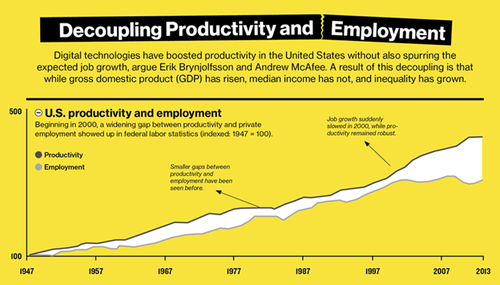

The observables for this economic disruption became obvious at the Great Doubling of the world’s workforce in the mid-1990s, and were confirmed after experiencing the dotcom bubble around 2000, at which time US productivity and job growth became decoupled.  Not surprisingly, MIT professors Brynjolfsson and McAfee call this the Great Decoupling (see figure from article).
 
What our progressive brethren have missed during this decoupling is the causal contributions of technology to the polarization of the workforce, the ‘hollowing out’ of the middle class, and the resulting growth of inequality of wealth and incomes.  Their analysis has been simple – it’s the fault of the dirty capitalists and their conservative chorus – and their solutions even simpler (minded?) – increase government size and its involvement in all sectors of society, and handout more free money (aka transfer payments).  Well, as we have been saying here for years, it turns out that the problem is much bigger than saying it was all the Republicans’ fault.


A big indicator of the systemic nature of the problem has been the reduction of Americans (citizens, not aliens) participating in the workforce (now down to 63%)  – more and more of us are just giving up working for a living, and have become satisfied with getting checks from the various governments every month.  Many factors have and are contributing to this, among them –

•    Destruction of public education by teachers’ unions
•    Globalization – exporting jobs to lower cost labor markets
•    Closed shop work laws (opposition to right-to-work initiatives)
•    Growing tsunami of regulations for small businesses and in all matters of human resources
•    Anti-business assault through environmental programs (e.g. California’s AB32 and now Obama’s new war on coal), Frank-Dodd financial regulations, Obamacare, etc
•    Ease of qualifying for all types of transfer payments (e.g. disability, food stamps)
•    Impact of illegal aliens in the underground workforce
•    Rampant advance of affordable technology (of course)

Meanwhile the progressive cadres in the Democratic party are doing everything they can to destroy the remaining jobs and squelch the economy, while the Republicans don’t have a plan to do anything other than push the same ol’ same ol’ approaches.  RR has argued that systemic unemployment is inevitable since technology is indeed destroying jobs faster than it is creating new ones.  Unless we retool economic theory and government policies to account for accelerating technology, these pre-Singularity years will be very grim for America.  Continuing on the same path and with the same policies has put us definitely beyond the tipping point.

Brynjolfsson and McAfee highlight three technology products to illustrate their understanding of what’s happening – Baxter (small robotics for small manufacturies), Kiva (robots for large warehouse operations), Watson (combines AI, big data, and voice interface for all kinds of cognitive tasks from expert systems in medicine and law to operating automated call centers).  All of these systems replace thousands of workers without providing any new categories of work that such redundant people will be able to do.  And tomorrow there will be more machines taking away jobs, mostly from the middle, but more and more also from both ends of the intellectual spectrum.

As a footnote, those in the forefront of developing and purveying job killing technologies are adamant in denying the net effect their products have on the workforce.  Putting on their game faces, they look into the camera and soberly conclude that such technology “makes (workers) more productive and efficient, but it doesn’t take jobs.”  (Dr Rodney Brooks, founder of Rethink Robotics, manufacturer of Baxter).  We should all mull that conclusion as we look at the above figure.

The collectivists of all hues (including the progressives) have responded with their well-practiced prescriptions – the government will expand to hire more minders.  These minder cadres will grow and mind more and more of our businesses and lives, be they employed in the IRS, HHS, DoJ, EPA, …, and, of course, on local levels to assure compliance with all the new reams of codes and socially just rules that will sustainably dictate every last facet of our new and environmentally sensitive, politically correct, low carbon daily round.  The correctly perceived benefit here is that such battalions of minders can be drawn from the ranks of those who don’t and can’t do well in jobs requiring deep knowledge and adaptability/creativity of the cognitive kind.  Moreover, these middle class minders do not like to do the more menial work still required in agriculture, facilities maintenance, etc.  Government is destined to shift from being today’s employer of last resort to employer of first resort for the work-dispossessed middle class.

Brynjolfsson confirms RR’s message that “it’s one of the dirty secrets of economics: technology progress does grow the economy and create wealth, but there is no economic law that says everyone will benefit.” (more here)  And that, I’m afraid, trumps the ideological finger pointing from all quarters that diverts our attention from the real problem and its limited solutions.

Posted in , , ,

41 responses to “Machines and Minders and Systemic Unemployment”

  1. Paul Emery Avatar

    George
    On the topic of public education systems can you point us in a direction of systems in the world that you believe we should emulate?

    Like

  2. George Rebane Avatar

    PaulE 212pm – good question Paul; on whose shoulders should we stand, or attempt to climb? I don’t have one that I can hipshoot, and therefore invite other readers more prepared to answer that. Most of my thinking has been along the lines of developing a curriculum from scratch that I’ve described in previous posts. I believe, the difficulties in emulating existing good systems are primarily cultural – our students would not put up with the rigor, discipline, and methods of feedback that their competitors consider the norm. Our students also demand a richer extra-curricular environment in their schools. In sum, we would have to absorb very carefully what works elsewhere.

    Like

  3. Gregory Avatar

    It doesn’t take a “system” to educate a child. Just a competent teacher using effective pedagogy to teach a complete curriculum.
    Common Core, a copyrighted private initiative designed in the shadows and unmodifiable by the states who were blackmailed by the Feds to adopt the ‘standards’ before there were standards to read (and in California, there was no public hearing on those standards), is not the road to a democratic education reform.

    Like

  4. Paul Emery Avatar

    I used the word system to steer the conversation to a specific example of what may be considered an effective educational program. It could be Swiss, German, New Zealand, Waldorf, Montessori, Catholic etc. We may have differences on what an “effective pedagogy” may be. If American students are missing out on opportunities because of their lack of education someone else must be taking advantage of the situation. Who are they and what was their education process?

    Like

  5. George Rebane Avatar

    An enterprise, independent of its field of application, that includes purposefully designed components or lower level functioning parts that are supposed to operate in concert to achieve an agreed upon objective is a system.

    Like

  6. Gregory Avatar

    Yes, given your support of Waldorf pedagogy, we probably do have differences. The worst performing two schools in Yuba River Charter’s list of 100 similar schools is Yuba River Charter and the other Waldorf charter school with similar demographics and size, and that’s not likely to change when YRCS is rewarded with a brand spanking new $8.5 million complex built to suit, assuming it doesn’t get derailed by their new neighbors-to-be in next month’s meeting at the county supes.

    Like

  7. Gregory Avatar

    Checking the latest incarnation of YRCS 100 similar schools list, the other Waldorf charter has dropped off (it was in danger of losing its charter, I’ll dig further when I can) and YRCS is 100th, last, on its list of 100 most similar schools. Bravo!
    George, I don’t agree with the use of systems terms for talking about what to teach and how to teach it, and solid knowledge of language, science, math, history and arts will be needed whatever the economy’s structure in the coming decades. The current teacher corps and the coming so-called Common Core isn’t up to the challenge.

    Like

  8. Videodrone Avatar
    Videodrone

    Personally, I’d challenge anyone one educated in US public schools under 50 to pass the 6th grade McGuffey Reader with better than a C average (sad state of US education)
    face it, any repetitive physical task or flow charted “knowledge tree” type of job is at risk, the entry level mail clerk, first (and 2nd) tier customer support, “inside sales” and other entry level type of jobs are a thing of the past – just waiting for the robo voice “…do you want fries with that?” at the drive through…
    if you don’t solve problems, if you don’t make something that others will pay for, if you’re not “talent” or “creative” please justify your existence to the new order

    Like

  9. Scott Obermuller Avatar

    Home schooling and Christian based private schools have done a very good job of educating children. A well rounded education is only the beginning. An attitude of ‘how may I be of value to society?’ will beat out the usual Obamites attitude of ‘where’s mine?’. Simply transferring wealth from producers to non-producers never achieves the desired effect and so increased transfers will be attempted until the wealth producers manage to find a way to protect what they can or simply give up producing. The poor, per usual, will end up with little or nothing.

    Like

  10. Joe Koyote Avatar
    Joe Koyote

    just waiting for the robo voice “—I recently saw a couple of documentaries and read some articles about the effect of robotics on jobs and economies. They painted a pretty unusual picture. On the one hand the rise of robots could create a sort of utopian lifestyle as people will have tons of free time to pursue personal interests and hobbies as the robots do all the work. On the other hand vast populations will be out of work as the robots do all the work. Many of the robotic experts predict some societal chaos due to ever decreasing jobs available for humans. Some jobs, they say, will always be around because robots just aren’t (yet) able to do touchy feely things like change bed pans or cook. We have already seen the effects of robotics in the auto industry displacing humans. What will happen in the 3rd world when robots learn how to sew clothing?
    The economists see an ever widening gap between rich and poor as those who make, use, and own the robots gain larger and larger portions of economies while those who have been displaced by robots will see their portion dwindle. The characteristics of the beginning of this upheaval are exactly what we are seeing in the world today and if the current global “recession/declining jobs/wealth concentration/etc.” doesn’t turn around soon then the technologically fueled Armageddon of society as we know it has begun. At least this is what the robot guys are saying.
    One of the contributors suggested that the only way chaos could be avoided would be if the very few people who will have virtually all the money supported everyone else through charity or taxes because there simply will not be enough jobs for all the people on the planet who need one. This will lead to widespread starvation and the complete disintegration of virtually all but the most remote and primitive societies. A return to feudalism?
    So the over riding question seems to be how will people support themselves in the technological/robotic world that looms just around the corner?

    Like

  11. Videodrone Avatar
    Videodrone

    I remember the concern in the early ’70’s about the coming “leisure glut” and the paperless society
    still waiting

    Like

  12. George Rebane Avatar

    Speaking of joblessness, highest taxes, and over-regulation, California continues its socio-economic misery without having a clue that Sacramento is doing literally EVERYTHING wrong. Russ Steele has an update vignette on it here.
    http://youvotedforitblog.wordpress.com/2013/06/26/27-june-2013/

    Like

  13. Paul Emery Avatar

    This is a typical RR posting. There is silence when specific examples are suggested. Kind of a hit and run operation with no substance beyond complaining about the usual stuff-unions, socialists, world government etc.
    Let me ask again, If we are not able to compete in the job arket because of our educational decencies who is getting those jobs and what education do they receive that gives them that ability. Pretty simple question I think.

    Like

  14. Gregory Avatar

    Paul, I gave specifics.
    Pretty much what we have had, only with competent staff and the ability to fail students whose work is failing and not promote by age.
    Some of our elementary schools fail to teach kids to read and fail to teach elementary mathematics, and I’m not just pointing my finger at the local Waldorf school. Checking the latest, the Nevada City School of the Arts is down in the lowest decile of their similar schools which includes Yuba River Charter (just not at the bottom). The Grass Valley Charter has slipped from an 8 decile overall (meaning from 70to 79th percentile) to a 7th (60 to 69th percentile), and their similar school placement taking account of expectations due to demographics is down to the 2nd decile.
    The GV Charter is staffed by some of the same folks who actually thought the constructivism of Mathland was the best way to teach kids. They’re pretty much following a constructivist pedagogy now, and they’ll love Common Core as it’s pedagogy meshes with their current failure prone choice.
    Kids deserve to be able to read at grade level at the beginning of the 2nd grade, and by the 4th grade be reading to learn rather than learning to read.
    No, when kids are born on 3rd base, being on 1st base isn’t a sign of success.

    Like

  15. Russ Steele Avatar

    PaulE@12:27
    I have been out of the hiring business for over 20 years, but I will recount some past experience when working with a TRW company staff member who was supporting a company executive on an industry education panel. TRW was an automotive parts supplier under the gun to implement the quality assurance standards pioneered in Japan by Deming, in the US this know as Six Sigma, by automotive manufactures trying to catch up to Japan who was delivering higher quality vehicles in US markets.
    “The term Six Sigma originated from terminology associated with manufacturing, specifically terms associated with statistical modeling of manufacturing processes. The maturity of a manufacturing process can be described by a sigma rating indicating its yield or the percentage of defect-free products it creates.”
    Six Sigma doctrine asserts that:
    • Continuous efforts to achieve stable and predictable process results (i.e., reduce process variation) are of vital importance to business success.
    • Manufacturing and business processes have characteristics that can be measured, analyzed, controlled and improved.
    • Achieving sustained quality improvement requires commitment from the entire organization, particularly from top-level management.
    Features that set Six Sigma apart from previous quality improvement initiatives include:
    • A clear focus on achieving measurable and quantifiable financial returns from any Six Sigma project.
    • An increased emphasis on strong and passionate management leadership and support.
    • A clear commitment to making decisions on the basis of verifiable data and statistical methods, rather than assumptions and guesswork
    Now that we understand the process, here is the problem. The employees that were expected to implement this statistical based program lacked the math skills necessary. In the early 1990s, companies that were members of the industry training council were spending $1 billion a year in math training, specially statistics. It was a billion dollars that their competitors in Japan did not have to fork over for training, as their workers had the learned the necessary statistical math skills in school. This lack of math training became a competitive issue.
    I hope that this helps you understand the one of the issues. You can read about the statistical training in Japan’s schools starting on page 95 of the document below, which starts in first grade and and ends in high school with a section on “Probability and Statistics.”
    https://www.stat.auckland.ac.nz/~iase/publications/18/BOOK1/A1-13.pdf

    Like

  16. Paul Emery Avatar

    Russ
    Do you see any role for the Federal Government in public education? Should curriculum and policy be left up to the state, county or city?

    Like

  17. Russ Steele Avatar

    Paul@02:30PM
    I do not see any redeeming value for the Federal Department of Education, they spend our tax dollars and produce nothing but confusion. The problem with State Department of Educations is that it has become a political cesspool under the influence of teachers unions. I would like to see the community set the educations standards at the County level. The County government is more accountable of the peoples needs and school boards can be elected and re-elected as the needs of the community are reflected by their actions. This allows enough flexibility that we do not have to suffer under the one standard meets the needs of the total student population. As Nevada County students started to excel at University and in Industry under a comprehensive curriculum, with a strong math and science core, the demand for those students would grow.
    What is your answer to your own questions. Who roles do you see?

    Like

  18. Russ Steele Avatar

    Ooops Should read “What roles do you see?

    Like

  19. Paul Emery Avatar

    Good question Russ. I see little reason for the Feds being involved except to insure some universal standard for the entire country. While that may sound like a good idea in reality it invites Federal control in order to be enforceable. Leaving standards up to Counties does run the risk of underfunded districts. Charter schools are not required to use Union teachers so the options are already there for parents to go in that direction if they choose.

    Like

  20. Gregory Avatar

    Russ, it’s a cesspool at the local level, too.
    I had Superintendent Holly Hermansen deny me FOIA access to information on the anonymous $50K given her office during McAteer’s occupancy, seed money to get International Baccalaureate program in our elementary and high schools, with money spent by the NJUHS and GVSD districts, when Ms. Hermansen’s husband, Jon Byerrum, was the super at the GVSD.
    The reason for not allowing the identity of the donor to become public was, essentially, that they might have a hard time getting parties wanting to change curriculums at our local schools to pay for it if they can’t keep it secret.
    In any case, FOIA is the law of the land specifically to root out public policy being created in secret without accountability. Personally, I suspect it was the Thomson managers at what used to be the Grass Valley Group who wanted the change but didn’t want to be seen as dissing the wretched local schools, but that’s just a guess from past experience with French managers from Thomson.

    Like

  21. Paul Emery Avatar

    Russ
    I see education as being a product of our culture not our government. That’s a pretty radical position and hard to defend but it’s my gut feeling on the matter.

    Like

  22. Russ Steele Avatar

    Paul,
    I see our education being a product of the future. Where is our culture headed, what are the future capabilities that society will need, and what current capacities should we be recycling. I am not suggesting we should reject our core principles, but look forward and determine where our knowledge base economy is headed and prepare our children to support that trajectory.
    Educating our children for a world that does not exist when they graduate should be considered a reprehensible. We are currently teaching our children to prepare for a world of global warming, with rising sea levels, limited snow pack, yet there is no evidence these are happening or have happened over the past 15 years. All the warming is based on computer models, which have been proven wanting by the facts. Nothing they predicted in the last 20 years ago has happened. Yet, we are teaching our children AGW is a great threat to humanity. Who are they going to look too when it does not happen, who will they trust? Not the people that told then warming was a threat when they are shivering in a home powered by wind turbines that are not turning and pealing solar panels that are covered by clouds.
    We need to teach our children to be creative, analytical, to solve problems, and develop leadership skills. The rest is just social fluff that will not produce jobs in the future.

    Like

  23. Joe Koyote Avatar
    Joe Koyote

    What do you all think of “No child left behind” in this context of federally mandated educational guidelines?

    Like

  24. Paul Emery Avatar
    Paul Emery

    So Russ you believe that education is a function of the government. I remember being taught in school that Manifest Destiny was our God given privileged rather than the slaughter and plunder of weaker human beings. That was pure government sponsored propaganda that warped the values of Americans for a hundred years.
    I’m all for home schooling, Charter Schools and vouchers to private schools with certain criteria which I’ve already expressed.

    Like

  25. George Rebane Avatar

    PaulE 1004pm – Having trouble following your thread with Russ. What’s the tie between “education is a function of the government”, “being taught in school Manifest Destiny”, and “government sponsored propaganda”?

    Like

  26. Russ Steele Avatar

    Paul@10:04PM
    I do not believe that education is an exclusive government function. I am a supporter of charter schools and home schooling, but all parents are not equipped to be home schooling teacher and mentors, and that is when the community must play a role. There are a growing number of online tools that can provide the needed resources for Charter Schools, who can provide the supporting infrastructure and supervision. In there current implementation government schools waste more of the students time than teaching “our children to be creative, analytical, to solve problems, and develop leadership skills.”

    Like

  27. Paul Emery Avatar

    George
    Russ apparently believes that education is a function and responsibility of the government and from his view uses the teaching of AGW as an example of state sponsored propaganda delivered through the schools. From my viewpoint I use the teaching of Manifest Destiny as an example of the same thing.

    Like

  28. Gregory Avatar

    Paul, you may be suffering from a false memory… the history books my schools used in the 60’s cast Manifest Destiny as a main rationale for 19th century expansion but didn’t paint it as correct or incorrect. Just historic.
    Your frequency of referral to it and the timbre of your repeated message leads me to think you’re stuck on the same One Note Samba. Time to lift the tone arm out of the skip and go to the next track?

    Like

  29. George Rebane Avatar

    PaulE 1058am – While teaching dubious propositions as fact is a form of state sponsored propaganda in public schools, Manifest Destiny is another matter since that was a national mindset and broadly held belief already in the first half of the 19th century before the federal govt even got into the education business. In short MD was a popular notion fomented by all kinds of people ranging from capitalists through academics to politicians.

    Like

  30. Paul Emery Avatar

    Gregory
    Where did you go to school? I went to grammar school in Oklahoma and MD was common fare for justifying the genocide of the native population.
    George
    This was in the 50’s and the “Indian Wars” were taught as us against evil savages and were regarded as a glorious victory for America when they were slaughtered and put in reservations which were located in the most desolate parts of the continent.

    Like

  31. Russ Steele Avatar

    Paul@10:04PM (Second Try)
    I do not believe that education is an exclusive government function. I am a supporter of charter schools and home schooling, but all parents are not equipped to be home schooling teacher and mentors, and that is when the community must play a role. There are a growing number of online tools that can provide the needed resources for Charter Schools, who can provide the supporting infrastructure and supervision. In there current implementation government schools waste more of the students time than teaching “our children to be creative, analytical, to solve problems, and develop leadership skills.”

    Like

  32. Russ Steele Avatar

    RISE OF THE MACHINES: Job-Stealing Robots Go Global.
    Asian workers have scored some victories in rising wages, but many are learning something the West has known for some time: Employers will seek out the cheapest labor on offer, and machines are even cheaper than an underpaid human. In the late 20th century, manufacturing jobs shifted from America to China, then from China to Southeast Asia, and now even those are being automated.
    For America, at least, this trend shouldn’t be so disconcerting. After all, it’s developed economies like ours that are designing the robots Nike is now using. Low-wage manufacturing jobs are drying up, but they’re being replaced by jobs in building, operating, and repairing the tech in question. Increasingly, companies will be likely to “onshore” these jobs to America, when shipping and distribution becomes much easier and cheaper. Manufacturing, it seems, will come full circle.

    http://blogs.the-american-interest.com/wrm/2013/06/28/job-stealing-robots-go-global/
    Send your children to robot maintenance school and they will have a job until the robots learn to repair themselves.

    Like

  33. Bill Tozer Avatar
    Bill Tozer

    Russ, an ATM machine works 24/7 50 weeks a year. Two weeks down time for maintenance and upgrades over the course of a year average. ATMs don’t get OT, don’t get medical, don’t sue their employer or draw unemployment insurance. An ATM requires no workman’s comp and works every single holiday, even little know State holidays. ATMs do not get a pension nor have any employer match into their company sponsored 401k.
    They don’t come in late no matter what the weather and never call in sick because of menstrual cramps. They never have to leave to pick up the kids from school or see the eye doc and can work 24 hours without even taking a break. And after working 24 hours straight, they wake up and do it again, day after day. Plus, they don’t get sassy.

    Like

  34. Bill Tozer Avatar
    Bill Tozer

    More on the themes of technology and government. Can government use technology to destroy a market via regulations? What is the real science of the delta smelt. Has government regulations helped the species? If not or if so, what is the real cost to those those doing menial jobs? Farming is a technology. Controlling water is a technology.
    http://smallbusiness.foxbusiness.com/entrepreneurs/2013/07/01/regulations-bleed-california-farmers-dry-as-record-drought-continues/

    Like

  35. Ben Emery Avatar
    Ben Emery

    In an economy isn’t a necessity for people not high tech robots or computer programs to purchase goods and services? One huge blind spot George, you discount the need for people to be able to afford to purchase such goods and services. Instead we have a small fraction at the top bringing in a vast majority of the financial gains in our economy and the rest are dependent on credit or government assistance to stay afloat. A dysfunctional system at best and immoral at worst.
    “John Henry said I feed four little brothers, and my baby sister’s walking on her knees, did the lord say that machines ought to take the place of living, and what’s a substitute for bread and beans, I ain’t seen it, do engines get rewarded for their steam”
    http://www.youtube.com/watch?v=hI0D44zYP-Q

    Like

  36. George Rebane Avatar

    BenE 716pm – excellent point, and one that needs to be made frequently as economic policy is debated. If you were an assiduous reader of this blog, then you would know that I have always considered the QoL of all the people in an economy. And I have proposed approaches how they may be gainfully employed in fulfilling jobs. Your contrasting solution for putting everyone to work is the same one that Lenin, Stalin, Mao, Castro, … have tried, and it doesn’t work. Artificial value for labor cannot be mandated by the state, it is utterly beyond the control of any council, commission, or commissar.
    Your aim should not be to equalize the material rewards in society, but instead to assure that the lowest talents and those who are truly unfortunate can live with dignity, purpose, and fulfillment. If that were your aim, then the capitalist and collectivist together can forge policies to provide such an economy. But if your aim is to promote class envy among the technology displaced masses and so seek to straighten the Gini Coefficient’s Lorenz curve, then you will reap the misery that your ideological forebears impressed on their people for at least the last hundred years.

    Like

  37. Ben Emery Avatar
    Ben Emery

    George,
    My goal isn’t to make sure everybody gets equal pay but rather just/ fair pay. The way the system is set up presently is accumulation of wealth is not only praised but encouraged and with that wealth government officials are bought off to secure that wealth along with the source and circumstance from which it came.

    Like

  38. Bill Tozer Avatar
    Bill Tozer

    What will happen to us misfits in the Blade Runner World?
    I do like to romanticize the idea of huddling in a tunnel somewhere around a burn barrel for heat wearing Mad Max garb. I am particularity fond of those gloves with the fingers cut out. Rebels without a cause, rebels without a job.
    Ben, it must be 25 years ago (maybe longer) when a non-profit pushed hard for Congress to pass a new minimum wage law. It was a single issue non-profit devoted solely to raising the minimum wage of us down trodden. When the bill passed, the non profit realized that if THEY had to pay their employees minimum wage, they would cease to exist. Yes, they applied for an exemption to the new increase in paying minimum wage, lol.
    I am all for technology, but I fear what our government will do with it. Just took a poll on the question “When you hear the word drone, what do you think of?” The answers to be checked included the Afghan war, commercial use, and a host of other options. I had to check “other” because when I hear the word drone, I think of our Government spying on civilian populations.
    The Big Corporations are not the main problem. The wealthy are not the main problem. Technology is not the main problem. The main problem is what our government is going to do with technology. That I fear more than any machine on the assembly line. And its a much more important and serious threat to us renegades.

    Like

  39. Gregory Avatar

    Ben, to even up the books, how much do you expect the wealthy (US and worldwide) owes you and your immediate family, in round figures?

    Like

  40. George Rebane Avatar

    BenE 854am – Here we are in full agreement. I want no one to get unjust or unfair pay, and most certainly not use such ill-gotten gains to buy off government so as to assure more of the same. So I eagerly await your essay on how fairness and justice in prescribing compensation are balanced against risk, and how you see people responding to your more equitable scheme.
    I also agree with Mr Tozer’s 959am, especially when we recognize that today no “Big Corporation” survives without a hefty dose of government intervention.
    And finally, your answer to Gregory’s 1008am would be most illuminating.

    Like

Leave a comment