

George Rebane
Automation and advanced digital technologies are eliminating the need for people in a growing number of jobs. We’ve survived severe technological change before but this time it might be different: are we facing a future of dismal job opportunities, stagnant income, and worsening inequality? Are we headed for chronic unemployment? So asks ‘How Technology is Destroying Jobs’ by David Rotman in the Jul/Aug issue of MIT Technology Review.
RR welcomes MIT’s Sloan School of Management into the discussion of what arguably is the most critical issue facing America and the developed world. Pursuing what took them so long to raise this on their radar is out of scope here, but acknowledging the problem is a large step forward since their trumpet is a mite larger than mine.
Please understand that this longtime, no-brainer conclusion is not uniformly accepted at that august institution. Rotman cites several economists there who are still convinced that nothing really has changed in these pre-Singularity years – all we’re having is a little slowness in the workplace expanding to catch up with technology, but nothing materially different from what happened in the 19th century, etc, etc.
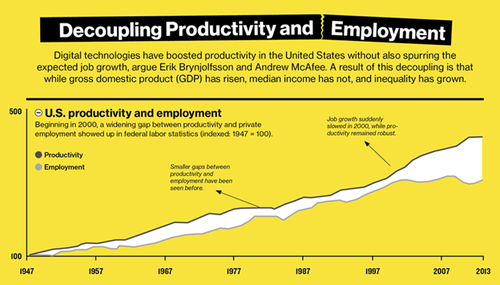
The observables for this economic disruption became obvious at the Great Doubling of the world’s workforce in the mid-1990s, and were confirmed after experiencing the dotcom bubble around 2000, at which time US productivity and job growth became decoupled. Not surprisingly, MIT professors Brynjolfsson and McAfee call this the Great Decoupling (see figure from article).
What our progressive brethren have missed during this decoupling is the causal contributions of technology to the polarization of the workforce, the ‘hollowing out’ of the middle class, and the resulting growth of inequality of wealth and incomes. Their analysis has been simple – it’s the fault of the dirty capitalists and their conservative chorus – and their solutions even simpler (minded?) – increase government size and its involvement in all sectors of society, and handout more free money (aka transfer payments). Well, as we have been saying here for years, it turns out that the problem is much bigger than saying it was all the Republicans’ fault.
A big indicator of the systemic nature of the problem has been the reduction of Americans (citizens, not aliens) participating in the workforce (now down to 63%) – more and more of us are just giving up working for a living, and have become satisfied with getting checks from the various governments every month. Many factors have and are contributing to this, among them –
• Destruction of public education by teachers’ unions
• Globalization – exporting jobs to lower cost labor markets
• Closed shop work laws (opposition to right-to-work initiatives)
• Growing tsunami of regulations for small businesses and in all matters of human resources
• Anti-business assault through environmental programs (e.g. California’s AB32 and now Obama’s new war on coal), Frank-Dodd financial regulations, Obamacare, etc
• Ease of qualifying for all types of transfer payments (e.g. disability, food stamps)
• Impact of illegal aliens in the underground workforce
• Rampant advance of affordable technology (of course)
Meanwhile the progressive cadres in the Democratic party are doing everything they can to destroy the remaining jobs and squelch the economy, while the Republicans don’t have a plan to do anything other than push the same ol’ same ol’ approaches. RR has argued that systemic unemployment is inevitable since technology is indeed destroying jobs faster than it is creating new ones. Unless we retool economic theory and government policies to account for accelerating technology, these pre-Singularity years will be very grim for America. Continuing on the same path and with the same policies has put us definitely beyond the tipping point.
Brynjolfsson and McAfee highlight three technology products to illustrate their understanding of what’s happening – Baxter (small robotics for small manufacturies), Kiva (robots for large warehouse operations), Watson (combines AI, big data, and voice interface for all kinds of cognitive tasks from expert systems in medicine and law to operating automated call centers). All of these systems replace thousands of workers without providing any new categories of work that such redundant people will be able to do. And tomorrow there will be more machines taking away jobs, mostly from the middle, but more and more also from both ends of the intellectual spectrum.
As a footnote, those in the forefront of developing and purveying job killing technologies are adamant in denying the net effect their products have on the workforce. Putting on their game faces, they look into the camera and soberly conclude that such technology “makes (workers) more productive and efficient, but it doesn’t take jobs.” (Dr Rodney Brooks, founder of Rethink Robotics, manufacturer of Baxter). We should all mull that conclusion as we look at the above figure.
The collectivists of all hues (including the progressives) have responded with their well-practiced prescriptions – the government will expand to hire more minders. These minder cadres will grow and mind more and more of our businesses and lives, be they employed in the IRS, HHS, DoJ, EPA, …, and, of course, on local levels to assure compliance with all the new reams of codes and socially just rules that will sustainably dictate every last facet of our new and environmentally sensitive, politically correct, low carbon daily round. The correctly perceived benefit here is that such battalions of minders can be drawn from the ranks of those who don’t and can’t do well in jobs requiring deep knowledge and adaptability/creativity of the cognitive kind. Moreover, these middle class minders do not like to do the more menial work still required in agriculture, facilities maintenance, etc. Government is destined to shift from being today’s employer of last resort to employer of first resort for the work-dispossessed middle class.
Brynjolfsson confirms RR’s message that “it’s one of the dirty secrets of economics: technology progress does grow the economy and create wealth, but there is no economic law that says everyone will benefit.” (more here) And that, I’m afraid, trumps the ideological finger pointing from all quarters that diverts our attention from the real problem and its limited solutions.


 rebanesruminations.com
Leave a comment