

George Rebane
Head of the National Security Agency, General Keith Alexander, goes in front of a closed doors congressional panel today. They will quiz him about what data the NSA and other intelligence agencies can collect, have been collecting, and plan to collect on Americans. He will tell them about the threats thwarted through the nation’s intelligence collecting systems operated by the NSA. This is all a part of the show of concern for balancing individual privacy and the nation’s security needs that Congress is putting on for our benefit after NSA contractor Edward Snowden outlined how intelligence is developed and named Prism as one such long-running program that snoops on us.
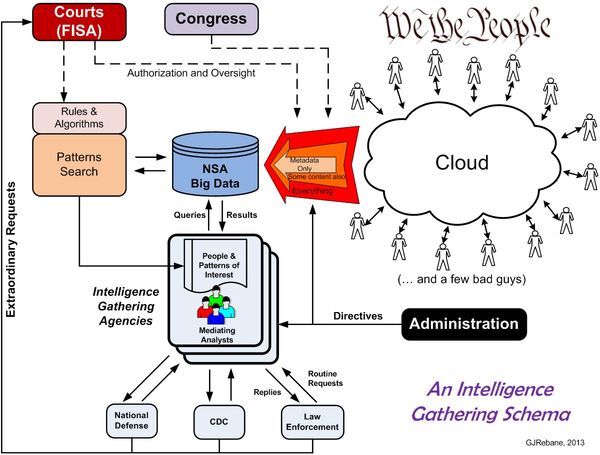
I have no idea what all Snowden gave to Britain’s Guardian and The Washington Post newspapers that would have been news to our enemies, whether they be terrorist organizations or sovereign nation-states. The information freely available in the public domain allows anyone who understands boxes and arrows to draw the above diagram that is one version of a high level representation of our intelligence gathering schema (click on figure for better resolution).
This level of openness is not shared by everyone in Washington. Last Sunday on Fox News former VP Dick Cheney told Chris Wallace that even understanding what I’ve put together in the figure should not be public knowledge and would compromise our security. I totally disagree, and feel we have little to fear from people who don’t already know that we operate such an intelligence gathering scheme – they simply aren’t smart enough to harm us.
My druthers are that Americans understand, to the level indicated in the figure, how our government collects and connects the dots on potential bad guys who mean the country harm. With such a basic understanding we can talk reasonably about what government branches and agencies do and how they interlink. We don’t have to know the details about what stuff passes through all the arrows. But some of the details are important to us.
For example, the set of nested arrows showing data sucked from the telecommunications cloud into, say, the giant NSA data repository soon coming on line in Utah. We are assured by people like Senator Dan Coats (R-IN) that Snowden has damaged America’s security with his revelations, and that we should now rest easy and trust government to continue protecting us because it is doing so without violating any of our privacy. He writes in the 18jun13 WSJ –
“The government is not and cannot indiscriminately listen in on Americans’ phone calls or target their emails. It is not collecting the content of conversations or even their location under these programs. For instance, the only telephone data collected is the time of the call, the phone numbers involved and the length of the call. That is how we connect the dots and identify links between international terrorists and their collaborators within the United States. All of this is done under the supervision of the nation’s top federal judges, senior officials across several different federal agencies and Congress.”
Mr Snowden says otherwise, and claims that he had the ability to get any data (including the content of phone calls, emails, text messages, etc) from NSA’s big bit bucket and/or the cloud while sitting at his work station. As reported by Cnet, Snowden’s remarks are backed up by one of Sen Coats’ congressional colleagues, Rep. Jerrold Nadler (D-NY), who “disclosed last Thursday that during a secret briefing to members of Congress, he was told that the contents of a phone call could be accessed “simply based on an analyst deciding that.” … If the NSA wants “to listen to the phone,” an analyst’s decision is sufficient, without any other legal authorization required, Nadler said he learned. “I was rather startled,” said Nadler, an attorney and congressman who serves on the House Judiciary committee.”
Referring to the figure, that means that the big red arrow labeled ‘Everything’ is already fully operational, and somebody out there is blowing smoke on what dots are being collected and subsequently connected. This is indicated by the administration’s ability to authorize such collections through confidential high level directives.
But in the end, dear reader, none of us should be surprised. As I’ve shown in the graphic schema, the ability to switch from collecting only ‘metadata’ to collecting ‘everything’ can be accomplished with a few keystrokes, whether or not authorized by a secret FISA court or Congress. And that our government may have already thrown the switch to collect all the dots is a safe bet.
[Addendum] Congressman Tom McClintock (R-CA) delivered these very relevant remarks on the floor of the House today. They are reproduced here in their entirety.
Our Nation’s Wake Up
Call
June 18, 2013
Mr. Speaker:
In the early 1760’s the Royal Governor of Massachusetts began issuing “writs of
assistance” as general warrants to search for contraband. They empowered
officials to search indiscriminately for evidence of smuggling.
These warrants were challenged in
February of 1761 by James Otis, who argued forcefully that they violated the
natural rights of Englishmen and were in fact, “instruments of slavery.”
A 25-year old attorney who attended
the trial later wrote, “Every man of a
crowded audience appeared to me to go away, as I did, ready to take arms
against writs of assistance. Then and there the child Independence was
born.” That young lawyer was John Adams. To him, that’s the moment
the American Revolution began – the general warrants were the first warning
that his king had become a tyrant.
The Founders specifically wrote the
Fourth Amendment to assure that indiscriminate government searches never
happened again in America. In America, in order for the Government to
invade your privacy or to go through your personal records or effects, it must
first present some evidence that justifies its suspicion against you and then
specify what records or things it is looking for.
Last week, we learned that the
federal government is today returning to those general warrants on a scale
unimaginable in Colonial times by seizing the phone and Internet records of
virtually every American.
We’re told that this is perfectly permissible under past Supreme Court rulings
because the government is not monitoring content but only records held by a
third party. This wouldn’t be the first time the Supreme Court has erred
grievously.
If phone records are outside the protection of the Fourth Amendment because
they are held by a third party, then so, too, are all of our records or effects
held by third parties. That means the property you keep in storage
or with a family member, the private medical records held by your physician,
the backup files of your computer maintained on another server — are all
subject to indiscriminate search. Many of the general warrants served in
Boston were on warehouses owned by third parties.
Even if we were to accept this rationale, then that third party – for example,
the phone company – should itself still be safe from general warrants like
those that have apparently scooped up the phone and internet records of every
American.
It is argued with Orwellian logic that it’s permissible to seize these records
indiscriminately since they aren’t actually searched until a legal warrant is
issued by a secret FISA court. But if general warrants can produce the
evidence for specific warrants, isn’t the Fourth Amendment prohibition against
general warrants rendered meaningless? And all we know of the secret FISA
court and its deliberations is that out of 34,000 warrants requested by the
government, it has rejected only 11– hardly a testament to judicial prudence or
independence.
We are told that the information will only be used to search for
terrorists. Does anyone actually believe this? Just a few months
ago, the Director of National Intelligence brazenly lied to Congress when he
denied the program existed at all. Just a few weeks ago, we learned that
this administration has taken confidential tax information belonging to
political opponents and leaked it to political supporters. Is there
anyone so naïve as to believe the same thing won’t be done with phone and
Internet records if it suits the designs of powerful officials?
A free society does not depend on a police state that tracks the behavior of
every citizen for its security. A free society depends instead on
principles of law that protect liberty while meting out stern punishment to
those who abuse it. It doesn’t mean we catch every criminal or terrorist
– it means that those we do catch are brought to justice as a warning to
others. This is true whether we are enforcing the laws of our nation or
the law of nations.
Indeed, if we had responded to the attack on September 11th with the same
seriousness as we responded to Pearl Harbor, terrorism would not be the threat
that it is today.
Ours is not the first civilization to be seduced by the siren song of a
benevolent all-powerful government. But without a single exception, every
civilization that has succumbed to this lie has awakened one morning to find
the benevolence is gone and the all-powerful government is still there.
Mr. Speaker, this is our wakeup call and we ignore it at
extreme peril to our liberty.
[19jun13 update] General Alexander lied to the House Intelligence Committee today telling its members that it was not possible to quickly switch modes from collecting only metadata to collecting everything (see figure above). Even the talking heads on cable news had problems swallowing such an obvious whopper. If there are any smart staffers working for the committee members, that may come back to haunt the general.
[3jul13 update] On this eve of celebrating our independence I received an email from a reader with a link to what kind of information can be developed from a database of cell phone metadata. Look at the detail (here) of what this Green politician in Germany discovered when he demanded and got six months of such recorded data from his government. And on to that we add the government’s ability to remotely turn on your cell phone’s audio and video even when you think you have powered down the device. ‘Smile, you’re on candid camera!’
And then (here) if you thought your snail mail was safe from prying eyes.


 rebanesruminations.com
Leave a comment