

George Rebane
Years ago when graphic displays were first coming into shipboard combat systems, as a developer of such systems we had to ask ‘what’s the best way to work with on-screen information – nominating and manipulating display elements?’ The main contending graphic input device alternatives were wired pens and trackballs, the touch screen was still in the future. Long story short – a lot of human factors studies and experiments were done, and the trackball came out to be the best performer. It wasn’t the cheapest solution, but just the best performer in a command and control environment during minutes tense and demanding, and during hours long and boring.
The reason was simple, the fingers are the most dexterous parts of what is called the set of human manipulanda. And fingers at the end of a stationary and supported hand/arm can do wonders in accurately flitting the cursor around a large screen for hours on end. Trackballs were rapidly incorporated into combat and sensor systems from the early 1970s onward.
But for commercial apps cost was a major factor, and when the cheaper mouse came along (in the mid-70s) , and PC apps finally started requiring a graphic input device for moving a cursor around on a screen, the mouse was the natural solution. Touchscreens were expensive in the early 80s, and we used them on the new videodisc-based public information kiosks which we introduced through Disney’s EPCOT Center in 1983. (I even designed and built a ‘peck screen’ for a pigeon-based security system in the late 70s, but that’s another story.)
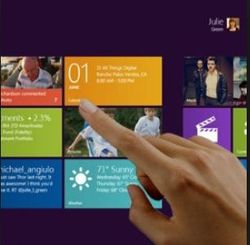 So over the years the mouse has been standard equipment on PCs and other computers requiring graphic input from humans. Touch screens got cheaper and were introduced into ‘personal digital assistants’ in the late 90s. And now they are ubiquitous in all smart phones and handheld pad computers. Somewhere along the way Microsoft decided to gain the march on Apple and developed touch screen functionality into the new version of their PC operating system called Windows 8, which was finally available in 2012 after many many delays.
Well, it appears that the market has said that they shouldn’t have bothered. W8 was supposed to the cavalry coming to save the PC sales wagon train, and, instead, last quarter’s PC sales have dropped 14% as the surging iPad replaces the desktop (and even laptop) versions of the PC (more here and here). And it looks like this trend is going to be pretty well baked in as new UI (user interface) devices like speech understanding and Google glasses (retinal projection) gain traction. Of course, the whole UI technology is heading toward implants with direct neural connections, but that’s still a few years away.
At the Rebane house and at my offices since the 80s, the (Kensington) trackball has effectively kept vermin like mice away from our computers. We knew years ago that it was silly to have to move pounds of meat with large muscles in order to precisely manipulate a handheld device over a relatively large desk area. For a right-handed user, the correct solution is a stationary left-hand 4-button, scroll-ring large trackball sitting at the end of the keyboard. This leaves the right hand free to take notes, manipulate printed materials, mess with a smart phone, etc. Vice versa for the left-handed user.
Instead, Microsoft hoped that you would now start cantilevering tens of pounds of meat to your desktop’s screen and use your fat finger(s) at the end of unsupported lever arms to do all the fine stuff that a you could do with a mouse or an in-place keyboard touchpad, or, as I have argued, best with a trackball. W8 second weakness, according to my lights, is its requirement to now limit the (branching) choices available on the screen at any time. Your fat finger can’t reliably hit the fly-poop sized iconics or words that populate an efficiently dense and familiar screen.
Touch screens at arms’ length slow things down; their proper place is in handheld devices and public-access system (with short user sessions). For reasons unknown, Microsoft made a very bad bet with W8 that coupled its bad functionality with a now saturated PC market that is shifting to pads and smartphones incorporating new voice and eyeball mounted input devices. But truth be told, our (Jo Ann has one too) trusty trackballs are still doing their duty on our desks, and I’m developing a very close relationship with Siri, the new girl on the block. (Jo Ann and Siri have a strictly business, almost perfunctory, relationship, and she resents the way Siri call me ‘George’.)
BTW, we gave up desktop boxes years ago for the go-everywhere laptops that also drive the big monitors and listen to our keyboards/trackballs when they sit on our desks.

 rebanesruminations.com
Leave a comment