

Only in America could the people who believe in balancing the budget and sticking by the country’s Constitution be labeled as “extremists”.
George Rebane
Hereabouts and in more distinguished forums the governance debate continues as to which types belong to the Left or the Right. The confusion from the Left’s academics seems to be with monarchy and fascism, and that stems from their use of the wrong set of coordinates that can productively frame the discussion. In the minds of some pundits, the attributes of a given governance type are totally absent. But when all is said and done, the modern progressives do accept a right/left view that is approximated in the figure below.
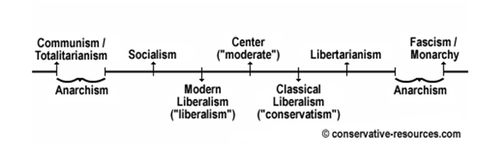 Without stopping to quibble about the specifics of what constitutes the ‘center’ or ‘moderate’, the single dimensional spectrum above does have some curious bookends. The leftmost one ends in ‘communism/totalitarianism’, which state of affairs is reached after passing through a region where anarchism rules. And the rightmost ends in ‘fascism/monarchy’ after also passing through anarchism. The better read student here will immediately point out that the Left’s anarchism is not the same as that of the Right’s. This is indeed correct, and I’ll have more to say about that below. However, in this fractured view, regardless of each having traversed the swamp of anarchy, both sides terminate in totalitarian forms of governance under the absolute control of a great leader.
A more accurate, useful, and historically exercised representation of ideologies and their supportive types of governance is given in the figure below (click to enlarge). Here we use a representation common in the system sciences wherein one significant dimension/attribute is isolated as being perpendicular (orthogonal) to a plane that contains all the other dimensions/attributes.
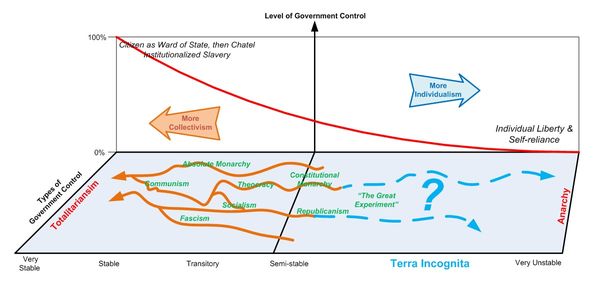
For the discussion of ideologies and their supportive forms of governance, the dominant dimension shown in the figure is the level of government control of the land and the affairs of its people. This ranges from a 100%, suffered under the absolute rule of a totalitarian dictator, to 0%, wherein anarchy is the order of the day and there are no visible institutions of state. In the figure the variation in this level of control is shown by the thick red line in the plane (dimension) perpendicular to the field (multiple dimensions) of the types of government control, hence governance.
Understanding this framework immediately clarifies the debate over what labeled ideology belongs where. I have shown the various collectivistic labels distributed on generalized trajectories of governance as they proceed leftward (orange lines) in the direction of greater government control of wealth creation/distribution, property ownership, class memberships, and behaviors (liberties) permitted to the individual.
Going rightward toward less government control and more individual liberties is shown by the blue dotted lines, and this is for all of us the most important, and for me the interesting part of the governance debate. Take a look at the bottom of the governance plane where the stability of governances at the various levels of government control is noted. In most of today’s developed countries we are at a semi-stable level within our various forms of republican and socialist-democrat forms of governance. In our universe consider that the great tendency of all dynamic systems is to migrate toward stability whenever possible. In systems theory the most stable systems are paid for by their having the lowest performance (e.g. ability to do work or transmit information) since performance and stability are at opposite ends of the seesaw (a concept foreign to progressives as is the opposition of freedom and equality), there is no free lunch. And over the eons, the most stable form of governance has been autocracy in the form of tyranny. This stability has also cost uncountable human lives that have been miserable, brutish, and short.
As societies became more intellectual, people began to ask if better forms of governance than tyranny could be implemented. Short-lived experiments, as in classical Greece, gave answers that remained attractive during the ensuing centuries. It took nearly two millennia after the Greek experiment for the light to return in the west. During the Renaissance governments in the low countries and certain city states began to liberalize (less government control) under their more enlightened royals. The result was an amazing generation and accumulation of wealth as individual entrepreneurs were allowed to compete for the favor of the then emerging markets. Soon political philosophers – e.g. Hume, Lock, Bacon, Hobbes, … – took note, and began to publish outlandish ideas for their time and place (cf. emerging research universities).
In response to the overreach and then tyranny of the British Crown, our American Founders took note of these ideas and began to put in place a philosophical cum ideological basis for a new nation. Their big question was ‘Can man govern himself?’, and if so, then how? Through their studies and debates they came to the hopeful answer ‘Maybe’, and the firm conclusion that it was worth a try to find out. Their effective ‘yes answer’ was a carefully constructed democratic republic, for they all knew that pure democracies were a sure and quick path to renewed tyranny. So they took a first cut that became the Articles of Confederation, improved upon it, and gave us our Constitution, thus launching what we know as ‘The Great Experiment’ which, after two centuries, is still a work in process.
To date and by any measure, our democratic republic has been the best solution devised for liberal self-governance. But as indicated in the figure, this mode of governance is semi-stable. But why so? Because again, our universe is so constructed that all systems operated at the edge of their performance envelope are marginally stable, be they a race horse, a hedge fund, a particle accelerator, a virtuoso pianist, a start-up with a new technology, or a government of, for, and by the people. They all run at the boundary between world class performance and blowing up.
Looking to the right (and the Right) on the diagram, as government control gets reduced more and more, we see tentative blue dotted lines heading toward social orders with ever greater individual liberties and self-reliance. Sadly, today all that is terra incognita, we don’t yet know for certain how to fashion ways to govern ourselves as we head closer to what ultimately must end in anarchy, the disappearance of formal government. But let’s be clear here, no one of the Right is suggesting that such a journey should continue until it actually ends in anarchy. We only believe that going in the direction of individual liberty and self-reliance promises the greatest fulfillment of human potential. And we also believe that moving in that direction should be done with great care and deliberation.
Perhaps as our race matures, we will be able to identify a form (forms?) of governance at very low levels of formal government control that then can be nurtured as a ‘sweet spot’ – an island of manageable stability and the greatest practical level of individual liberties. On the other hand, we know with the certainty of a rising sun that going in the direction of ever greater levels of government control will encounter a reprise of human disasters that fill (unrevised) history books. And with advanced technology in the hands of autocrats then tyrants, the abyss of the human condition will be beyond imagination, and it will be rock stable. (Already we hear from our Left that today resistance to government is futile, and submission to greater control is our inevitable future – for our own security and peace of mind we should simply accept and learn to love it.)
So I hope this makes it clear again that conservatives, classical liberals, libertarians, conservetarians, … all seek the beneficial future of Man in the direction of diminished government control. And this above all means reducing the scope of government in our lives, increasing individual liberties, and promoting self-reliant enterprise. So far the best demonstrated approach to that for us may be a careful return to, say, de Tocqueville’s America of the 1830s sans slavery.
Coming full circle, we now see why the liberals’ assignment of fascism as being an endpoint on the far Right is ludicrous. Fascism is an embodiment of national socialism in which government is in complete control of all means of wealth creation and its distribution. Fascism is simply anathema for a consevetarian or classical liberal. What fools the lightly read and becomes the propaganda tool of progressive intellectuals is that, in the interval between WW1 and WW2, the fascist regimes did not formally nationalize major industries. The European fascists saw the benefits of letting the owners and experienced operators of such industries retain formal ownership and even accrue profits. All that was allowed as long as industry produced exactly what the state dictated and sold it to designated customers (including the state) in dictated quantities and for dictated prices. Every fascist regime had longer term plans to ultimately appropriate such industries directly into state ownership, and effectively did so as WW2 started.
Also noteworthy here is that as state control increases – say, under communism, fascism, absolute monarchies – multiple political parties are prohibited, and all workers’ unions become organs of state control of the workforce. This is exactly the opposite of what people of the Right persuasion seek – multiple political parties and unfettered ability to organize/assemble into an untold number and types of groups and organizations. As government control (collectivism) increases, free markets disappear. Again this is exactly the opposite of what is desired by people who embrace less government involvement (individualism) in their lives.
(For more on the debate as to whether fascism is a Right or Left form of governance, google ‘fascism, right or left’. This should highlight the laughable position of some progressive worthies here who have accused my correctly ascribing fascism to the Left as ‘revisionist Estonian history’. The fun never stops.)
Some political scientists say that the extremes of the Left and the Right forms of governance will all meet within the common embrace of anarchy. That simplistic view is wrong. However, it is often promoted to advance an agenda.�
160; Political philosophers recognize two distinct families of anarchy – collectivist and individualist. In both, the ‘immoral state’ disappears. The collectivist anarchists see society forming into an unstructured amalgam of peer collectives, co-operating as needed and filled with properly evolved/educated altruists. Here the individual is subsumed and happily lives by and for his collective.
Such an idealized anarchy was the vision of Marx as the successful endpoint of communism – ‘the end of history’. At that stage of perfection the state would fall away, and collectivist anarchy would become the new social order in which Man would continue in glory. But to get there required a path involving ever increasing state control of its citizens, and to achieve its goal Stalin observed (and demonstrated) that “to make an omelet, you have to break a few eggs.” However, even after some hundreds of millions of ‘broken eggs’, no communist philosopher has yet figured out how that final transition from 100% to zero control could possibly occur.
On the right end, the panacea of individualist anarchy idealizes a peaceful reign of individuals motivated by enlightened self-interest, living together, guided by the ‘invisible hand’, and joining socially and in commerce as needed. In some as yet undefined way, no one would become rapacious and deny the other their just due. Presumably such people would be shamed and/or shunned in their misbehavior by others, and thus encouraged to straighten out and fly right. Again, it is a reach to imagine that such a social order would be anything but precipitously unstable given what we know about ourselves today. But then, this goal of liberty loving individualists is for a tomorrow when we may indeed become a different type of person having been molded by our technology abetted journey.
I hope that this little exposition sheds some light on how many of us see the choices now facing Man – one being the way of certain destitution and despair, the other a road we have already traveled part way, one that invites us to use that experience to explore new and yet undiscovered societies comprised of free, enlightened, and enterprising individuals.


 rebanesruminations.com
Leave a comment