
Rebane's Ruminations
February 2013
S M T W T F S
 12
3456789
10111213141516
17181920212223
2425262728  

ARCHIVES


OUR LINKS


YubaNet
White House Blog
Watts Up With That?
The Union
Sierra Thread
RL “Bob” Crabb
Barry Pruett Blog

George Rebane

Education is the key to a strong democracy, economic competitiveness and a world-class standard of living. In recent decades, however, America has lost its place as a global leader in educational attainment in ways that will lead to a decline in living standards for millions of our children and the loss of trillions of dollars of economic growth.
 
So starts ‘For Each and Every Child – a Strategy for Education Equity and Excellence’ authored by a distinguished panel of mostly very progressive professionals empaneled by the Dept of Education as the federal Equity and Excellence Commission.  From their efforts we (re)learn that
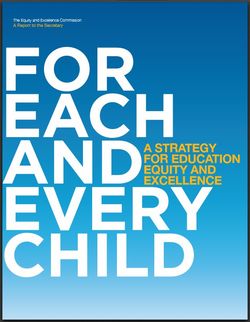
EducationCommissionRpt–    American students are well below world student performance averages for developed countries (before 1965 we used to be in the top tier in education).
–    27 developed countries do better than America in global rankings
–    Only one in five American students perform at or above world average.
–    Mostly Asian and white kids rank average, but combining all students – predominantly with black and Hispanics – we fall below average.
–    The performance levels of our students has been “roughly flat” for the last 40 years despite the enormous increase in education spending
–    In poorly performing schools there is a preponderance of “weakly trained teachers”.
–    Funds for education are allocated differently in different school districts because in the poorer zip codes there are more students who have ‘special needs’.
–    But even well off zip codes don’t fare too well – e.g. Palo Alto students perform at the 67% world level.
–    To fix the problem we require to put in place programs that yield an “equity” in student performance so that zip code does not determine students’ academic rank.

All of this is really not news, and has been discussed (revealed to some) on these pages for years.  The real purpose of the commission and its report appears to be to launch a new initiative for increased federal control of funding for K-12 public schools.  While at this time not asking for money directly, the injection of performance “equity” is the key for the forced conclusion.  Equity quietly introduces a measurable figure of merit for directing additional funds and/or redistributing existing federal education funding from, say, Palo Alto to Oakland.  Of course, equity can be achieved in several ways – the salutary method is to raise all kids to an appropriate distribution of higher level performance, the other is to find that equitable performance distribution closer to what now the blacks and Hispanics are able to deliver.  Higher or lower, the correct goal in the transformed America seems to be equitable homogeneity.

With the release of this report a select group of its authors are making the media rounds.  Today’s NPR Morning Edition featured three of them (podcast here).  The report itself has some good insights, but when taken overall, there is nothing there that stands out from the same ol’ same ol’ of the last 40 years since we were ushered into the Great Society.  What caught my attention beyond (re)introducing ‘equity’ into K-12, is the commission’s recommendation for “regionalization”.  Upon closer reading, that seems to be another federal assault to remove control over matters of education from local school jurisdictions.  The report concludes with – 

The commission’s report provides a five-part framework of tightly interrelated recommendations to guide policymaking:
• Equitable School Finance systems so that a child’s critical opportunities are not a function of his or her zip code;
• Teachers, Principals and Curricula effective enough to provide children with the opportunity to thrive in a changing world;
• Early Childhood Education with an academic focus, to narrow the disparities in readiness when kids reach kindergarten;
• Mitigating Poverty’s Effects with broad access not only to early childhood education, but also to a range of support services necessary to promote student success and family engagement in school; effective measures to improve outcomes for student groups especially likely to be left behind—including English-language learners, children in Indian country or isolated rural areas, children with special education needs, and those involved in the child welfare or juvenile justice systems; and
• Accountability and Governance reforms to make clearer who is responsible for what, attach consequences to performance, and ensure that national commitments to equity and excellence are reflected in results on the ground, not just in speeches during campaigns.

All this is heavy stuff, and promises little profit.  To lighten your day, take a look at this video ‘Romancing the Wind’ of a truly uplifting hobby that invites virtuosity (be sure to have your speakers on).

Posted in , , ,

60 responses to “The Status of America’s K-12 Public Education”

  1. Gregory Avatar

    I think “that the average IQ of those pursuing an education major is 91” says a lot. That’s one datapoint with very large error bars, but it’s clear that K-12 not only accepts those with the weakest academic preparation into the teaching profession, it erects barriers to climb and hoops to jump through such that the most prepared go elsewhere.
    George, the biggest barrier to real “STEM” in high school is literacy and numeracy in the earliest grades. There is a great deal of intellectual capital built up in the earliest years, and while an older child can make up for lost time, most don’t. Two straight years with a lousy teacher in the first three grades and a child, not to mention their parents, may have a real crisis on their hands but would probably not know it until the kid is in high school and needs to grok enough math and language to squeak past the exit exam.

    Like

  2. Michael Anderson Avatar
    Michael Anderson

    George wrote: “MichaelA (cf GeoR 829am) – ‘… Estonian revisionist history …’??!! Well, I think that this thread has come to an end. Your knowledge of what actually happened in Europe in the first half of the 20th century exhibits some extremely narrow reading and profound ignorance as you ascribe to me (and Estonians?) your first acquaintance of which tyrants were doing what to whom and when. There is no prior evidence that this kind of knowledge base responds to remediation, so we’ll just have to leave it there.”
    I apologize George, it was not my intention to offend. And you’re right. I was ascribing revisionist history-making to all Estonians when clearly you are only Estonian I know who is trying to move Nazi fascism from the right-authoritarian quadrant to the left-authoritarian quadrant.
    My assumption was that Estonians during the first part of the 20th century loathed the left-authoritarian communists on their eastern flank to such a degree that they were willing to accept the flaws of the right-authoritarian capitalists to the southwest. Neither group did much regarding liberty and justice for all, that’s for sure.

    Like

  3. Russ Steele Avatar

    The Union’s Did It
    “Nothing is more determinative of our future than how we teach our children,” California Gov. Jerry Brown said in his January State of the State address. “If we fail at this, we will sow growing social chaos and inequality that no law can rectify.”
    Bad news, governor: California is already failing its children. And it wasn’t always this way.
    According to RAND Corp., as late as the 1970s California’s public schools still had an “excellent” reputation. Then, in 1975, Brown (in his first stint as California’s governor) signed the Rodda Act, giving government unions the power to take money directly out of government employees’ paychecks.
    The California Teachers Association quickly poured this new revenue stream into an organizing drive, more than doubling the union’s ranks. The Golden State’s politics have never been the same since — nor has the quality of its public schools. Between 2000 and 2010, the CTA spent more than $211 million to influence California voters and elected officials. That is more money than the oil, tobacco and hospital industries combined. . . .
    At an average salary of $69,434 per year, a family of two teachers would bring in almost $140,000 in income per year. That is almost triple the state’s $57,000 median family income — and teachers get summers off.
    But all of that money for teachers salaries hasn’t helped students in the classroom. By 1992, the first year for which state-by-state comparisons are available, California ranked second to last among states tested (ahead of only Mississippi), in reading proficiency among fourth-graders.
    More HERE: http://washingtonexaminer.com/conn-carroll-the-california-spending-rush/article/2522627

    Like

  4. Ben Emery Avatar
    Ben Emery

    George,
    re BenE’s 1043am and 1150am
    Did you have support in the home? Did you eat nothing but processed foods? Was our education system being built up or knocked down at that point in time? Did you own a tv and watch it excessively because there was no adult supervision around? It is a different time that is full of profit motive marketing schemes that help produce over sugared, under nourished, under nurtured, economically stressed, divorced riddled, and bleak future students. Two parents vs a trillion dollar marketing industry is not a fair fight. That is why we need to build up individuals within a community not individuals that just happen to live in the same community.
    You were lucky to grow up in FDR and the progressive policy era. Where I got Nixon – forward in the Reagan and corporate era.

    Like

  5. Ben Emery Avatar
    Ben Emery

    Sorry I went off Georges response not his time. George @ 25 February 2013 at 12:45 PM

    Like

  6. George Rebane Avatar

    MichaelA 1051pm – This thread on right/left governance actually belongs under ‘Ideologies and Governance …’ where I’ll respond.
    BenE 822am – Actually I and the country were lucky that Truman cut short the 1946 recession by wiping the slate clean of almost all FDR’s progressive policies (most notably SS was allowed to survive), and the economy soared. And I mostly grew up in the Eisenhower years with my own profit motive in full swing. On a Willimantic, Conn sidewalk I started selling used comic books to astonished citizens, that was unheard of in 1949. And I never stopped working.
    A “trillion dollar marketing industry” is no match for any parents worth their mettle, and culture provides the best mettle. We have always known (and to this day know) dozens of parents who have raised their kids properly in a very commercialized environment. The biggest problem arises when the state enters the picture to destroy families and put insane legal strictures on parents.

    Like

  7. Joe Koyote Avatar
    Joe Koyote

    George 9:51 — Again, I disagree with your focus on teachers. Is it because they are an easy target to get people upset about? Many resent the fact that teachers make more money than they do, work fewer paid hours (without calculating in, of course, grading, prep, etc that is done at home and off the clock), and get more vacation. Why not focus on the hard targets (and I think the real culprits) like the marketing of “cool” to our children (it’s not cool to be smart or get good grades but it is cool to stick a bottle rocket up your rear and light it off or mutilate an animal, or rape a girl and laugh about it and then put it on a U-tube video. Another focus might be why, unlike the countries whose students are doing better than ours, teachers are constantly devalued and attacked. It is a mindset.. How does anyone expect kids to respect and learn from teachers when they are constantly being blasted and blamed? I refer to the study cited earlier where the primary determinate of student success was ultimately parental attitudes about education not per pupil spending. I read a business analysis 15 years ago that predicted that the two main targets of corporate privatization in the first portion of the 21st century was water and education. The bottled water craze is already upon us The forced implementation of NO Child Left Behind (now largely discredited and being dropped like a hot potato) was part of the scheme as most schools in the nation could never meet the absurd requirements and thus were failures and in need of being privatized. Talk about government intrusion and forcing laws on people. Where were the anti-government voices on that one? No where to be found because anti-government is very exclusive. It seems to be just fine to regulate and dictate education, but not to regulate pollution.

    Like

  8. Gerry Fedor Avatar
    Gerry Fedor

    I find it rather “interesting” that Administrators salaries have risen by 870% over the last @20 years, but teaches have received an additional 12%.
    You want to look at costs of schooling this is where we should be looking as why do we have numerous superintendent’s of schools, when they could be effectively combined thus saving millions.

    Like

  9. George Rebane Avatar

    JoeK 1031am – You can be sure my problem with teachers is not salary envy or working hours, I lived in a different world and taught only as a labor of love (still do). And I don’t put the entire blame of failure on the teacher segment – unions, administrators (agree with GerryF’s 1113am), university education departments (e.g. UCLA’s History Project), and insane government regulations all play their part. But the teacher is where the rubber meets the road as I tried to convey in my 951am. I owe a lot to my K-12 teachers, even the bad ones taught me some life’s early lessons.

    Like

  10. Joe Koyote Avatar
    Joe Koyote

    Teachers are where the rubber meets the road, but they don’t make the tires. My statement about envy was more in reference to the general population most of whom make less money than teachers.

    Like

Leave a comment