

George Rebane
Education is the key to a strong democracy, economic competitiveness and a world-class standard of living. In recent decades, however, America has lost its place as a global leader in educational attainment in ways that will lead to a decline in living standards for millions of our children and the loss of trillions of dollars of economic growth.
So starts ‘For Each and Every Child – a Strategy for Education Equity and Excellence’ authored by a distinguished panel of mostly very progressive professionals empaneled by the Dept of Education as the federal Equity and Excellence Commission. From their efforts we (re)learn that
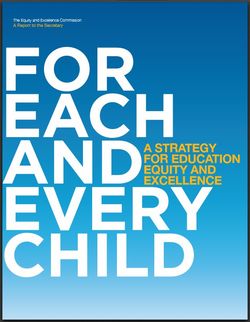 – American students are well below world student performance averages for developed countries (before 1965 we used to be in the top tier in education).
– 27 developed countries do better than America in global rankings
– Only one in five American students perform at or above world average.
– Mostly Asian and white kids rank average, but combining all students – predominantly with black and Hispanics – we fall below average.
– The performance levels of our students has been “roughly flat” for the last 40 years despite the enormous increase in education spending
– In poorly performing schools there is a preponderance of “weakly trained teachers”.
– Funds for education are allocated differently in different school districts because in the poorer zip codes there are more students who have ‘special needs’.
– But even well off zip codes don’t fare too well – e.g. Palo Alto students perform at the 67% world level.
– To fix the problem we require to put in place programs that yield an “equity” in student performance so that zip code does not determine students’ academic rank.
All of this is really not news, and has been discussed (revealed to some) on these pages for years. The real purpose of the commission and its report appears to be to launch a new initiative for increased federal control of funding for K-12 public schools. While at this time not asking for money directly, the injection of performance “equity” is the key for the forced conclusion. Equity quietly introduces a measurable figure of merit for directing additional funds and/or redistributing existing federal education funding from, say, Palo Alto to Oakland. Of course, equity can be achieved in several ways – the salutary method is to raise all kids to an appropriate distribution of higher level performance, the other is to find that equitable performance distribution closer to what now the blacks and Hispanics are able to deliver. Higher or lower, the correct goal in the transformed America seems to be equitable homogeneity.
With the release of this report a select group of its authors are making the media rounds. Today’s NPR Morning Edition featured three of them (podcast here). The report itself has some good insights, but when taken overall, there is nothing there that stands out from the same ol’ same ol’ of the last 40 years since we were ushered into the Great Society. What caught my attention beyond (re)introducing ‘equity’ into K-12, is the commission’s recommendation for “regionalization”. Upon closer reading, that seems to be another federal assault to remove control over matters of education from local school jurisdictions. The report concludes with –
The commission’s report provides a five-part framework of tightly interrelated recommendations to guide policymaking:
• Equitable School Finance systems so that a child’s critical opportunities are not a function of his or her zip code;
• Teachers, Principals and Curricula effective enough to provide children with the opportunity to thrive in a changing world;
• Early Childhood Education with an academic focus, to narrow the disparities in readiness when kids reach kindergarten;
• Mitigating Poverty’s Effects with broad access not only to early childhood education, but also to a range of support services necessary to promote student success and family engagement in school; effective measures to improve outcomes for student groups especially likely to be left behind—including English-language learners, children in Indian country or isolated rural areas, children with special education needs, and those involved in the child welfare or juvenile justice systems; and
• Accountability and Governance reforms to make clearer who is responsible for what, attach consequences to performance, and ensure that national commitments to equity and excellence are reflected in results on the ground, not just in speeches during campaigns.
All this is heavy stuff, and promises little profit. To lighten your day, take a look at this video ‘Romancing the Wind’ of a truly uplifting hobby that invites virtuosity (be sure to have your speakers on).


 rebanesruminations.com
Leave a comment