
Rebane's Ruminations
February 2013
S M T W T F S
 12
3456789
10111213141516
17181920212223
2425262728  

ARCHIVES


OUR LINKS


YubaNet
White House Blog
Watts Up With That?
The Union
Sierra Thread
RL “Bob” Crabb
Barry Pruett Blog

George Rebane

In my scratch file for blog topics, items on the flood of government lies are overflowing.  I was going to do an update post on the most egregious ones.  There are so many –
–    The new $9 minimum wage is going to boost the economy.  If so, why stop at $9?  Instead it will compete for the biggest job killer for the poor and minorities.  But then, Obama is making that a tough competition with all of his job killers lined up.
–    Obamacare’s expenses will kick deficits into overdrive; there is not ONE part of its advertised benefits that is turning out to be true.
–    Gun violence is growing in the land, and guns need to be confiscated – if not actually, then constructively (q.v.).  Federal crime statistics show that both violent crime and crime involving guns have both dropped over an astounding 50% in the last 20 years.  The fawning lamestream is predictably silent.
–    SecTreas nominee Jacob Lew is competing with SecDef nominee Hagel as to which is the dumbest and least informed for the job.  Lew’s $1M bonus from Citi, while it was on its ass and a ward of the state, was outrageous in itself.  But its immediate deposit in a Cayman Islands account drew crickets from the lamestream that was busy pillorying Romney for putting his own money into the same accounts.
–    Meanwhile Team Obama is occupied handpicking sequester cuts so that it would most impact ordinary Americans and then blame the Repubs.  Totally out of consideration are the legions of government double-dummies who work on the reams of new federal regulations and their enforcement to make sure that our economy remains crippled into the indefinite future.   In one of his biggest current lies, Obama publicly denies that it was he who introduced the sequester provision into last year’s budget negotiations.
–    And on and on and on.

So instead of the ongoing government lies, prevarications, and deceptions, let’s consider something much more pleasant – end of life on earth as we know it.
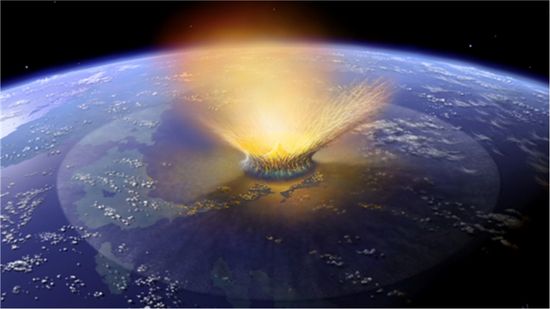
Nemesis
This past week we had two rocks from who knows where catch our attention.  Well, one (named 2012-DA12, about 150 ft diameter) was predicted and caught our attention by whizzing by within the orbit of our geo-synchronous satellites (about 22K miles), and the other put about 1,100 central Asian Russians into emergency rooms with various injuries.  That last rock arrived unannounced at 33K mph, from a radically different radiant (below) than the flyby, and exploded with an energy release that they are still trying to calculate as they figure out the damage done to buildings in the Chelyabinsk region.

All this brought to mind the 1908 Tunguska asteroid(?) explosion that leveled trees in a 20 mile radius of uninhabited Siberian forests, and is reckoned to have had a yield of 17 megatons of TNT (or about 1,000 times more powerful than the Hiroshima bomb).  It is safe to say that almost all humans within at least 20 miles of such an airburst would have been killed.  And, of course, no one knew it was coming, which opens an important topic area in itself.

For more on why we’re not spending enough resources looking out for the next Tunguska, or the Chelyabinsk surprise, or the DA12, see Russ Steele’s post here.  Here in the following I want to play with a little data that will allow us to calculate some odds of imminent death and destruction.  BTW, this is a good exit point for those readers who don’t do numbers.


First, meteor showers (comets, asteroids, rocks, …) are said to arrive from a point in the sky called the radiant.  Standing in one spot under a night sky during a meteor shower, you actually see meteor trails that appear to come from or radiate from a single point if you trace back the bright lines they leave in the sky.  DA12 and the Russian firecracker had widely different radiants, therefore they were not part of the same swarm of rocks among which some may still be on the way.  To the best of our knowledge, each one was a solo performance.

So where do these soloists come from and what kinds of ‘performances’ can we expect to witness in the coming years?  Astronomers tell us that many of them originally came from the asteroid belt that is between the orbits of Mars and Jupiter – there are gazillions of rocks in orbits around there, the largest one is the 950 mile diameter ‘dwarf planet’ called Ceres.  Other places that give rise to comets and such stuff are the Kuiper Belt and the Oort Cloud.  The Kuiper Belt is a bunch of orbiting hunks of icy rocks that starts just beyond the orbit of Neptune and reaches out to about 50AU from the sun (One Astronomical Unit is the distance from the Earth to the sun, about 93M miles.).  The Oort Cloud is another bunch of rocks orbiting way beyond the orbit of Pluto that may reach out to 1.5 light years from the sun.

Anyway, every once in a while another passing star or alignment of the larger planets may destabilize the orbits of certain rocks, sending them careening toward the sun with the possibility of hitting Earth.  The icy rocks that do this on a regular basis are called comets.  The bottom line here is that Earth’s orbit is still intersected by literally millions of such rocks of various sizes.  I say ‘still’ because in the old days, billions of years ago, the place was lousy with this detritus left over from the planets’ accretion, and the planets and their moons were being impacted constantly with asteroids – just look at the moon.  Now things have gotten a little more quiet as the planets and sun have had time to vacuum up a lot of the stuff, thereby reducing the density of these objects in the solar system.  But there are still millions of them out there.

So what’s been going on lately, say, in the last half a billion years or so (the Earth is about 4B years old)?  Well, astronomers and their math buddies have been calculating the arrival rates of various sizes of these rocks (we all know about the dinosaurs 66M years ago), and they’ve discovered an unsurprising and thankful relationship between such rates and rock sizes – the impact frequency goes down as the rocks get bigger, or frequency = K/diameter^3 where K is a constant.  On the average a Hiroshima size asteroid impacts earth every five years or so releasing about 16K tons of energy.  Tunguska sized events releasing around 16M tons come about every 1,900 years or so.  Bigger ones less frequently as we remember that a so-called Nemesis event occurred about 66M years ago.  A Nemesis event would wipe out all human life on earth.

So how can we tie a bow around the scenario of Earth cruising through this gauntlet of space junk that is constantly whizzing by us, with some of the pieces big enough to end human life on the planet?  Well, let’s start with the piece ‘A Warning From the Asteroid Hunters’ by two credentialed techies Ed Lu and Martin Rees in the 14feb13 WSJ.  Read the piece and come away with their bottom line, “The chance of another Tunguska-size impact somewhere on Earth this century is about 30%.”  What does this mean?  We have 87 years left in this century, if nothing of that sort would happen and the year is 2099, is the probability almost one out of three that a Tunguska or larger asteroid will hit Earth in the next twelve months?  If that’s not true, can we still say in 2099 that “The chance of another … is about 30%.”?

Now we get to the tricky part, and it’s important to pay attention because what we will consider is important for understanding other kinds of things that may or not occur in the future.  Start with thinking about probability as, say, a bunch of sand.  30% probability is a bag of sand that weighs an agreed upon amount.  So when Lu and Rees make their above claim, that means that we can take the ‘30% of sand’ and spread it evenly over the next 87 years of calendar time.  Evenly is the key word here, because that means that every year gets 1/87 of the sand, and represents a probability of (30/87)% = 0.345% that the impact will occur in any given of the 87 years in the future.  If we want to know what the probability is for any two year period, then we take 2*0.345% and get 0.69% for the impact occurring in that period, and so on.

Spreading the sand (probability) evenly across the years means that we have no more information about one of those years being a more likely recipient of an asteroid than any other year.  But here’s a key point – we’re doing all this in 2013, the year we were informed by the experts Lu and Rees.  But they have left us in a bit of a quandary.

Next year in 2014, after an uneventful 2013, is the probability of a Tunguska event in the remaining 86 years still 30%, or has it been diminished by an 1/87th and is now only 29.66%?  In other words have we redistributed the 1/87th sand from 2013 over the remaining years, or have we discarded it to compute the remaining risk that we still face in this century?

Well, it all depends on the type of process (asteroids whizzing by Earth) that we are observing.  If we reliably know that there is a certain cohort of available asteroids coming by Earth in the next 87 years, and there is a 30% chance that at least one of them will hit us, and that no succeeding information dispels that knowledge, then we have to redistribute every year’s sand over the remaining years of the century when an uneventful year passes.  And in 2099 all the sand will have wound up piled in that year, making it 30% likely that the remaining asteroid(s) will impact in those twelve months.

But there is no reasonable basis for knowing of a certain cohort of such asteroids (we haven’t even seen all of the dangerous ones), all we know is that asteroids of a certain (Tunguska) size and bigger are heading toward us at various rates determined by their size as described above.  In other words, a process is ongoing of darts being thrown at us by a thrower whose aim is such that he has a 30% chance of hitting us at least once during the next 87 years.  And that process will be unchanged the next year, and the year after that, etc.

In technical terms, this process is memory-less.  In 2014 the thrower is not affected by the fact that he either hit us or missed in 2013, and the same for 2015 and so on.  The thrower’s accuracy is unchanged as the years pass.  How do we deal with that?

We do that by recognizing that the impact arrivals are what is called a Poisson process (q.v.).  Skipping the very interesting math involved, this means that this uneventful year’s (probability) sand is not distributed over the remaining 86 years, but is placed in its entirety into the year 2100.  Doing that allows us to make the same statement at the beginning of 2014, namely, ‘The chance of another Tunguska-size impact somewhere on Earth during the next 87 years is about 30%.’

Another way to view this process is that there’s a bag of probability sand with a hole in it, moving forward 87 years in the future and dropping (30/87)% of sand into each new year as it comes up.  And behind us we lose or forget about the sand that was
sprinkled onto the year that just passed.  So at all times we are looking ahead at 87 years of probability sand that totes up to a 30% chance of at least a Tunguska impact.  (In technical terms, the probability of the impact event in any given year is statistically independent of that probability in any other year.)

But that means that sand is drizzling out at a given and constant rate.  What is this rate, and can we use it to answer more questions?  Let’s first calculate this constant rate using the discrete approach of so much sand (probability) being dropped into each year.  Let this amount of probability sand be called s.  Then the probability that the impact WILL NOT happen in any given year is 1-s (we’re now dealing with the decimal equivalents of percents, i.e. 1 = 100%).  And the probability that there will be no impact in any two given years is (1-s)*(1-s) = (1-s)^2 (the little ^ means exponentiation, like in 4^2 = 16).

In this manner we can express the probability that no impact will occur in 87 years as (1-s)^87.  Of course, the probability that such an impact WILL OCCUR at least once in 87 years, the next 87 at that, will be the complement of the previous probability that an impact WILL NOT OCCUR during that time, or simply 1 –  (1-s)^87.  This is clear because the total possible outcomes are just two, the impact will or will not occur, that’s it, and the probabilities of those two mutually exclusive contingencies must add to a certainty which is 1 or 100%.  And furthermore, Lu and Rees tell us that the impact probability for the next 87 years is 30% or 0.3.  This gives us the equation 0.3 = 1 –  (1-s)^87 we need to solve for s, the probability drizzle rate for an impact in any given year.  I’ll save you the trouble and give the answer, s = 0.0041 or 0.41% per year.

This probability rate number summarizes what we know about the chances of a Tunguska or larger event at any time in the future.  Why?  Because we’re not limited to using 87 years as the only interval of interest.  We know the value of s is unchanging, probability sand dribbles out at a constant rate whether over 87 years, or 10 years, or 500 years.  For example, what is the probability that such an impact will occur some time during the next decade.  That is calculated as 1 – (1 – 0.0041)^10, and it equals (the envelope please) 0.04 or 4% or one chance out of 25.

An interesting question is to use our equation to ask ‘in what future interval is the chance 50-50 that we’ll be hit by a Tunguska or bigger asteroid?’  That requires us to solve 0.5 = 1 – (1 – 0.0041)^N for N, the number of years.  Again I’ll do the algebra and tell you that N = 169 years.  These results may give everyone a breather that such an impact will even be witnessed by very many people now alive, let alone become one of its victims.

Oh, you now ask what’s my chance of being killed by such a rock impacting at tens of thousands of miles per hour?  Well, if everyone within a 20 mile radius dies, and the asteroid can hit randomly anywhere on Earth, then the probability that you will die, given an impact, will be the area of a 20 mile radius circle divided by the surface area of the Earth.  This is just (pi*20^2)/(4*pi*3957^2) = 0.0000064 or a little more than 6 chances out of a million.  Assuming that you live out the entire coming 87 years, your chances of being killed by a Tunguska like event is 0.0000064*0.3, or about 2 chances out of a million.  Go back to bed.

Posted in , , , ,

22 responses to “Scattershots and Asteroids”

  1. Ryan Mount Avatar

    The new $9 minimum wage is going to boost the economy. If so, why stop at $9?
    The whole minimum wage issue is very ambiguous, to say the least. Hikes, as we’re discussing here, are almost completely arbitrary and have no study behind them. They’re typically made the way teenagers make decisions.
    It would be best to study all sectors when considering a minimum wage hike, for starters: what about self-employed people? People who mow laws? get it? Probably not.
    Let’s be honest here. We’re the public hears minimum wage, they’re thinking McDonald’s. Which is really the last/worst place to start the discussion as it is easily the most inelastic sector (Fast food) on planet Earth. In other words, raising the minimum wage for the average McDonald’s worker to even $15/hour would barely impact what economists call “textbook” minimum wage employment either way as people who go through drive thru [sic] will happily pay $.45 more for their cheeseburger. Would they be willing to pay $3.00 for a cheeseburger so we could raise Minimum wage to @$25/hour (I’m just making numbers up here to make a point), no. Probably not. So there are limits and considerations.
    But the point is the way we go about the minimum wage issue is really irrational and sloppy and lazy and frankly very paternalistic.

    Like

  2. Ryan Mount Avatar
  3. Bill Tozer Avatar
    Bill Tozer

    Dr. Rebane, I relish the opportunity to ponder the end of life on Earth as we know it. Might put a damper on gifts to Pachamama. She is considered at good deity and some call her Mother Earth. After all, it is Carnival Season in Columbia at this very moment. Besides messing up a perfecting good Carnival Celebration and a perfectly good cup of java, I hope the end of life on Earth as we know it is a lot more exciting and newsworthy than that Mayan Calender yawn or another Fiscal Cliff dud. Bring it on.

    Like

  4. Bill Tozer Avatar
    Bill Tozer

    Mr. Mount. Just a tiny FYI: A McDonalds in North Dakota is advertising jobs for 15 bucks an hour and can’t fill its needs with workers. Seems all the working folk are out in the fields extracting fossil fuel out of the ground and rolling in cash. Well, not all. Others are busy slapping up housing as fast as they can while roughnecks sleep in the Walmart parking lot for lack of available housing. Don’t think 15 bucks an hour is even a reasonable starting point there considering.

    Like

  5. George Rebane Avatar

    BillT 727am – an excellent point Mr Tozer. For fullest employment and the best allocation of investments, let market price communicate need and value. But for a politician there’s nothing like the surety of a guaranteed vote bought and paid for by a desperately needed transfer payment.

    Like

  6. Russ Steele Avatar

    Why President Obama keeps the press away – playing golf with Tiger Woods doesn’t look good with 12 million Americans out of work and a $16 trillion debt
    It is not hard to see why Barack Obama is rather camera shy over his latest golfing outing, this time with sports superstar Tiger Woods. The optics certainly don’t look good for a president who has in the past called on Americans to make sacrifices, while blatantly refusing to do so himself. It’s certainly not an image the president wants to project to the 12.3 million Americans who are out of work, or the millions more who are also seeking full-time employment. Nor does it suggest he is serious about reining in the $16.5 trillion of debt his government owes, $6 trillion of which was racked up in his first term of office. Flying Air Force One to Florida at a cost of about $180,000 per hour hardly sends the right message to US taxpayers, who have just seen their payroll taxes go up.

    Like

  7. Scott Obermuller Avatar

    The minimum wage is an ongoing joke. As noted, it is mainly a political talking point for politicians who wish to appear as though ‘they care’. The best part of the free market is the flow of information as to the relative value of goods and services. This is why commodity brokers are so important. The left see them as capitalist pigs that needlessly drive up the cost of goods. What they are doing is providing society with an accurate, honest assessment of the value of a good. The same is true with labor. If a person’s wages and benefits were left solely to the willing buyer and seller, we would have an accurate picture of what any individual’s time is worth. If a 25 year old discovered that they were only worth $1.00 an hour to all employees, it would inform that worker in no uncertain way that they were not making themselves very useful to society and they had better improve their skills. Or re-locate to an area that actually needed their labor. The left finds this unacceptable as they feel that a person’s time is worth only what a govt minder determines it to be. Not too low and certainly not too high. Just right. While they are at it, why not have the govt hire another army of paper pushers to determine the ‘fair’ price of goods? It certainly worked well enough for decades in the USSR.

    Like

  8. Scott Obermuller Avatar

    Sorry – ‘to all employees’. I meant employers.

    Like

  9. Ryan Mount Avatar

    The Minimum Wage debate is just more fodder for this nation’s disembrained. If the pro-minimum wage crowd was truly serious, and I think they’re not, they’d be advocating for something around $20/hr.
    There really isn’t any debate per se, just a lot of hot air. I’m not implying that increases don’t impact business owners, quite the contrary. I’m just saying that’s it’s a complex issues with many factors that need to be considered, notably as I mentioned above, an examination of market sectors and their “elasticity” for starters. But it’s just easier to generalize, I suppose.
    And Mr. Tozer, not sure if I’ve mentioned it here or not, but my friends in the HR business often tell me that one of the chief impediments to employment these days, which did not exist with previous American generations, is worker mobility. That is, people with lower skills are refusing to move to where the work is, like North Dakota.

    Like

  10. George Rebane Avatar

    RyanM 1029am – It is indeed a “complex issue” as you point out. And government does most harm when it attempts to interject itself into complex societal issues, and doubly so when it shoots out diktats that cover the land in a one size fits all fashion. Another progressives’ wet dream fulfilled.

    Like

  11. Bill Tozer Avatar
    Bill Tozer

    Mr. Mount, another thing I have yet to consider, i.e., a mobile workforce, or as you pointed out, an immobile workforce. Suppose the price of gas and eating on the road might have something to do with it. Or maybe the inability to sell one’s home. HR people? I call them Personnel folk just to see their faces turn a shade of red and their jaws clinch. But I digress.
    A little boring personal story is that I moved here in 1988 and for the first couple or so years I took my show on the road. Had to. That’s where the money was. I believed then to go where the work was. I soon raised children alone and that changed my tune about taking off for a couple months at a time. By 1992 I was working at minimum wage here in Nevada County. But I never stayed at minimum wage very long and never ever asked for an increase in compensation. I am rather thick at times and I just assumed if you are the first one in and last one out and fill the time in between with tasks besides sucking air, then you automatically will be offered more mula within a week. Can’t tell ya how many times I was told that I will get 50 cents an hour more or a buck an hour more if I show up tomorrow. That was usually by day 2. And how many raises I got without asking if I stayed 3 months.
    Those were fun times, I tell ya. Would I want to go back to those days? Nope. Would I do it in the future? You bet! Just bought a nice little short sale on 10 acres for cheaper than the price of rent. I would take my show on the road to keep cracking the monthly nut now that the youngest is 20 and working in South America. But, that is just me and I am the last guy to have an true sense of my worth….I suppose I am paid according to the worth somebody else places on me. Rambling is over, enjoy Presidents Day in one form or another, Mr. Mount.

    Like

  12. Russ Steele Avatar

    Bill@11:40AM
    I was born in Nevada County and grew up here and places were my Dad could find work, or in some case a high paying job. In the Summer of 1949 my Dad was logger, he fixed up a surplus WWII Army 6×6, welding the log bunks, and became a contract log hauler. In June the Forest Service shut down logging in the National Forest due to the fire danger. He found a job in Idaho at a Cobalt mine. A few years latter we moved back to Nevada County and dad when back into the logging business, which collapsed in the late 50s and we went back to Idaho. When the mine closed, we moved again. Dad would look for potential jobs in newspaper, hop a bus to where the job was, get hired, find us a place to live, and then send for the family. This happened, time and time again through out my Dad’s life. He went where the jobs were and then moved his family. After I jointed the Air Force, I never came home to the same place on visits. He supervised building ships in both Washington, South Viet Nam, Chile and Puerto Rico and tested welds on the Alaska Pipe Line, to name just a few. If I were a young man without a job, I would be on my way to North Dakota.

    Like

  13. Joe Koyote Avatar
    Joe Koyote

    Does anybody in here think that employees would have ever gotten a 40 hour work week or 8 hour day standardized without organized labor? The pacific rim sweatshops often require 14 hour days and 6 day weeks or more in rush situations. In France they have a 32 hour work week and a mandatory 2 week paid vacation. Here vacations are a benefit and not required. The average American only takes one week off a year. Should we even care about the standard of living in the working classes or are they just another commodity like high fructose corn syrup to be bought at the lowest possible price and their efforts sold at the highest? Should they just be happy with Taco Bell, a big screen TV, and working until the day they die, or is there more to life?

    Like

  14. Bill Tozer Avatar
    Bill Tozer

    Thank you Mr. Steele. I drove by the Cobalt Mine region about 3 years ago on my way to Glacier. Stomped around that area a lot in the early 70’s..revisited the old crossroads and I suppose you can’t expect it all to be the same I remembered after a few decades. Noticed Coeur d’Alene now looks like Westlake Village in Southern Cal or some yacht club. No thanks. Oh well.
    Good point about your Dad. Loved it that he would hop the Greyhound. I would hitchhike sometimes. I made my choice when the girls were just little things to stay put. Tried doing long 4 day weeks in Reno and Modesto, but it caused problems. Couldn’t leave them with their mother (neither safe nor healthy) and my family was great, but it became a burden on them as well, despite their selfless sacrifices and love. Plus the girls missed me terribly. Wished they still felt that way, hahaha.
    Know a guy about 50 who was losing his house and truck over in Clear Lake. He bit the bullet and headed to North Dakota. He came back after 3 months with enough to keep it all together. Not much happening around Lakeport (or Nevada County) in his trade, so he rested up, insulated his camper, and headed back to the Dakotas until the economy turns around.
    I made my decision to stay put and provide a stable nest for the little ones. Best decision I ever made. Plus I was getting burned out on the road and even company paid motels and hotels and luxury suites gets very old. But, as you said, if I was a young man I be heading to where the work is, be it North Dakota or the UAE or Thailand.

    Like

  15. Ryan Mount Avatar

    Does anybody in here think that employees would have ever gotten a 40 hour work week or 8 hour day standardized without organized labor?
    How many work hours a week do the unemployed current get to enjoy? Pardon the snark. That’s the point you’ll hear from those(fiscal Conservatives, Classical Liberals and Milton Friedman to drop a name) who think minimum wage is a dumb idea. Including me. At a minimum there should be no set minimum wage (or a very low one) for dependent teenagers.
    Frankly I think the solution is a crap or get off the pot one: we either need to get rid of it or make real(set to some real standard of living) and live with the inflationary consequences. But what we have right now is somewhat a cruel joke. It’s enough to keep the minimum wage earner quiet and complacent.

    Like

  16. George Rebane Avatar

    JoeK 135pm – “Does anybody in here think …” Absolutely. It may not have been exactly the 40 and 8 numbers, but darn close. Clearly the 10 hour days, 6 days a week was too much; not enough time to consume, and too short of a working life. In their own self-interest, employers competing for qualified labor would have offered better terms to workers. The shorter work hours would have automatically spread appropriately to the less skilled jobs. (And France’s short 32 hour week doesn’t work; the country is sliding into fiscal chaos.)
    The ivory tower progressives may be interested to know that America’s highly talented employees have never enjoyed 40/8 work weeks. Somehow the vaunted unions never provided such benefits to the job makers and their salaried employees who kept their businesses competitive. Personally, I don’t recall ever enjoying a 40/8 work week during my half century in the saddle. The guys who did probably became Democrats 😉
    And “caring” about the standard of living of “working classes” sounds a bit like another preamble to central planning. Unleashing commerce for achieving its potential to grow would create the greatest demand for jobs and talents of all kinds. It would also point people to what they should be learning to get their next better job. And those who cannot or will not rise above commodity talents, should be paid commodity wages. What would you suggest as an alternative that doesn’t recreate the sit-on-your-ass culture that we have in our workforce now?

    Like

  17. Scott Obermuller Avatar

    re Joe the K at 1:35 – ‘ In France they have a 32 hour work week and a mandatory 2 week paid vacation.’ And France is doing so well, financially. Current unemployment is 10.6% and climbing. http://ycharts.com/indicators/france_unemployment_rate_lfs
    Farmers and self-employed rarely get anything close to 40 hour weeks. When I was painting for a living I worked every day if I had work. Sometimes 30 days at a stretch. 8 hour days were rare. My ‘paid’ vacations were in the winter when there was no work. My ‘unemployment pay’ came from my savings account. I didn’t want the govts ‘help’. I wanted work. The ‘working class’ seems to be the class that ‘works’ the least. My son in law hasn’t seen a 40 hour week in decades. But according to the left, he doesn’t even work. Some thing is bass-akwards here.

    Like

  18. Joe Koyote Avatar
    Joe Koyote

    Certainly small business owners, independent contractors, and the like work long hours well beyond a 40 hour week until and if they make enough money to hire help, and sometimes not even then. The family farm with truck crops, chickens, and ole Bessie don’t much exist anymore. The remaining small farmers are much like contractors in that they have busy times and slack times and specialize in a crop or two. I believe that the backbone of America was the small business, the mom and pops that have been replaced by big boxes.
    But not everyone is a risk taker, is intelligent enough, or can raise enough capital to start a business. I don’t think very many people choose to work at Walmart at low wage no benefit jobs with little to no opportunity for advancement. They have little choice, most of the good jobs are gone. Oh, but they can retrain themselves. How many lower economic ladder folks can afford an education especially since Pell grants, etc. are being scaled back significantly? Trader Joes full time employees start at $40k with full benefits. Maybe they follow the Henry Ford model of capitalism rather than the Walton family model. I think more Henry Fords and less Waltons would go a long way in solving our economic woes.

    Like

  19. Ryan Mount Avatar

    I don’t think very many people choose to work at Walmart at low wage no benefit jobs with little to no opportunity for advancement.
    [face palm] Please document in detail how we might provide for these people. That’s all most reasonable people are asking for. Provide. Specific. Detail. With specific goals. God damn it.[it’s hard not to be pissed as such disorganization]
    I would happily support such measures on top of my already generous tax contributions. As long as it doesn’t get to “hippie” as we say here at IBM: measurable and specific success metrics.
    Please provide and I will happily support. I’ll take my answers off-air.

    Like

  20. Bill Tozer Avatar
    Bill Tozer

    JoeK: What is missing here is the upward mobility of the American worker. Dr. Rebane has posted several articles with stats from our own Labor Department that show people stay at minimum wage jobs for a very short period of time during their working careers. They move up and out of the bottom tier. You make it sound like minimum wage earners are stuck for life or somehow the lowest income earners are the so called “middle class”. Neither premise is true.
    Workers drop in and out of various income tiers throughout their lives. A high school kid may start as an usher at the movie theater, finds a trade or skill set, move up, enter his peak earning years and then enter his final years on SS, making less than minimum wage. Life happens. Central planners among others give no leeway for life altering events. One size does not fit all. The problem with human nature is that when things are going good, we somehow think they will always be this way. And when things go south, we somehow think it is worse than it actually is. That kind of broken thinking is based upon emotion, not fact or probabilities. I have gone from a buck 45 an hour to 1800/week by 1983, back to $5.50/hour in 1992 to my middle class wage now. My self employment years followed the same up and down path as well. Don’t need laws to pay me more for pumping gas. Few gas pumpers left anymore. I needed to hit the pavement and change my life. When my thinking changed, many things in my life changed, including income.

    Like

  21. Scott Obermuller Avatar

    “I don’t think very many people choose to work at Walmart at low wage no benefit jobs with little to no opportunity for advancement.”
    I’ve been to Wally-World a few times and the place is crawling with employees. Seems as though quite a few folk do, in fact, choose to work there. And they do offer benies. There are plenty of folk with low IQs making piles of money. For starters – check out east Texas or North Dakota. The weather is crap in both places, but high school drop-outs are making very good money. As far as the ones that ‘aren’t risk takers’ – well too bad for them. Hunger has an amazing effect on that quirk of nature. As long as they can tell the social worker that they just don’t seem to be able to take the ‘risk’ of getting up at 6am and hitting the streets, then the govt provides an easier way. Of course you have to have a ‘progressive’ govt.

    Like

  22. Russ Steele Avatar

    WSJ:
    “The meteor that crashed to earth in Russia was about 55 feet in diameter, weighed around 10,000 tons and was made from a stony material, scientists said, making it the largest such object to hit the Earth in more than a century.”
    Happens about every 100 years say the scientist. Are we done now for another 100? Not really, the next one can fall tomorrow.

    Like

Leave a comment