

George Rebane
In my scratch file for blog topics, items on the flood of government lies are overflowing. I was going to do an update post on the most egregious ones. There are so many –
– The new $9 minimum wage is going to boost the economy. If so, why stop at $9? Instead it will compete for the biggest job killer for the poor and minorities. But then, Obama is making that a tough competition with all of his job killers lined up.
– Obamacare’s expenses will kick deficits into overdrive; there is not ONE part of its advertised benefits that is turning out to be true.
– Gun violence is growing in the land, and guns need to be confiscated – if not actually, then constructively (q.v.). Federal crime statistics show that both violent crime and crime involving guns have both dropped over an astounding 50% in the last 20 years. The fawning lamestream is predictably silent.
– SecTreas nominee Jacob Lew is competing with SecDef nominee Hagel as to which is the dumbest and least informed for the job. Lew’s $1M bonus from Citi, while it was on its ass and a ward of the state, was outrageous in itself. But its immediate deposit in a Cayman Islands account drew crickets from the lamestream that was busy pillorying Romney for putting his own money into the same accounts.
– Meanwhile Team Obama is occupied handpicking sequester cuts so that it would most impact ordinary Americans and then blame the Repubs. Totally out of consideration are the legions of government double-dummies who work on the reams of new federal regulations and their enforcement to make sure that our economy remains crippled into the indefinite future. In one of his biggest current lies, Obama publicly denies that it was he who introduced the sequester provision into last year’s budget negotiations.
– And on and on and on.
So instead of the ongoing government lies, prevarications, and deceptions, let’s consider something much more pleasant – end of life on earth as we know it.
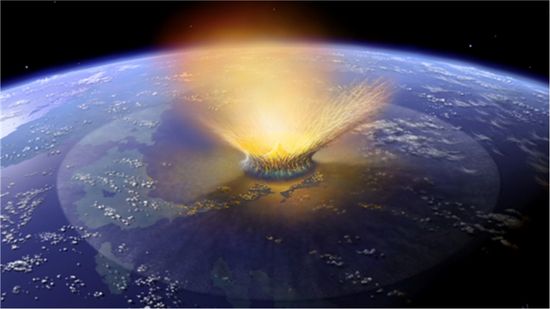
This past week we had two rocks from who knows where catch our attention. Well, one (named 2012-DA12, about 150 ft diameter) was predicted and caught our attention by whizzing by within the orbit of our geo-synchronous satellites (about 22K miles), and the other put about 1,100 central Asian Russians into emergency rooms with various injuries. That last rock arrived unannounced at 33K mph, from a radically different radiant (below) than the flyby, and exploded with an energy release that they are still trying to calculate as they figure out the damage done to buildings in the Chelyabinsk region.
All this brought to mind the 1908 Tunguska asteroid(?) explosion that leveled trees in a 20 mile radius of uninhabited Siberian forests, and is reckoned to have had a yield of 17 megatons of TNT (or about 1,000 times more powerful than the Hiroshima bomb). It is safe to say that almost all humans within at least 20 miles of such an airburst would have been killed. And, of course, no one knew it was coming, which opens an important topic area in itself.
For more on why we’re not spending enough resources looking out for the next Tunguska, or the Chelyabinsk surprise, or the DA12, see Russ Steele’s post here. Here in the following I want to play with a little data that will allow us to calculate some odds of imminent death and destruction. BTW, this is a good exit point for those readers who don’t do numbers.
First, meteor showers (comets, asteroids, rocks, …) are said to arrive from a point in the sky called the radiant. Standing in one spot under a night sky during a meteor shower, you actually see meteor trails that appear to come from or radiate from a single point if you trace back the bright lines they leave in the sky. DA12 and the Russian firecracker had widely different radiants, therefore they were not part of the same swarm of rocks among which some may still be on the way. To the best of our knowledge, each one was a solo performance.
So where do these soloists come from and what kinds of ‘performances’ can we expect to witness in the coming years? Astronomers tell us that many of them originally came from the asteroid belt that is between the orbits of Mars and Jupiter – there are gazillions of rocks in orbits around there, the largest one is the 950 mile diameter ‘dwarf planet’ called Ceres. Other places that give rise to comets and such stuff are the Kuiper Belt and the Oort Cloud. The Kuiper Belt is a bunch of orbiting hunks of icy rocks that starts just beyond the orbit of Neptune and reaches out to about 50AU from the sun (One Astronomical Unit is the distance from the Earth to the sun, about 93M miles.). The Oort Cloud is another bunch of rocks orbiting way beyond the orbit of Pluto that may reach out to 1.5 light years from the sun.
Anyway, every once in a while another passing star or alignment of the larger planets may destabilize the orbits of certain rocks, sending them careening toward the sun with the possibility of hitting Earth. The icy rocks that do this on a regular basis are called comets. The bottom line here is that Earth’s orbit is still intersected by literally millions of such rocks of various sizes. I say ‘still’ because in the old days, billions of years ago, the place was lousy with this detritus left over from the planets’ accretion, and the planets and their moons were being impacted constantly with asteroids – just look at the moon. Now things have gotten a little more quiet as the planets and sun have had time to vacuum up a lot of the stuff, thereby reducing the density of these objects in the solar system. But there are still millions of them out there.
So what’s been going on lately, say, in the last half a billion years or so (the Earth is about 4B years old)? Well, astronomers and their math buddies have been calculating the arrival rates of various sizes of these rocks (we all know about the dinosaurs 66M years ago), and they’ve discovered an unsurprising and thankful relationship between such rates and rock sizes – the impact frequency goes down as the rocks get bigger, or frequency = K/diameter^3 where K is a constant. On the average a Hiroshima size asteroid impacts earth every five years or so releasing about 16K tons of energy. Tunguska sized events releasing around 16M tons come about every 1,900 years or so. Bigger ones less frequently as we remember that a so-called Nemesis event occurred about 66M years ago. A Nemesis event would wipe out all human life on earth.
So how can we tie a bow around the scenario of Earth cruising through this gauntlet of space junk that is constantly whizzing by us, with some of the pieces big enough to end human life on the planet? Well, let’s start with the piece ‘A Warning From the Asteroid Hunters’ by two credentialed techies Ed Lu and Martin Rees in the 14feb13 WSJ. Read the piece and come away with their bottom line, “The chance of another Tunguska-size impact somewhere on Earth this century is about 30%.” What does this mean? We have 87 years left in this century, if nothing of that sort would happen and the year is 2099, is the probability almost one out of three that a Tunguska or larger asteroid will hit Earth in the next twelve months? If that’s not true, can we still say in 2099 that “The chance of another … is about 30%.”?
Now we get to the tricky part, and it’s important to pay attention because what we will consider is important for understanding other kinds of things that may or not occur in the future. Start with thinking about probability as, say, a bunch of sand. 30% probability is a bag of sand that weighs an agreed upon amount. So when Lu and Rees make their above claim, that means that we can take the ‘30% of sand’ and spread it evenly over the next 87 years of calendar time. Evenly is the key word here, because that means that every year gets 1/87 of the sand, and represents a probability of (30/87)% = 0.345% that the impact will occur in any given of the 87 years in the future. If we want to know what the probability is for any two year period, then we take 2*0.345% and get 0.69% for the impact occurring in that period, and so on.
Spreading the sand (probability) evenly across the years means that we have no more information about one of those years being a more likely recipient of an asteroid than any other year. But here’s a key point – we’re doing all this in 2013, the year we were informed by the experts Lu and Rees. But they have left us in a bit of a quandary.
Next year in 2014, after an uneventful 2013, is the probability of a Tunguska event in the remaining 86 years still 30%, or has it been diminished by an 1/87th and is now only 29.66%? In other words have we redistributed the 1/87th sand from 2013 over the remaining years, or have we discarded it to compute the remaining risk that we still face in this century?
Well, it all depends on the type of process (asteroids whizzing by Earth) that we are observing. If we reliably know that there is a certain cohort of available asteroids coming by Earth in the next 87 years, and there is a 30% chance that at least one of them will hit us, and that no succeeding information dispels that knowledge, then we have to redistribute every year’s sand over the remaining years of the century when an uneventful year passes. And in 2099 all the sand will have wound up piled in that year, making it 30% likely that the remaining asteroid(s) will impact in those twelve months.
But there is no reasonable basis for knowing of a certain cohort of such asteroids (we haven’t even seen all of the dangerous ones), all we know is that asteroids of a certain (Tunguska) size and bigger are heading toward us at various rates determined by their size as described above. In other words, a process is ongoing of darts being thrown at us by a thrower whose aim is such that he has a 30% chance of hitting us at least once during the next 87 years. And that process will be unchanged the next year, and the year after that, etc.
In technical terms, this process is memory-less. In 2014 the thrower is not affected by the fact that he either hit us or missed in 2013, and the same for 2015 and so on. The thrower’s accuracy is unchanged as the years pass. How do we deal with that?
We do that by recognizing that the impact arrivals are what is called a Poisson process (q.v.). Skipping the very interesting math involved, this means that this uneventful year’s (probability) sand is not distributed over the remaining 86 years, but is placed in its entirety into the year 2100. Doing that allows us to make the same statement at the beginning of 2014, namely, ‘The chance of another Tunguska-size impact somewhere on Earth during the next 87 years is about 30%.’
Another way to view this process is that there’s a bag of probability sand with a hole in it, moving forward 87 years in the future and dropping (30/87)% of sand into each new year as it comes up. And behind us we lose or forget about the sand that was
sprinkled onto the year that just passed. So at all times we are looking ahead at 87 years of probability sand that totes up to a 30% chance of at least a Tunguska impact. (In technical terms, the probability of the impact event in any given year is statistically independent of that probability in any other year.)
But that means that sand is drizzling out at a given and constant rate. What is this rate, and can we use it to answer more questions? Let’s first calculate this constant rate using the discrete approach of so much sand (probability) being dropped into each year. Let this amount of probability sand be called s. Then the probability that the impact WILL NOT happen in any given year is 1-s (we’re now dealing with the decimal equivalents of percents, i.e. 1 = 100%). And the probability that there will be no impact in any two given years is (1-s)*(1-s) = (1-s)^2 (the little ^ means exponentiation, like in 4^2 = 16).
In this manner we can express the probability that no impact will occur in 87 years as (1-s)^87. Of course, the probability that such an impact WILL OCCUR at least once in 87 years, the next 87 at that, will be the complement of the previous probability that an impact WILL NOT OCCUR during that time, or simply 1 – (1-s)^87. This is clear because the total possible outcomes are just two, the impact will or will not occur, that’s it, and the probabilities of those two mutually exclusive contingencies must add to a certainty which is 1 or 100%. And furthermore, Lu and Rees tell us that the impact probability for the next 87 years is 30% or 0.3. This gives us the equation 0.3 = 1 – (1-s)^87 we need to solve for s, the probability drizzle rate for an impact in any given year. I’ll save you the trouble and give the answer, s = 0.0041 or 0.41% per year.
This probability rate number summarizes what we know about the chances of a Tunguska or larger event at any time in the future. Why? Because we’re not limited to using 87 years as the only interval of interest. We know the value of s is unchanging, probability sand dribbles out at a constant rate whether over 87 years, or 10 years, or 500 years. For example, what is the probability that such an impact will occur some time during the next decade. That is calculated as 1 – (1 – 0.0041)^10, and it equals (the envelope please) 0.04 or 4% or one chance out of 25.
An interesting question is to use our equation to ask ‘in what future interval is the chance 50-50 that we’ll be hit by a Tunguska or bigger asteroid?’ That requires us to solve 0.5 = 1 – (1 – 0.0041)^N for N, the number of years. Again I’ll do the algebra and tell you that N = 169 years. These results may give everyone a breather that such an impact will even be witnessed by very many people now alive, let alone become one of its victims.
Oh, you now ask what’s my chance of being killed by such a rock impacting at tens of thousands of miles per hour? Well, if everyone within a 20 mile radius dies, and the asteroid can hit randomly anywhere on Earth, then the probability that you will die, given an impact, will be the area of a 20 mile radius circle divided by the surface area of the Earth. This is just (pi*20^2)/(4*pi*3957^2) = 0.0000064 or a little more than 6 chances out of a million. Assuming that you live out the entire coming 87 years, your chances of being killed by a Tunguska like event is 0.0000064*0.3, or about 2 chances out of a million. Go back to bed.


 rebanesruminations.com
Leave a comment