

George Rebane
[This is the transcript of my 4jan13 KVMR commentary. I last covered MOOCs in my 21aug12 post. This post has an addendum that explains in more detailed how intelligent MOOCs can be designed to deliver complex instructional sequences that are not available in traditional learning environments. ]
Let’s consider higher education for bit tonight, especially its cost, relevance, and the impact of learning technologies on traditional ways of delivering education products. Our post-secondary education and its graduates are the national jewel that affects every American’s quality of life. As a stake in the ground, consider that our population growth has slowed to under one percent per year, which still translates to adding almost 3M people annually. With demographic lags, we currently pump out about 4M young people a year into our job markets.
Everyone knows that they will earn more, the more post-high school education they get. And everyone is told they are college material, and are encouraged to borrow money and apply for scholarships to pay for college. This encouragement has been so successful that outstanding student loans now amount to over $1T nationwide. On the whole, it’s hard to see how much of this debt will be paid off given that many or most college students select majors that don’t teach marketable skills. The Atlantic reports that “53% of recent college grads are under- or unemployed”.
Distinguished professor Richard Vedder of Ohio University tells us, “In 2009, spending by Americans for post-secondary education totaled $461B, an amount 42% greater than in 2000, after accounting for inflation. This $461B is the equivalent of 3.3% of total U.S. gross domestic product (GDP) and an amount greater than the total GDP of countries such as Sweden, Norway and Portugal.”, adding that “…more than 17 million college graduates were ‘underemployed’ in 2008.” For many college graduates ‘Would you like fries with that?’ is a recurring theme across the land.
Many educators and employers, especially those who can’t find enough qualified workers, tell us that not everyone needs to go into debt getting a mushy major. Most high school graduates are not ready for a college education, and would do much better for their careers by learning a marketable skill set that is confirmed by various accepted levels of certification. And to do that, more and more young people and older workers needing to change careers are turning to online education and training courses. The acronym to remember is MOOC – massively open online course.
MOOCs are now being delivered by major universities like Harvard, MIT, Duke, and Stanford, and additionally through private companies like Udacity and Coursera, often founded by academics. MOOCs are free and open to the masses, and cover a widening range of subjects from the sciences to liberal arts. These online courses are taken by students from all over the world with tens of thousands attending a single course.
Most MOOCs don’t yet count for credit toward a degree, but that is also changing as methods are developed to allow students to take proctored exams. Venture capitalists have taken an interest, and are now investing in for-profit education companies that deliver MOOCs. The industry is still in its infancy, and, as reported in the 2jan13 WSJ, they are still looking for viable business models. Some candidate models incorporate job placement services to students who successfully complete courses.
In the meanwhile, there is some pushback from college presidents, many of whom are paid in the multiple millions per year. But I believe they will be swept aside as the demand for skilled workers dovetails with millions of people who want to upgrade their skills and get good paying jobs. MOOCs and new automated learning technologies will rapidly obsolete exorbitantly expensive institutions with gleaming student unions sporting steam baths and climbing walls, huge athletic programs, managed by top-heavy administrative staffs, and offering feel-good fields of study that aren’t worth a warm bucket of spit on the job markets.
Recall the ancient teachers lecturing their eager students in the shade of a tree. We look forward to thousands of teachers again teaching under the virtual trees of the internet, trees that can shade untold of thousands of students who will be more eager than ever to learn something useful.
My name is Rebane, and I expand on this and related themes on georgerebane.com where the linked transcript of this commentary is posted, and where such issues are debated extensively. However these views are not necessarily shared by KVMR. Thank you for listening.
[Addendum 5jan13] Some readers may find it hard to see what all the fuss is about MOOCs. Isn’t it just sticking a video camera in a lecture hall and recording the lecture and what’s written on the whiteboard? We’ve been doing that for years. And can’t we get essentially the same benefit from the careful reading of a well written book (codex) on the subject?
Well yes, that is one way to assemble and deliver a MOOC. But the real difference comes when we incorporate the full power and glory of a smart, interactive, multi-media teaching system which is anything but sticking a camera in a professor’s face. More advanced approaches like the Khan Academy already use some of these new teaching paradigms.
Actually, the paradigms are not all that new. The early ones began to be developed and tested during the 1970s, and video recorded lectures were pioneered in the early 1960s. (I took a course on the ‘Intellectual History of America’ at UCLA from the celebrated historian Page Smith in 1961, half of which was delivered as prerecorded lectures the class watched on monitors. This gave Dr Page the opportunity to meet with us in very small groups in places of opportunity which included under some magnificent trees on the beautiful campus.)
The minicomputers of the 1970s were still expensive, and the interactive graphic systems even more so. But the DoD had the money and the need to seek new and automated ways of teaching the military how to operate and maintain ever more complex combat systems. At the time my company was a leading researcher in the field of interactive computing, and we proposed some projects based on BF Skinner’s pioneering work in ‘programmed learning’. Long story short, we came up with some instructional paradigms which have now become quite common, and will give you an idea of where MOOCs are headed and beyond.
I’ve drawn a figure of a very simple flow diagram that illustrates how a topic can be broken into a collection of instructional elements (IEs) shown as squares, and tests (Ts) shown as diamonds. The topic to be taught is structured as a main instructional sequence of IEs, each IE followed by a test T. The tests are actually the ‘secret sauce’ in the entire interactive paradigm. If you pass the test, then you advance in the main sequence. However, every test can be failed in several different ways, and each way takes you onto a unique path of remediation depending on where you were having problems. The remedial paths are shown as branches ‘perpendicular’ to the main instructional sequence.
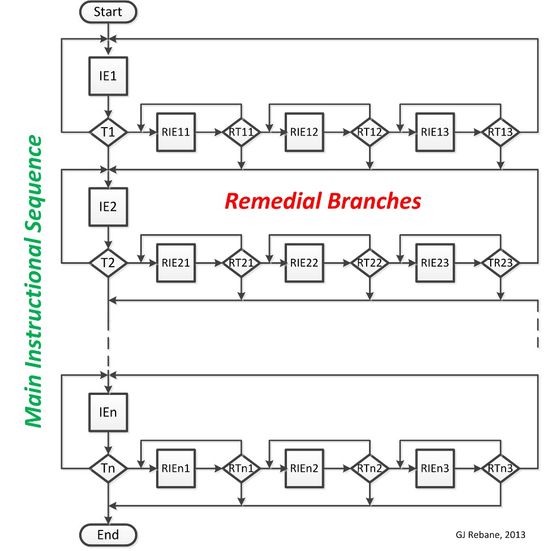
The figure shows a main sequence of an arbitrary number of n IEs. Depending on how you fail the follow on test, you may be shunted to retake the entire IE or onto a remedial sequence consisting of remedial IEs (RIEs). Each of these is again followed by a test (RT) which, if passed, may direct you back to the main sequence. Else, the student is directed repeat the RIE or to study the next RIE which is structured to give more detailed, different perspective, etc in the area where the student has problems. The testing is repeated as shown.
In this manner the entire course is taught in an automated interactive manner with intelligence built into every stage of instruction and testing. Various media, simulations, and advanced forms of interactivity can be integrated into every IE and T depending on the requirements of the taught subject and the level of expertise required for successful completion.
In the 1980s when computer controlled laser disc systems became much more affordable to produce and buy, my company was involved in the development of early automated training systems. One of the systems we developed for the Air Force was a complex F-16 engine maintenance trainer that used the full resources of the available media. The student could actually destroy the engine if he screwed up the correct maintenance procedure. One mode of destruction occurred when the incorrectly maintained engine was put on a test stand and exercised. The Air Force gave us a video of an actual engine exploding on the test stand to use in the appropriate test. This yielded a memorable experience for the student without blowing up a million dollar engine.
[9jan13 update] Here is more information on the growth, functions, and features of online educations from Dr Larry Press, professor of informatioin technologies at CalState (here), and the Washington Post (here).


 rebanesruminations.com
Leave a comment