

George Rebane
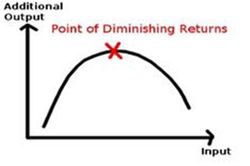 Another large impediment to making progress when attempting to reason with progressives is that their world lacks the reality of diminishing returns that accrue when any enterprise is taken past its optimum operating point, let alone being taken to an extreme. Most certainly the concept is no longer taught in schools as a short conversation with the public educated teenager of your choice will reveal.
This seminal truth about the liberal mind again displayed itself in recent debates on these pages that concern the looming fiscal cliff and bringing socialized healthcare to America. Preceding these issues has been the already decades long imperative to make our country insanely safe and risk free. Consumer advocacy groups, manned almost wholly by leftists, scream bloody murder when the next kid is injured, sickened, or killed on a playground or from his (usually) unusual use of a plaything.
Simple back of the envelope calculations (an inaccessible feat in this land) will quickly show that the rate or probability of occurrence of almost all such incidents is vanishingly small, but that makes no nevermind to the liberal brain. The clinching argument for overreaction is – ‘But what if s/he were your child?’ When presented as response, that clinching question is sure to draw a bevy of self-satisfied nods from a chorus of the like-minded. To liberal minds it appears that social policies are immune to the law of diminishing returns.
The notion underpinning this is the unfounded tenet that every life is of infinite worth, and we should not rest or leave any stone unturned in the attempt to save that last life. Well, a moment’s thought about how we put finite dollar values on lives all throughout our land should dispel that belief, but alas, that moments’ thought is never forthcoming. Instead, we go forward with a fistful of new laws, regulations, and litigation cases ‘to make sure that this tragedy never happens again.’ The overall cost to the common weal is never considered when the video of the injured child or the distraught/grieving parents is shown.
As an aside for the untutored in how human life is priced in our society, look no further than the calmly made decision to spend highway funds for decorative landscaping, instead of on, say, additional center divide barriers. Again, the back of the envelope lets us calculate how our road department puts a dollar value on human life. But that sacrifice to esthetics is invisible because the losses don’t occur right after the last roadside petunia is planted.
The same opacity is ever present (for reasons that completely elude me) in the healthcare field in which we lose about 100,000 lives annually due to what are simply called “medical mistakes”. It turns out that in this statistic, ALL of these mistakes could have been prevented. Nevertheless most of these mistakes occur year after year because – you guessed it – human life is not of infinite worth. (In fact, to some professions such ongoing mortality and morbidity come as a special blessing – any guesses which ones?)
An added facet of diminishing returns states simply that there comes a point in the attempt to achieve a realworld goal where the cost of marginal benefit starts going up, and skyrockets as we try to achieve that last percentage point of perfection. A particular weakness, here again revealed in the liberal mind, is the static analysis to predict tax returns that totally ignores/rejects the reality of the Laffer Curve (q.v.) – another expression of diminishing returns.
Our progressive brethren will not accept the reality that the last indigent, and probably many more, will still die in the street or alleyway, no matter what they do. But he’s willing to spend your last cent in the attempt to create a healthcare system that will save those poor and unfortunate souls whose number seems to grow with every passing month. (The original government figure of 9M, less than 3% of the population of those who want and don’t have healthcare, has now magically ballooned to almost 50M who are pining for healthcare they can’t afford. To correct that, the government will take over and mismanage another sixth of our economy.)
Socialized healthcare also takes the profit motive out of medicine. And as cited numerous times in my posts and by RR readers, this diminishes the level of care overall and devastates the advances that science and technology enterprises have brought to healthcare (compare EU and US developments and installations). Obamacare’s new and insane excise tax on medical devices is an a fortiori example of such policies.
So on one hand the liberal wants to equate healthcare with the right of breathing air, and on the other hand thinks that taxing the bejeezus out wealth creators will provide basic medical services to even the last percent of those living within our borders (note the absence of ‘citizens’ here).
As the share of GDP of every one of their social nostrums increases, the dedicated progressive just continues to cinch tighter his blinders, and rolls out another heart rending anecdote of a family home lost to medical bills and a child gruesomely killed on a playground structure. To their similitude of logic, that is sufficient to require more spending, litigation, and the constriction of individual liberties. The dictum served is that wherever risk is found or contemplated, it must be stamped out, even unto its last vestige.
Mathematician, former floor trader, and economic philosopher Nicholas Nassim Taleb (also of Black Swan fame) has some explosive new thoughts on the matter – well, mostly new, but never so well argued. In his just released Antifragile – Things That Gain from Disorder, he makes the case that successes in evolutionary development favored critters, plants, and systems in general that accepted chaos, disorder, and unpredictability, and responded by dynamically reacting and reconfiguring themselves to tolerate and thrive in such environments.
Things that are fragile or brittle call attention to themselves by breaking. Our wrong-headed reaction to that – now institutionalized by progressives – is to launch (usually futile) attempts to remake them so that they will become robust. Using tools from the systems sciences, Taleb points out that robustness is also a form of stasis, since robust things resist change and therefore have trouble surviving. Time destroys the fragile and robust, and there is an unending supply of time. The bottom line here is that evolution selected out both fragility and robustness, and continues to favor participants in the grand scheme that were and are antifragile. I’ll have more to say about this idea in future posts.


 rebanesruminations.com
Leave a comment