

George Rebane
Productivity growth is the engine of an economy’s wealth generation, and the bane of the poorly educated/skilled worker.
[The
following commentary on the October 2012 jobs report is also the latest
installment of the RR series on employment and the economy. These are viewed from
an existential perspective that is avoided by our politicians of all
stripes. Most recent contributions to this series were ‘edX meets the
workforce’
and ‘The real jobs problem – shhh!’ (and its tech appendix) respectively.]
This is really a letter
to the future, few today are interested or capable of following these arguments. Things in America are going from bad to worse, and the
promised fundamental transformation (i.e. massive social crisis) of the
country is not far off. The delay from here til then will depend on next
Tuesday’s (6 November 2012) election. The purpose of this post is to
tell some future reader that the coming change was not a surprise to all
of us living in these exciting times. Credence to these and succeeding
words is supported by the predictions for these last four years as
presented herein in 2008.
Today the Left is attempting to squeeze the
most out of the latest bad report on our staggering economy. The big
message for the country’s light thinkers is that in October ‘the economy
added more jobs than expected.’ And that’s all you can say about it in
the attempt to mislead people into thinking that things are improving.
But
as soon as you peek behind the curtain a bit, the whole thing falls
apart. Who are those people who “expected” a lower job figure for
October? Why, they are the usual gang of economists and analysts who
have yet to get anything right in their prognostications – they are
constantly surprised one way or the other, for they are the Gang That
Can’t Shoot Straight. But the closely guarded wonderment of our times is
that these dufuses (q.v.) are still tolerated in the public square –
nay, they occupy honored positions and their words are ever the
gold standard for private and public sector decisions, until followed by
their inevitable “surprise” when the actual data is published. But let’s
get back to the real employment picture.
Today’s
salient data includes: US population of about 310M; workforce size is
155M of whom 131M are actually working somewhere; the official
unemployment rate is 7.9%, and would be 10.9% if our workforce
today were the size it was in early 2009. A more comprehensive measure of
unemployment is above 14% with about 24M workers out of work. The
mysterious workforce participation rate sits somewhere near 63%, but
nobody knows how that number ties to the ones quoted by the Dept of
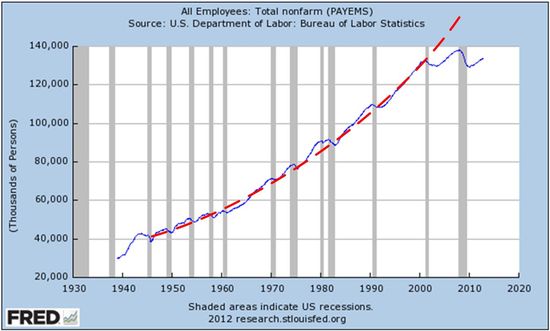
Commerce and the Federal Reserve. The above figure shows how our
nonfarm employees have grown since the eve of WW2.
Recently the US population and its workforce component have been growing
at about 1.5% annually. Our Census Bureau mavens have peered
into the future, and they see this growth rate reducing to about 1% per
year until 2050. And most of that will be made up by immigration
(nothing is said about the contribution of illegal aliens). Today about
one of eight Americans are foreign born (I am one), in 2050 one out of
five will be so designated. Also today we have about 3 to 4M new
entrants (over 250,000 a month) into the workforce annually, and that
number must come down if the projected growth rate is to hold true.
Readers
who understood the cited precursors to this report, and are able
to extrapolate (red dashed line) the above ‘All Employees’ graph from the year 2000 (with
130.78M employed) onward will realize that had the ‘Dotcom Recession’
and the ‘Great Recession’ not occurred, then today our total employed
would be above 170M if we use the average growth rate of 2.2%/yr
experienced in the 1946 – 2000 interval. But let’s not be piggy about
it, and use the most recently experienced 1.5% annual growth rate for
this extrapolation to get 156.4M employed today, which ties with the
assessment that there are about 24M unemployed today (131 + 24 = 155,
close enough). (I hope that at least all you younger readers are
following this, because your butt is riding on these numbers.)
Now
let’s really strap on our good feelies for the future, and believe that
our 2012 workforce of 155M will grow only at 1% annually as currently
projected by the feds. Then what will things look like in ten years
(2022)? Well, our work force will then number over 171M. And just for
the hell of it, let’s declare total victory and say that we’ve then
achieved an unemployment (core) rate of 5%, or only approximately 8.5M
unemployed. That means that the number of employed (remember the
current 24M already unemployed) had grown by 171 – 155 + 24 – 8.5 = 31.5M
workers.
For this to occur gradually over the coming decade, the
existing number of employed (131M) will grow to 131 + 31.5 = 162.5M
workers, or again at the annual rate just shy of 2.2%. With this number in our hot little hands, we can calculate the rate of GDP
growth required to absorb this rate of worker influx over the next ten
years. And given that unhampered technology development is
pushing worker productivity levels up at 3.75% annually (see ‘The real
jobs problem – shhh!’), here’s the punchline. The envelope please – to achieve this little feat of bringing unemployment down to 5% requires a GDP growth of 6% per year after year after year after … .
Maintaining that kind of
sustained growth rate is even beyond the wet dreams of any US
politician with a three digit IQ. Given the education and skill
deficits of our workforce, the regulatory burdens in place and increasing,
and the tax environment that will discourage new risk taking in spades –
we can all bet the ranch that such growth will not happen. Then what?
Well,
before we abandon this tale of woe, let’s see what we can do if we
throw a few eager workers under the bus (aka put them on permanent govt
dole). Let’s condemn the 24M now unemployed, and say that we are willing
to accept a new systemic unemployment rate of 6% – all together now ‘6%
is the new 5%!’. This means that in ten years we will have 0.06*171 +
24 = 34.3M unemployed. And our workforce will consist of 171 – 34.3 =
136.7M employees. This means that in ten years we will have to add only
5.7M new jobs. Hell, even Obama shouldn’t be able to screw things up
to stop that jobs growth rate which comes to only 0.43% annually. Today
that will require the addition of 47,000 jobs a month, which we seem
able to do.
But here’s the bad news even with that sickly
prospect of job growth and adding over ten million to the unemployed
rolls over the next decade – we will still have to grow the
economy at over 4.2% per year to reduce today’s 7.9% unemployment to 6%
in ten years, and keep it there thereafter. When was the last time we
enjoyed this level of GDP growth year after year? Not in my lifetime.
So
let’s come back to the bullcrap that spews out of the President’s
campaign regarding the latest wonderful news of creating 171,000 new
jobs in October, and some 5M jobs during his presidency. The sheeple
who vote next Tuesday have no idea that 250,000 new jobs were required
in October, and that since the end of the Great Recession (clearly a
joke), a total of about 10M should have been created during a normal
recovery, the kind of recoveries that we have had over the last half century. It was
Obama’s policies which kept this from happening, and promise us a dismal
four more years should he win next Tuesday.
Yesterday’s job
report, properly understood, should have prompted the country to
don sackcloths and sprinkle ashes on their heads. Today, we instead have over
150M idiots celebrating ‘slow but steady progress’ when there is nothing
of the kind happening and we continue to fall further behind in unemployment
numbers.
So is there another solution? You bet there is – stop
productivity growth. From the arguments presented above, we can get to a
5 to 6% unemployment rate in ten years if we put the kabosh on
productivity growth. I bet it would not take too much imagination for the
fuzz balls at the EPA, FDA, DHS, FCC, FAA, and Dept of Commerce to pass
enough productivity killing regulations that would bring the
productivity growth rate to zero. Then all we have to do is grow the economy
at a measly rate of around 2%. Even though nobody is sure about how to do
that – Ayn Rand gave some hints – but the answer is clear, from stage
left (where else?), ‘CUE THE LUDDITES!’
[5nov12 update] To put the above arguments into a more graphical format, we consider two levels of productivity growth, and their effect on systemic unemployment over the next ten years, given a range of GDP growth rates that reach upwards beyond hope. In both cases we accept the low 1% annual workforce growth rate promoted by the Census Bureau and the Bureau of Labor Statistics. (If actual workforce growth exceeds this, then things get very bad very fast.)
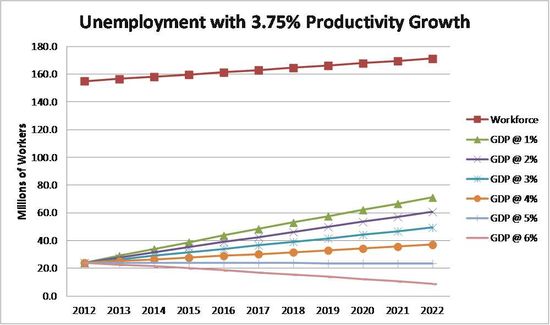
Let’s first look at how unemployment behaves when the productivity growth rate is kept at its current 3.75% per year (figure below). The top red line shows the growth of the workforce, i.e. the number of workers who would like to work. From the current 24M unemployed, the lower lines fan out showing how unemployement behaves under various levels of GDP growth. Note that only above an unsustainable growth of 5% per year do we see the number of unemployed decrease. Even at a robust GDP growth of 3% a year we will see the number of unemployed double to 50M over the next decade.
Now consider the scenario in which government Luddites actively stymie productivity growth to 1% per year through regulatory and taxing policies. In such an environment it is beyond reason to expect our economy to even achieve 3% annual growth. Nevertheless, the figure below again includes GDP growth rates up to 6% to illustrate the impact of such never-neverland rates on unemployment.
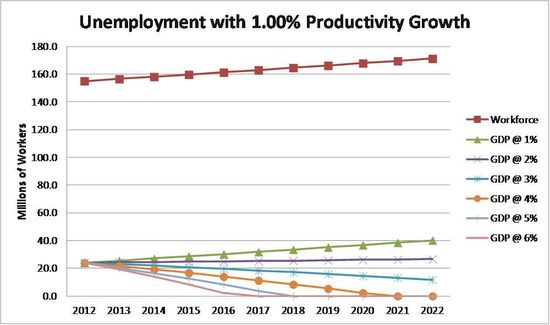
Again, workforce growth is not affected by these arguments. New workers just keep increasing at 1% per year. But now in a 1% productivity growth environment we see unemployment begin decreasing when GDP growth gets somewhere above the 2.5% region. Growth of 4% and above will drive unemployment to zero (actually, to a very low ‘core level’). But the sad reality is that in such an aggressively stifled economy, sustained growth rates above 2% will range between implausible and impossible. Nevertheless, such a ‘Luddite Solution’ will look very attractive to collectivists (aka Democrats) and their union allies. The problem here is that it will also be very difficult to fine tune and control the sustained growth of GDP at these low levels without the high likelihood of plunging the country into a dismal and tranformative depression.
So take your pick, massive systemic unemployment or massive nationwide poverty or both. Again the only plausible, but politically impossible, way out is to implement 1) massive tax reform, AND 2) massive regulatory rollbacks, AND 3) fundamental revamping of public education.


 rebanesruminations.com
Leave a comment