
Rebane's Ruminations
October 2012
S M T W T F S
 123456
78910111213
14151617181920
21222324252627
28293031  

ARCHIVES


OUR LINKS


YubaNet
White House Blog
Watts Up With That?
The Union
Sierra Thread
RL “Bob” Crabb
Barry Pruett Blog

George Rebane

Yesterday the Steeles and Rebanes joined many other Nevada County conservatives in Auburn for a delicious and informative fundraiser for state Senator Doug LaMalfa running for Congress this November.  There to help him in the effort was House Majority Leader Eric Cantor.
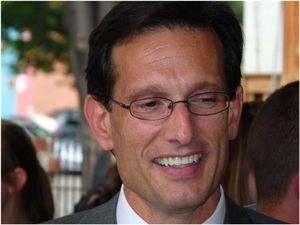
EricCantorCantor gave a good, concise, and fairly comprehensive stump talk about national politics and Doug LaMalfa’s support in implementing the Republican agenda for the next Congress.  During the Q&A I asked the congressman about the Republicans’ planned response to the administration’s announced intention to violate the Warn Act on November 4th. You’ll recall that this act requires companies to give 60 days advance warning of impending layoffs, such as will happen when another law of the land – last year’s sequestration agreement by Congress – has to be implemented as part of the fiscal cliff over which Washington will propel the country after we sober up from our New Year’s Eve festivities (perhaps sobering up will not be a good idea this January).

Cantor’s response to my question was a non-response.  He used the opportunity to talk about the partisan perspective of how Democrats are planning for a fiscal Armageddon (the so-called taxmageddon) and other cynical socialist sobriquets in store for a fundamentally transformed America.  It seems clear to me that the Republicans will not let that important issue lie fallow, just two days before the election as companies such as California’s Lockheed-Martin’s requirement to send out hundreds of thousands of layoff warnings to prospective voters.  But apparently the response will be one that cannot yet be disclosed.  Is that the Republicans’ November surprise?

Posted in , , ,

13 responses to “Eric Cantor at Doug LaMalfa fundraiser”

  1. Jesus Betterman Avatar

    Cleared cookies on other machine, can’t log in as either wordpress or twitter accounts there. You might want to clarify what you mean by the Administration planning on violating the Warn Act on November 4th?
    I see Lockheed is practicing political coercion by playing the “do you like your job?” card, a very common boss intimidation move, happens in school districts too.

    Like

  2. Ryan Mount Avatar

    I still want a good explanation why Mr. LaMalfa likes redistribution programs such as farm subsidies, at the same time he rails against other spending. Sounds like Rep. Cantor doesn’t like tricky questions either.
    Maybe it is just one of those, “He supports most of what we want, so we’re just gonna ignore that” things? Or maybe the “Welp, everyone is doing it, so why shouldn’t we do it?”
    Or maybe it’s just like Grandma used to say, “if you want perfection, go to church.”
    Mr. LaMalfa seems to argue that one needs to participate in the program, in order to reform and/or remove it. Also he says that they’d be out of business if they didn’t take the dough. That’s pretty screwed up anyway you look at it.
    http://www.youtube.com/watch?v=HfscWgIxBiU

    Like

  3. George Rebane Avatar

    JesusB 1147am – you may want to broaden your media consumption spectrum Doug. Violating the Warn Act has been explained in detail on all reputable outlets. The lamestream would, of course, not want to touch it for obvious reasons. For more, follow the provided link.
    RyanM 1219pm – As RR readers know, I’m against both farm and corporate subsidies. One of the longstanding control mechanisms the feds put in place decades ago (and increase yearly) is the appropriation of excess tribute that is then returned in the form of commons to which massive strings are attached. Anyone unilaterally withdrawing from the commons on principle will be severely punished. That keeps everyone obediently at the trough.
    Consider if Nevada County withdrew from complying with the regulatory provisions that come with the tens (hundreds?) of state and/or federal subsidies it receives for everything from repairing the roads to school lunches. Even though I’ve strongly urged the BoS to take the ‘Just say NO!’ initiative (especially on pensions) on some reprehensible mandate from on high, it ain’t going to happen. More here –
    http://rebaneruminations.typepad.com/rebanes_ruminations/2012/07/the-great-pension-heist-is-discovered.html

    Like

  4. Barry Pruett Avatar

    Ryan said, “Mr. LaMalfa seems to argue that one needs to participate in the program, in order to reform and/or remove it. Also he says that they’d be out of business if they didn’t take the dough.”
    George said, “Anyone unilaterally withdrawing from the commons on principle will be severely punished. That keeps everyone obediently at the trough.”
    I, more or less, agree with both of these statements, but one thing that people fail to consider is that LaMalfa is not forced by the government to grow rice. I would posit that such choice to grow rice is because of the heavy subsidies and not in spite of them.
    http://farm.ewg.org/persondetail.php?custnumber=A09247988

    Like

  5. George Rebane Avatar

    BarryP 250pm – there is no contention that govt subsidies also attract people into enterprises they would otherwise not touch because it would not make economic sense. Our entire green technologies and green jobs programs are the current poster children for such misguided initiatives that cause the solindrizing of companies. But your point is well taken in that we don’t know how many marginally productive and profitable farmers are so only on the basis of the subsidies they receive.

    Like

  6. Russ Steele Avatar
    Russ Steele

    The LaMalfa family was growing rice before their were farm subsides, and once subsidize became part of the farm sector, it was participate or go out of the growing rice business.
    Given the growing dependency on global markets ag markets and the desire to keep rice a California product to insure that we have a source of rice should world events cut the us off from access to global producers, the LaMalfa family decided to continue their participate in the subsides program. What were the alternative and were they acceptable?
    I was wondering what other non-subsidize agricultural product that Barry would suggest the LaMalfa family plant? Corn – subsides. Soybeans – subsides, Water hungry cotton. Climate dependent grapes, which is currently in over supply? What would Barry the farmer plant that is not subsidized?
    Bottom line. The Government should never have gotten in the subsidies business, it distorts the market. But, once the game is on the table, it is play the game or walk away.

    Like

  7. Ryan Mount Avatar

    I appreciate the pragmatic aspects of this issue. And frankly I think it’s decent of Mr. LaMalfa to be frank about it. So he gets points for that.
    But instead of apologies, I would really hope that he would use this as an issue to discuss the whole redistribution issue. Is pumping tax money into certain sectors a good thing? How is it different, as George infers above, from GM or Solyndra? Hint: we can’t eat a Chevy Volt and we can land tens of thousands of bags of USA Rice, branded with the graven image of George Clooney, in starving countries.
    Maybe it’s like an analog for national defense? Maybe we need to ensure, despite all of the market twiddling and the numerous* unintended consequences that come from that activity, that we produce lots of food. Maybe farm subsidies are just the price of admission.
    *pick any Classical Liberal theorist

    Like

  8. Barry Pruett Avatar

    Thanks Russ, but I know that you did not write that. Americans pay for the rice program three times over–as taxpayers, as consumers, and as workers. Direct taxpayer subsidies to the rice sector have averaged $1 billion a year since 1998 and are projected to average $700 million a year through 2015. Tariffs on imported rice drive up prices for consumers, and the rice program imposes a drag on the U.S. economy generally through a misallocation of resources. Rice payments tend to be concentrated among a small number of large producers.
    Globally, U.S. policy drives down prices for rice by 4 to 6 percent. Those lower prices, in turn, perpetuate poverty and hardship for millions of rice farmers in developing countries, undermining our broader interests and our standing in the world. The U S. program also leaves the United States vulnerable to challenges in the World Trade Organization.
    LaMalfa has been an elected official for eight years. When LaMalfa was in DC in January 2010, instead of lobbying Congress against these subsidies, he was lobbying Congress for support to become a Congressman with his high speed rail ploy. LaMalfa has been courting the Republican leadership for support for almost three years – hence Eric Cantor, Boehner, et al. LaMalfa cannot blame the government when he has been a part it and part of the problem. So long as the money rolls in, LaMalfa has nothing to say. Will he pledge to work in Congress to get rid of this corporate welfare? Answer: No.
    If you think that LaMalfa is strong and will stand up to the leadership, you are mistaken. He is one of them and is already in bed with them. A strong principled Republican who will stand up to leadership, he will never be.

    Like

  9. Russ Steele Avatar
    Russ Steele

    Barry@06:55
    You wrote: “Globally, U.S. policy drives down prices for rice by 4 to 6 percent. Those lower prices, in turn, perpetuate poverty and hardship for millions of rice farmers in developing countries, undermining our broader interests and our standing in the world. The U S. program also leaves the United States vulnerable to challenges in the World Trade Organization.”
    Thanks for the information, where can i find additional information on this subject of global rice pricing and the impact on our broader interests. This sounds more like Obama than a Republican position. Can you give me some references. Thanks.

    Like

  10. Ryan Mount Avatar

    I don’t think people are going to vote against their short term self-interests.
    So what I and others want to know, is:
    1) Are these farm subsides “worth it?” I inclined to say no. They might have had their place at one point in time, but like all other Government programs, it’s grown into a monster which always happens. Suddenly, for example, unemployed people not only need cash, but they need mobile phones as well.
    2) How do we get farms them off the nipple in a reasonable way? Yanking/shutting it down in a hasty fashion would seem to be reckless.

    Like

  11. Paul Emery Avatar

    Romney is losing in his home state of Mass. by around 20%. If he was such a great governor why is he being rejected by historic numbers? There is no precedence for this in modern history. Normally you ask a former employer for a recommendation if you hire someone so in this case it’s a thumbs down.
    http://elections.huffingtonpost.com/pollster/2012-massachusetts-president-romney-vs-obama

    Like

  12. JesusBetterman Avatar

    While we would never qualify for one, farm subsidies are a part of national defense, and in time of peace, food for the poor of our and other nations. That being said, decentralized via no farm too big too fail (support family owned farms under 1,000 acres, and ranches under 10,000 acres) and non GMO crops much more than the Big Boys, is even more secure and supportive of national interests.

    Like

  13. George Rebane Avatar

    Most people agree that a century ago the feds were right in not attempting to save the tens of small automobile companies that dotted the landscape, and were beginning to have a hard time competing against the bigger ones with more manufacturing and marketing muscle. All this came in handy when the big survivors were able to greatly reduce the cost of cars to the public, and then respond in a mighty way for both war efforts (e.g. Ford’s Detroit plant was quickly converted into making B-24s and made the most airplanes during WW2).
    Does this experience and related policies provide anything for us to draw on when today we consider ‘saving’ the small family farms vs the big ADMs and Conagras?

    Like

Leave a comment