

George Rebane
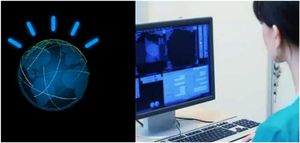 Wired magazine has a very lame article on what should be an exciting report – the advent and functionality of clinical AI systems that are entering the healthcare service. ‘Paging Dr. Watson: Artificial Intelligence As a Prescription for Health Care’ authored by Brandon Keim paints an inconclusive ‘on the one hand, … but then on the other hand’ picture of how these AIs will perform. Reader motivation and understanding is tied to the now famous Jeopardy victories by IBM’s Watson supercomputer. But I’m sorry to report that Keim’s understanding of the power of these AIs and how they will serve is severely limited.
Once people become educated on the statistics of the complexity of the human system, its maladies, and medical errors encountered in human-only healthcare delivery (about 200K annual deaths attributed to ‘medical mistakes’), it will not take a leap of faith to conclude that physicians attending patients ‘a capella’ of AI will be rejected by those patients who have a choice. And as the Dr Watsons (equivalent and more powerful medical AIs) become available, if not ubiquitous in the industry, then insurance rates in great measure will reflect the advance.
What Keim misses is the obvious power and glory such Dr Watsons will bring to the physician’s office and hospital bedsides. As an extension of the human clinician, Dr Watson will prevent the psychological pitfalls (e.g. anchoring, limited memory, poor deduction ability, …) which also afflict the physician, often with horrendous consequences for the patient.
Without making this a tutorial on how large data probabilistic reasoning systems work, let me just point out one obvious use of a Dr Watson. Working with the attending physician, the AI will be able to take existing diagnostics, ask the human more questions, prescribe more tests where necessary, and construct an extremely informative spectrum of potential maladies giving the probability values for each for various outcomes of the prescribed tests. Additionally, it will overlay the (Pareto) optimal trade-off of additional costs to uncertainty reductions in the most morbid/mortal diagnoses. This will allow the patient and the physician to make knowledgeable decisions on how best to proceed to a correct diagnosis.
Dr Watson will be able to explain itself in meticulous detail to the physician on the reasoning behind its assessments. In this the AI will use not only established clinical practice and published research, but also have the possibility of presenting original research done in the quest of the current case.
After the diagnosis, Dr Watson will present recommended prescriptions for treatment ranging from the established ‘standard of care’ to novel approaches buried in clinical literature and/or synthesized treatments never before encountered/considered. The informed alternatives will be presented in various formats to include normal English speech, printed reports, and interactive graphics. At this stage of introduction of these Dr Watsons, the human physician will mediate every step with the patient, therefore alleviating any and all concerns about the AI flying solo in the patient’s care.
I predict that it will not take long after that before the first stage mediator will be someone with less training than an MD. This will be possible because the AI will bring the world’s medical knowledge to that mediator who will be trained to bring in an MD should that be required. These machines will expand the availability of state-of-the-art healthcare at tremendously lowered costs to millions of people who today have few alternatives to waiting in line for an overworked and error prone physician or nurse practitioner.
What are the major hurdles to such a healthcare future? They are the AMA, Congress, FDA, and, of course, the entire legal profession – in short, government and the unions. But as far as the technology is concerned, fasten your seatbelts, you ain’t seen nothing yet.


Leave a comment