

George Rebane
Today we observe Cristofo’s grand achievement in 1492 that started the European conquest of the Americas – the Vikings blew their attempt about 500 years earlier. This national holiday is specifically eschewed in Hawaii, Nevada, and, of course, California. Nevertheless, I was reminded by a reader that RR would be remiss in not taking note of this auspicious beginning.
Actually, on this day I want to commend Queen Isabella of Spain for launching the three ships. It was her investment that made the Italian’s trip possible, being the first among his countrymen to arrive in this hemisphere ‘without papers’, thereby establishing the denigrating ethnic label to a generation and more Italians who followed him 400 years later. But that’s another story.
Here I wish to draw your attention to one of the most momentous of all government investments – and it truly was an investment, totally unlike the spending programs of today – to find a shorter route to India, since Portugal ruled the long route around Africa to trade with that fabled land.
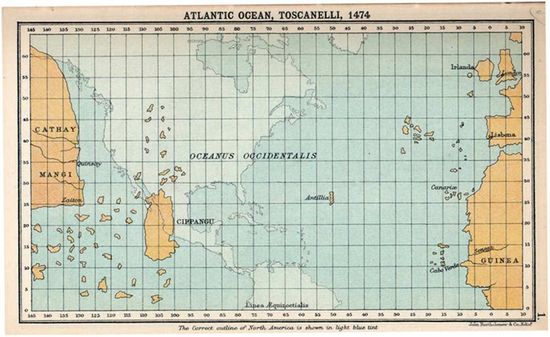
So anyway, Columbus sailed bravely onto an ocean that many thought would come to an abrupt end at the edge of the world as depicted in many woodcuts of the time. After a long voyage he blundered into a new hemisphere instead, while still believing that he had landed on some outer archipelago of Asia. But then who knew. The map he got from his subscription to the National Geographic of the day was drawn by some clown named Toscanelli who should have opened a restaurant instead.
Later voyages by true Spaniards – they got the WOP out of the way, and even prosecuted him for some financial shenanigans – confirmed that this was a new world, and that it contained riches beyond their wildest dreams as soon as they could get rid of some pesky Indians.
After the peskier Indians were dispatched, the remainder were put to work digging out and hauling in unimaginable amounts of gold that was then shipped off to Spain. Some of it got nailed by hurricanes and pirates, which again is another story. But here I’d like emphasize what the Spanish government did with their windfall.
The first thing they did was to establish a behavior that has come to be known as ‘spending money like drunken sailors’, which is exactly what they did for the next three centuries. (This part of California’s Spanish heritage is still practiced in Sacramento.) Who needed to work when all that gold was coming in? It was all eat, drink, and make Mary, or merry, or was it war? The bottom line is that like all governments, Spain spent itself silly for 300 years until the gold shipments stopped, mostly through the efforts of Spain’s European neighbors like the French and the English, whom the profligate Spaniards had managed to piss off to a fair thee well with successive attacks, wars, and other sundry intrigues.
In the 19th century Spain was broke, and through revolution and competitive imperialism it managed to lose all the possessions in the New World it had discovered. America, flexing newly found international muscles, put a bow on the whole sordid affair in 1898 with the foisted Spanish-American War in which Spain lost its remaining overseas possessions – we got Cuba and the Philippines, and some other sundry real estate. And Spain was reduced to making sangria for tourists, and muttering something about their shoulda, coulda, wouldas.
By the way, Spain learned nothing from its centuries long government spending. In the 20th century Spaniards gave various forms of socialism a try, settling finally on what we today know as the European model. This got them into policies that called for even more ‘investments’ in things like green energy, public employee pensions, 25% unemployment, and a national debt up to their collective interglutial cleft.
So happy Columbus Day, and the next time you hear someone from Washington talk about government investments, consider the sad tale of España. Ole!


Leave a comment