

George Rebane
The importance and magnitude of EVERY social problem lies in its numbers. If you don’t understand the numbers and how they relate, all you can do is emote about the problem.
 In these pages I have written an uncounted number of laments regarding the country’s dismal and deteriorating job situation. Various organizations estimate that today there are about three million jobs in America that go unfilled. Why? Well it turns out that it isn’t all about not having enough STEM skills in the workforce. No doubt, science, technology, engineering, and math trained people are in great demand, but there is also a big demand for workers who can demonstrate that they have the so-called ‘soft skills’. The near term problem is that available jobs outnumber workers with the required skill sets.
As an example, due to a skills shortage 600,000 manufacturing jobs went unfilled in 2011. Yes, manufacturing, the sector that we have been moaning and groaning about that is being exported overseas. With somewhere in excess of 20 million workers unemployed, employers still can’t even connect one out of forty of those to jobs that require strapping stuff together and moving it around.
Nick Schulz of the American Enterprise Institute outlines some of the basic shortcomings of our unemployed workforce (here). These start at the low end of just being able to properly answer the telephone. They also have little knowledge of the social contract that makes our culture (or the lack of it?) work, i.e. they lack certain “forms of social discipline” essential in a multi-person workplace. But perhaps ranking right up there in our workforce deficits is “the lack of elementary command of the English language” which includes things like “simple grammar and spelling”. This shortcoming is primarily present in the younger contingent who have been most recently blessed and passed through our unionized public education systems ranging from K-16.
How much softer can a skill set get than having these elements, skills which were much more prevalent in the 2007 workforce than today when the unemployment rate was four percentage points lower? And I notice that in this election season no politicians of any stripe are pointing these facts out to the country for fear of offending tens of millions of voters with realworld facts, as Romney recently found out. If you can’t find a job, and you kinda think that your problem is a chronic one as outlined above, then it doesn’t take rocket science to know that you’ll probably vote for the candidate who is going to send you more money, preferably forever.
As technology and investment increase, so does worker productivity – each worker accounts for more of the country’s generated wealth, thereby requiring fewer workers to pump out any given level of GDP. The ONLY solution to this conundrum is a healthy and predictable environment for a high-level of economic growth, as we will see below. Sadly none of this is fostered by the current federal government which is hell bent to implement obamunistic policies to restrain America from a timely exit from its economic doldrums which I believe history will record as Depression2.
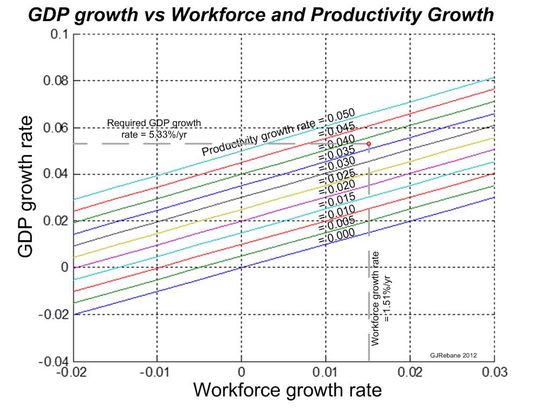
The data that support these conclusions are worker productivity and workforce levels. I downloaded some data from the Fed on this and did some back of the envelope noodling to try and illustrate the problem. During the 1987-2007 interval the real per worker productivity (in 2005 dollars) of goods and services per worker rose at an average annual rate of 3.76%. In the same period the size of our workforce grew at 1.51% per year. And America’s annual GDP growth rate averaged 2.98% in real terms (again anchored to 2005). What does that tell us that we don’t hear on the news?
If worker productivity growth were zero, then GDP would enjoy a nominal growth rate that is the same as the growth rate of the number of workers. But real GDP grew at almost twice the rate (2.98/1.51) of worker growth. That means that workers in the aggregate became more and more productive during those 20 years. Think of (# of workers) x (annual productivity/worker) = GDP as a good working approximation.
When you crank out the simple algebra here (see the tech addendum below), these numbers point to what has been happening, and what will happen in spades as accelerating technology continues to increase worker productivity. The brutal truth is that we could have produced that GDP growth without adding a single worker since 1987 – actually, the number of workers could have declined by almost 1% a year in that interval, and the country would still have produced the recorded wealth gain.
So what happened with all the ‘surplus’ workers. Well, a lot of them quit producing or produced at a much lower than the average productivity rate. Government programs, and perhaps even our underground economy, helped absorb and maintain some such workers. So here is the conundrum. Today we need to boost our GDP growth rate for all the right economic reasons ranging from reducing deficits, providing needed entitlements, and generating new jobs to absorb our workforce growth. But if we add productivity growth into the equation, then that pushes down the need for new workers and new jobs to achieve any given level of GDP. And if we absorb the surplus workers into the transfer payment population, then that destabilizes the social order and reduces investment, job creation, technology development, and productivity. A very vicious loop which we can illustrate with an influence factors diagram, but I’ll spare you.
But do you see the relationships, at least intuitively?? It appears that no one in the Obama administration sees it, or, alternatively, they are obamunists of a common mind and look forward to the impending chaos in the country (ref the DHA and FEMA armaments build up). Let me be more brutal, I don’t think that even the Republicans in Congress or in the state legislatures have come to grips with this Titanic heading for the iceberg. No one wants to talk about IT.
So let’s take a look at this ‘IT’ as we peer into the future. According to the Bureau of Labor Statistics the current civilian labor force numbers 154.6 million, and the labor force participation rate is 63.5 percent, giving us about 98.2 million workers employed at some level. That leaves 56.4 million people of working ages not working for various reasons. If we take the above result from the worker numbers, productivity, and GDP growth rates, and assume that they hold for the next, say, ten years, then playing with these numbers (see technical appendix) shows that there will be approximately 180 million people in the civilian labor force in 2022. And recalling the above arguments, technology abetted productivity increases dictate that we can still grow the economy (GDP) at the stipulated (recovered) 2.98% rate without adding a single worker to today’s 98.2 million employed. In fact, we can achieve that GDP growth rate with even fewer workers, other things being equal.
Hopefully this will let you understand why I have been saying that there will be at least 70 million people un(der)employed by 2020. And the real situation will be worse since current tax and regulatory policies in effect (and those about to go into effect) will not let us achieve anywhere near the 2.98% economic growth rate during the remainder of this decade.
A natural question at this point would be, at what rate would we have to grow GDP in order to absorb the new people coming into the workforce and employing them at the current participation rate. Here we conservatively assume that the chronic and systemic unemployment rate at today’s levels will persist – we just have to absorb the influx of new workers. Again, we can go to our model in the appendix and squeeze out the answer by solving for the required GDP growth rate – so, the answer please. We would then require a sustained level of 5.3% growth per year. This is shown in the figure below that also let’s you answer other ‘what if’ questions on how GDP, workforce, and productivity growths relate.
And now you know why no politician of any stripe wants to talk about the real employment problem in America, because no one has a clue on how to get the economy to such unprecedented sustained growth levels with our currently underskilled workforce, educational system, built-in latencies, socialistic dreams, and entrenched obamunistic goals and policies.
Instead, employers have been using every recession, especially the current one, as an opportunity to permanently pare their employee ranks of redundant, obsolete, and generally incapable workers. And the added regulations requiring new and, in my opinion, egregious worker compensations just continue to roll up the lower rungs of the economic ladder for the low skilled workers. They simply become permanent Democrats, which, of course, is another target objective of obamunism.
All said and done, it’s a sad tale when so many unemployed American workers have become such double dummies that they can’t even reach for the low hanging fruit in the job markets.


Leave a Reply