

George Rebane
An ideology is a structured and communicable belief system that in its best expression is composed of tenets defendable by reason.
I have always wondered why the Left appears to have no intellectual roots or basis for its scattered ideology. The Right has its social philosophers in people like Locke, Bastiat, von Mises, von Hayek, and Friedman among others, and frequently cites their ideas and writings.
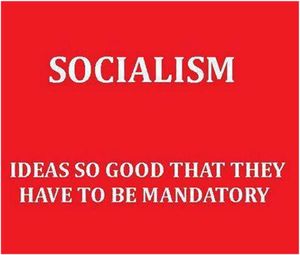 The post-WW2 Left denies any apparent intellectual roots, especially since the embarrassment of Soviet communism which they so admired in the 1920s and 30s. Now they propose a scattering of collectivist notions and social policies that have no grounding in history, and even less in what is known about human behavior. In short, the banners it marches under are bare of anything save the pitiful slogans that signal some particular shortages their constituents have yet to receive from the bountiful state.
But in the ideological landscape the thinning of intellectual roots is already detectable when the student enters the so-called independent or middle-of-the-road region of social thought. People populating this region lack the ability to list, let alone define, any of the ideological tenets that inform and motivate the middle. They also have no intellectual basis for what is clearly a faux political philosophy that panders to those who somehow want to distance themselves from ‘the extremist ideologues’.
In doing this they also distance themselves from any ability to tell people what they believe in. Instead, they just repeat their desire to stand away from ‘the extremes’ of political thought, and consider this desire to be a sufficient belief system in which rejection substitutes for definition. Moreover, the rejected extremes are apparently inaccessible to them, since in their declarations they never seem to get any of these disavowed tenets right. For example, while they glibly join the Left in assigning someone to the ‘hard’ or ‘extreme Right’, they can offer no argument as to what specific conservative tenets confine a person to that ideological bookend. Understandably, they are even more disabled in their attempts to characterize the Left for reasons considered below.
Therefore, the self-declared middle-roaders are truly muddled in an ideological Never-never Land. For confirmation, all you have to do is to go to the website of any avowed independent, and try to come out with a list of tenets that is coherent and unique to that part of the political spectrum. It has yet to be done.
Having established the above, I was introduced by a reader to the thought of Professor Beverly Gage of Yale. Historian Gage is a talented leftwing academic whose “teaching and research focus on the evolution of American political ideologies and institutions.” To my delight, she turns out to be a kindred spirit in her assessment of the intellectual wasteland that today serves for liberal thought.
Her recent essay ‘Why Is There No Liberal Ayn Rand?’ (on Slate.com and my annotated pdf) is definitely worth a read. This is an excellent apology for the difference between how the Right and the Left approach and argue their worldviews on Man, governance, and public policy. She correctly delineates the liberal approach of framing and executing their efforts in terms of “issue-oriented activism” that is essentially free of any philosophical base, and appeals directly to the emotional perception of violated social justice. It is a mode of conduct and communication that has been more than sufficient to their unread and pre-educated constituencies.
Of course, Dr Gage does not characterize the Left in such stark terms. Instead, she sees the Left as the mass of people yearning for a better future, and who want to go forward into that future. (It is not a coincidence that President Obama’s campaign slogan has been reduced to the simplest imperative – ‘Forward.’) She summarizes the seminal difference between the Right and the Left in the “old political truism” of the progressives – “Liberals look to the future, while conservatives look to the past.”
This mythical ‘truism’ is exactly the obverse of what we have experienced within the frame of post-WW2 history. It is the Left that has hewn and continues to hew to the demonstrably failed policies of collectivism, of reintroducing the systematic removal of individual liberties with the promise that this time an altruistic society will emerge that works. To the extent that the Right has embraced modestly regulated, free-market capitalism, only it has provided the social environments which have given rise to the economic, technological, and socio-political advances that have increased the quality of life worldwide.
End Notes. An important corollary to today’s intellectual wasteland that represents liberal ideology is its contribution to an almost total block to informative conversations between the two sides. The utter futility of reasonable dialogue has been well documented on RR and countless other blogs, media websites, and broadcast talk programs. To be sure, there are occasional glimmers of light, but these are quickly extinguished when it is required to go deeper where actual public policies can be fashioned.
My correspondents have correctly surmised that this disconnect is a factor that powers the discussion of the Great Divide as the simplest peaceful resolution to our governments becoming more dysfunctional with every passing month. As long argued here, living harmoniously together requires some minimal level of like-mindedness. Such minimums are no longer recognized, with one side working to replace them with government diktats, common to no one and lethally enforced.
The conservetarian in me sees such mandated solutions as large scale thuggery imposed by the state. My response is to continue arguing for exploring and implementing the provisions in our Constitution that anticipated the United States becoming a laboratory of freedom and self-governance, where divers experiments would constantly be underway trying different approaches. The Founders gave us the notion of states’ rights to carry out such experiments.
However, starting with the War Between the States, our federal government embarked on an insidious road to collective homogeneity. At the turn of the last century, the road became well lit by its distinctive ideology, as classical liberalism gave way to modern leftwing liberalism. As covered in these pages and supported by Professor Gage, this shift had well-formed intellectual roots in the writings of Marx, Engels, Lenin, Dewey, DuBois, … .
Additionally, the collectivist ideologies had established working models that were in practice in and launched by the Soviet Union. By mid-century the exemplars of these polar ideologies were visible to all who would see. And as Gage also corroborates, after the 1950s it became painfully clear to the socialists in free countries that their goals could not be achieved on the basis of reasoned argument of their tenets. Their “movement culture” was abandoned, and the way ‘Forward.’ to a socialist future could only be accomplished through the opportunistic subterfuge of ad hoc “issue-oriented activism”. This removed the last viable tools for productive debate, and left propagandists alone on the public stage.

 rebanesruminations.com
Leave a comment