

George Rebane
The systemic and growing unemployment in these pre-Singularity years is an ongoing topic on RR, and a stringently ignored social phenomenon by our political elites of all stripes. A graphic that illustrates this unemployment growth is the graphic below showing how manufacturing activity varies over time along with employment in the sector.
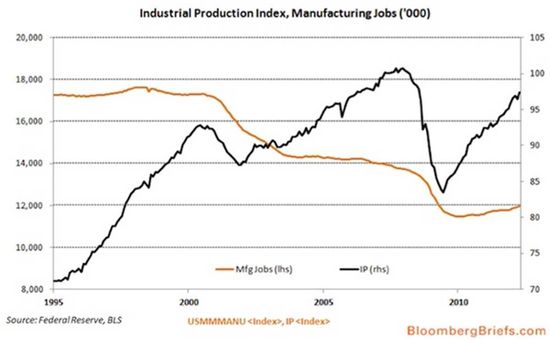
Note how the normal cyclicity of business activity in manufacturing ratchets down the number employed. Workers are laid off in recessions during which manufacturers implement labor and other cost saving methods for survival. When better times return, the productivity changes are in place and few, if any, new hires are needed to continue business growth. And this phenomenon is not restricted only to manufacturing, but repeated in almost every other sector of business. The only sectors that seem to be immune are those requiring expertise in STEM areas.
So the real problem is still how can we help the rapidly growing cohort of (non-STEM) unemployables. Even as the employer of last resort, the government can’t hire all of them and force a diminishing fraction of the population to pay for it all. It would invite a bloody revolution in a new age in which technology will no longer create as many jobs as it destroys (more here).
Nevertheless, there are several technological advances available that look promising for delaying the day of reckoning, at least until some newer technology comes along to delay it even more. I want to discuss three and summarize how I think they would help us in the near term. These are 1) body worn multi-media input/output (I/O) devices connecting us to the cloud; 2) online education that bypasses the atrocious public schools which are beyond timely repair; and 3) computing/storage implants that connect directly to our neuro-system.
Multi-media I/O devices
The multi-media I/O devices were conceived on then-classified DOD programs like the early 1970s RUWS (Remote Underwater Work System) in which the shipborne system operator wore small-screen 3D video monitors in a headset whose pointing directions were sensed and transmitted to the RUWS platform working thousands of feet below on the seafloor. When the operator turned his head, the twin cameras on the platform followed his head movements. He also had his hands in special manipulanda, one with force feedback, that allowed him to operate the powered arms on the platform. However these were not body-mounted, but contributed to the launch of today’s remote manipulating systems that either reduce big human movements to a microscale, or amplify them to large macroscales. Here we’re interested in the body-mounted stuff.
Twenty years later, after having developed some maintenance training system for the DOD, I had the chance to wear a set of retinal projection glasses during a confidential demonstration at a big aerospace company. A low-powered red laser refreshed high resolution images on my retina that consisted of various schematics and text. The concept we were working on was a maintenance/repair system for the B-1 that would be carried on the aircraft. Special interactive maintenance and repair manuals would be stored on CDs. The aircraft could then land at an airfield of opportunity and the system would allow a crew member, who was not a trained maintenance specialist, to maintain and/or repair certain critical aircraft subsystems.
The objective here was to use the human as the computer’s sensors and manipulanda (eyes, ears, hands) subsystem. The information and data presented through the retinal projection glasses (and controlled by a wireless handset) would lead the crew member through a diagnostic and repair routine by taking him through a kind of a decision tree – look here, do this, if response is so, do that – while presenting all the needed visuals in a constrained (crawl?) space where the work had to be done. In effect, the smarts in the computer fixed the airplane with the help of a compliant (and ‘low level’ intelligent) set of eyes, ears, arms, and legs.
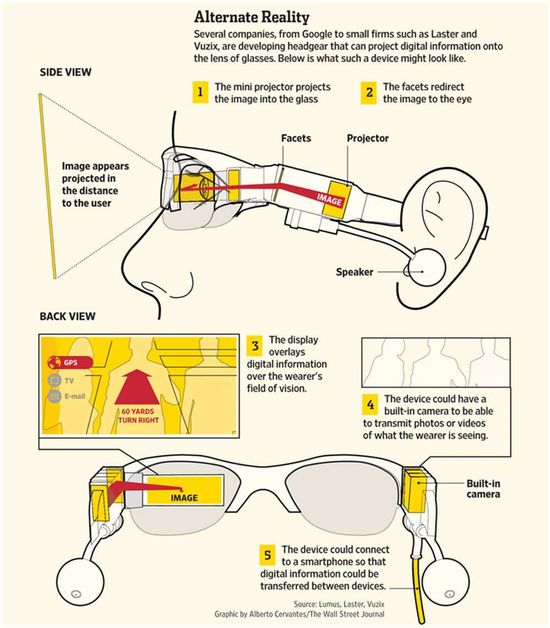
Both computer smarts and body-mounted I/O hardware have come a long way during the last 20 years, and now we have systems like the one shown in the figure (more info here). So how does this work into the big problem facing the country. The answer is that these gizmos worn by a wide variety of more or less untrained people can provide them with the realtime in situ smarts to do all kinds of tasks that require only a willing and co-operative set of sensors (eyes, ears, nose, …) and effectors (arms and legs). To be sure, such human workers will eventually be replaced by more capable robots that can see, hear, manipulate, and move better than we can. But until such machines (beings?) come along, body-mounted I/O equipment will enable millions of under-educated people to work productively and earn a living.
Online Education Alternatives
As long covered on RR, advances in automated and online educational technologies are already available to augment and/or replace the millennia-old paradigm of a teacher lecturing to an assembled group of students. Now many schools are beginning to turn the ‘teacher teaching a class, and student going off alone to practice’ methodology on its head. Students are today given assignments to learn on their own using resources like the Kahn Academy, edX, and online courses from established institutions. They then return to a group setting with the teacher and do their ‘homework’ with the teacher there to act as a resource, and deliver remedial lecture snippets on common areas where students are perceived to have a problem.
Many online learning programs now have very sophisticated AI-based remediation algorithms that detect when a student may experience a difficulty and then branch into a more detailed exposition, or shunt the student onto a remediation branch before returning him to the ‘main sequence’ of instruction. Such programs also have the ability to include a detailed report on the student’s learning experience, and make it available to his human teacher before they again meet.
Today it is hard to predict how all this ‘automated teaching’ technology will be integrated into the formal course of a young person’s education. All we can say for sure is that such technology will become a standard component in tomorrow’s educational systems. And here I am also talking about its perhaps heaviest use in the retraining and upgrading of workers already in the workforce. Private corporations have been pioneers in the development and use of such ‘training tools’, driven by the reinforcing factors of rapidly accelerating technologies in the workplace and the deterioration of public education.
Machine Augmented Man (MAM)
We are in the early stage of a sea change in how humans will become “super-abled” through the donning and implanting of devices which will enhance the functions of orthopedics (mobility, manipulability), sensing (vision, hearing, touch, …), and mental augmentation. The so-called ‘bionic man’ is standing on the threshold of our everyday lives through becoming a part of each of us individually.
Author Daniel Wilson in Bionic Brains and Beyond gives a good survey of how we are hooking up to a laundry list of gizmos, each of which promises to increase our abilities that originally came from our double helix.
Decision Support Enterprises (DSE)
But before we get our MAM implants, there is one little known area of employment that could potentially employ a significant number (millions?) of lowly trained (non-STEM) workers. This is in the development and operation of myriads of computerized experts and decision aids. It turns out that fairly simple computer algorithms, that involve factors observable from everyday life and available datasets, routinely outperform human experts, analysts, and other habitually recognized pundits in tasks that involve prediction, diagnostics, and prescriptive measures. (And don’t forget that we already have legions of Bayes and soon causal nets – here and here – capturing expertise and reliably delivering it to workers everywhere.)
How many times during the course of the day do we hear that ‘economists and analysts were surprised’ with the release of data on the economy, or stock markets, or the environment, or healthcare costs, or medical diagnoses, or the effectiveness of education policy, or which roads would need to be repaired first, or the price of beer in China, or …?
Such expert algorithms work by combining (say, as a weighted sum of) factors such as consumer mood, the upkeep of suburban yards, the cleanliness of streets, the recent effect of weather on traffic flow, the severity of gastric distress after consuming X, the sufficiency of savings accounts, etc. The problem with such algorithms is that the factors need to be assessed numerically (say, a value from 1 to 10), and they need to be assessed independently from the other factors that go into the mix from which a prediction, diagnosis, or prescription is obtained.
Many psychologists and systems scientists have demonstrated the improved performance of such computerized algorithms over currently recognized human experts. Daniel Kahneman has also described and documented this phenomenon in his recent book Thinking, Fast and Slow. If we take these research results and look at how they may be commercialized, a method immediately suggests itself – set up decision support enterprises (DSEs) that employ ‘factor assessors’. Such decision support systems would be specific to any of a countless number of areas of human activity that includes commerce, entertainment, law, medicine, marketing, law enforcement, investment, public policy, … – you can think of such systems as man augmented machines.
Each DSE would employ many factor assessors who would regularly communicate their assessments via the web to be integrated and served by the DSEs to their subscribing customers. Each factor assessor (FA) could serve several DSEs providing services in different areas. The FAs would not even need to know what DSEs their assessments serve, the other factors integrated by the DSE, and most certainly not the form of the algorithms which use their inputs. In fact, such a DSE industry may best be served by one or more ‘factors clearinghouses’ that commission and actually hire FAs. Such clearinghouses would sell their factor assessment data to the numerous online DSEs.
Conclusion
What I have attempted to communicate here is that there are opportunities to employ legions of uneducated and mis-educated workers in useful, interesting, and challenging tasks that are commercially viable when combined with new technologies here today and coming tomorrow. To be sure, these approaches are a stopgap for an unknown number of years until the inevitable AIs arrive to displace even these jobs. But I believe that, for the near future, this kind of approaches are the ONLY ones available to us that will continue to improve the quality of life for the excess number of humans who cannot profitably sell their labor in today’s markets, and whose only hope is to work for government to increase the inevitable frictions and inefficiencies from which we now suffer.

 rebanesruminations.com
Leave a comment