

George Rebane
[This is the submitted form of my regular Union column that was published on 9 June 2012. Remarkably, The Union published its print and online versions without the inclusion of the figure.]
How’s that recovery working out for you? It’s seems like we’re watching molasses flow uphill, and we know that is not going to last. There is no indication that anyone has a plan that would let us catch up with our historical growth curve, and the mavens in Washington and Sacramento are applying every trick they know to destroy the incentives for businesses to create jobs and the unemployed to find work.
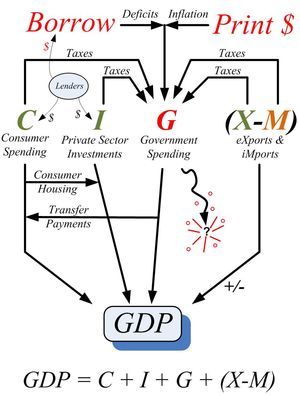 All the numbers that drizzle out of the various government bureaus and agencies are confusing and so much hooey. Harvard economist Robert Barro advises us to keep it simple by just gluing our eyeball to the gross domestic product (GDP) – if that’s not going up at a good pace, nothing else matters. To give you an idea of a good pace, GDP went up at an average of 3.1% a year since recovering from the post-war recession in 1948. And to put a bow on it, in the 1982-89 years GDP growth spurted up to average 4.3% a year.
In this so-called recovery we have averaged 2.4% annually since 2009, and that rate has been slowing. Last quarter it dropped to 1.8%, and the per capita rate has dropped about $1,000 since 2009. The reason all this is doubly troubling is that historically recession recoveries have enjoyed GDP rates significantly above the 3.1% average when supportive economic policies have been followed. The bigger the recession, the stronger has been the recovery. Not this time.
Most folks don’t pay much mind to GDP; it’s just another number they hear on TV that’s supposed be something like a speedometer, or fuel gauge, or gas pedal, or some other thing to do with America’s economy. But as things keep going downhill – and make no mistake, we are now going downhill – all of us who vote should know a little something about what GDP is and what goes into its make-up. The nearby figure helps us understand GDP’s important inputs and outputs – it’s really a simple arithmetic problem that sums a few fairly straightforward parts as shown.
The main thing to focus on is government spending (G) because that is the spigot all politicians like to get their hands on and claim to turn to your benefit. However the government’s money comes only from taxing everything it can, and then borrowing what it can’t tax, and then printing what it can’t borrow. All three sources are opportunities for mischief that puts sand in the gears of commerce, made up of consumer spending (C), business investments (I), and exports (X), these are the only wealth generators that make it all happen.
A quick look at the figure tells us why government spending should be kept to an absolute minimum required to keep us safe, commerce humming, and consumer incomes high. And that is because all of government’s sources of cash, including borrowing, subtract from what contributes to a sustainable high quality of life. A proper recovery that would return us to our historical growth rate should now be above 4% instead of the sickly and shrinking 2.4% that we are experiencing.
A byproduct of low growth is that America can’t absorb each year’s arrival of 4.3M new workers into the workforce. And no one yet has a plan to handle this growing population of un(der)employed. The most ballyhooed approach is to keep raising taxes on those who create jobs so we can continue the transfer payments (entitlements, welfare, unemployment, …) and attempt to tread water until the next election.
In California we have brought this policy to perfection, and are now reaping its full benefits. (Did you hear that Stockton’s new city hall is being foreclosed by Wells Fargo, and it’s just as well since the city is flat broke and doesn’t have the funds to move. In Nevada County we have $119M of unfunded liabilities coming due on some unknown schedule, and no plan to handle it.)
So to summarize, keep your eyes on GDP growth and filter out all the bamboozle about unemployment numbers, green jobs, and climate change while we tax and regulate ourselves back to prosperity. Without strong GDP growth none of the other numbers will get back to levels that let us feel we are out of the woods. Look again at the figure and see where that growth will come from. In the meantime, gird your loins because ever since this so-called Great Recession started we have been in Depression2. And it has a way to run, both deeper and longer.
George Rebane is an entrepreneur and a retired systems scientist in Nevada County who regularly expands these and other themes on KVMR and Rebane’s Ruminations (www.georgerebane.com).
[12jun12 update] Mathew Mitchell of the Mercatus Center observes that government spending has grown more than 13-fold in the last 60 years, while private goods and services have grown about five-fold. The figure below says it all.
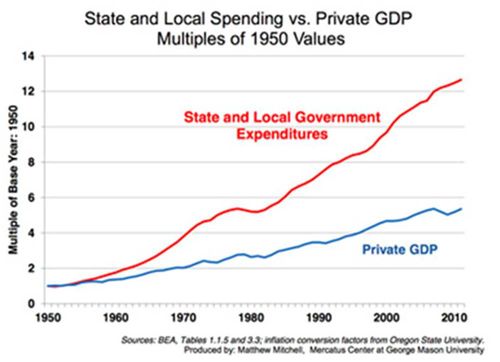
State and local governments depend on the private sector for their survival. Yet, more more than half a century, these governments have continuously outpaced the growth of the private sector on which they depend. After 60 years, the private economy is 5 times its 1950 size while state and local governments are spending almost 13 times as much as they did in 1950. This divergence is unsustainable.


Leave a Reply