

George Rebane
Gross Domestic Product is constantly in the news. It is the definitive measure of a country’s annual production of goods and services. GDP is calculated in several different ways, all are supposed to be compatible. The most often used and useful way is called the Expenditure Method that relates to the different kinds of spending that go on in an economy. In this post I will lay down a little background on GDP that will serve as a ready reference when we talk about things economical during this election year, and keep an eye on the indicators that tell us about the world in Depression2.
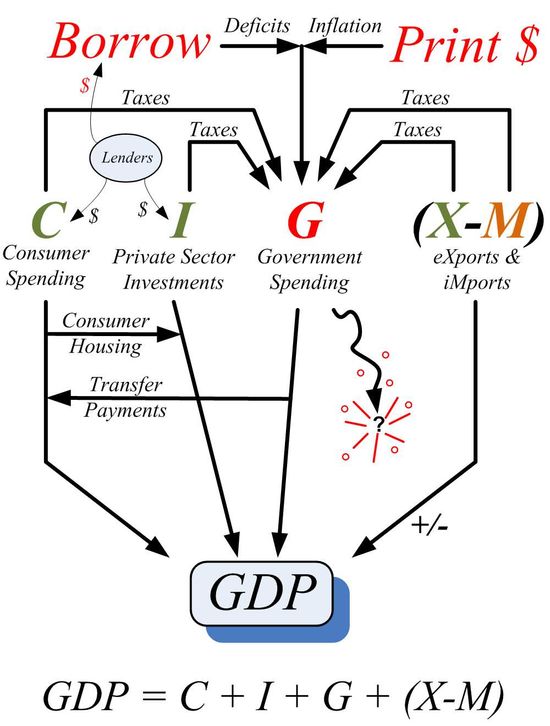 As shown in the above figure, the expenditure method defines GDP as the sum of consumer spending (C), private investments (I), government spending (G), and the net of exports (X) minus imports (M), which is also known as the ‘current account’ of the country’s foreign trade.
The first thing to notice is that government spending (G), which itself generates no wealth, contributes to GDP. This is the notorious Keynesian spigot that is supposed to be opened wide during economic hard times to flood the economy with cash and stimulate spending. The problem comes when we examine the source of G. It all derives from three sources that can at best only hide the pain temporarily when the spigot is opened, and then after a while the whole thing simply ceases to function. (Actually, many of the President’s constituents believe that there is fourth and more mysterious yet just as reliable source called ‘Obama’s Stash’)
G is made up of mainly taxes of several kinds and collected under various guises, and labeled so as to hide their true sum. But all taxes come out of the wealth creating private sector, with the possible exception of autocratic governments selling their nationalized natural resources to other countries. When taxes don’t generate enough ‘revenues’ (love their use of business terms like ‘revenues’ and ‘investment’), then an alternative source is to borrow from lenders (foreign and domestic) to make up the shortfall.
And when borrowing costs become too high, then there’s always the printing press to generate as much new faith-based money as needed (backed by the government’s ‘full faith and credit’). In the US, and many other countries with a central bank, this is labeled as “quantitative easing”. QE is pulled off by our Federal Reserve through its ‘purchase’ of all kinds of securities – like US Treasurys and bad mortgages – using freshly printed money. The idea sold is that the net of this is zero, since this cash is later recovered when the Fed sells back the securities to the private sector, or cashes in its Treasury bonds. The problem is that seldom does it sell those things back at 100 cents on the dollar. But those are just details, which we poor schlubs see as inflation.
Before we leave borrowing, we note in the figure that the loaned cash comes from lenders who at any given time have only so much to lend. And there are more borrowers out there than just the government. The government competes with consumers who want to buy and build, and businesses who need to borrow to manage their operating and (real) investment cashflows. In the lending markets governments are the secure, low risk borrowers. This important factor explains why recovery from a recession is slow when lenders would rather lend to the big guy with guns and a printing press, than some risky business trying to survive in bad times. That’s how wealth creating credit dries up.
During times good and bad, but especially during bad times, government vacuums up cash at a very high rate when it has to support spending programs that it cannot afford. A lot of the money governments take out of the productive economy is grossly mis-allocated through its inept choice of winners and losers, and an untold amount of the money literally disappears as shown by the wiggly arrow in the figure. Economists use a technical term to describe this loss of cash known as ‘pissing away’.
Finally, so that we don’t double count and also understand how governments dispense social justice, we look at the crossing cashflows. When consumers buy housing that is an investment in a long-term asset, those monies are put into the investment (I) column and are combined with business investments. And when governments pay out monies to consumers for things like Social Security, Medicare, Medicaid, various kinds of welfare, veterans’ benefits, pensions, …, and buying votes, those are termed transfer payments and go directly to consumers who then include it in their overall consumer spending.
What contributes to our $15T+ national debt is the annual parade of growing deficits. Each year’s deficit is made up of the difference between taxes plus borrowing minus total government spending (G). And here we come to the easiest way to tell that socialism is not sustainable. Just take a look at any government program of transfer payments or debt service costs, and see if it is taking up a growing or shrinking part of the federal budget (today’s Europe is ‘Exhibit A’). Or if you’re a real stickler, calculate it as a fraction of the country’s GDP. The only way to sleep soundly at night is to firmly believe that people will ignore how much taxes they have to pay, and continue working just as hard and taking just as many risks investing their savings.
Finally, in this discussion we don’t even want to talk about the $100T+ of unfunded liabilities that have accrued to all levels of government. The best thing to do here is to pour yourself a stiff one, and keep mumbling something about ‘lock boxes’ in which all of those liabilities are covered by IOUs. If you don’t drink enough to generate that level of belief in how our leaders have prudently provided for the future, then just think of your kids and grandkids. It’ll serve the little darlins right for all the grief they’ve given you.

 rebanesruminations.com
Leave a comment