

George Rebane
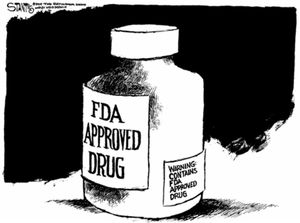 A recent ’60 Minutes’ surprised me with a segment in which it was reported that placebos worked just as well as drugs like Prozac for fighting depression – well, almost as well. Prozac did have a tiny edge in really severe cases of depression. The research was done by Dr Irving Kirsch of Harvard, and it has reignited a firestorm of debate as to what real effect do many expensive big pharma concoctions have over sugar pills.
The power of the human brainbone to gin up alternative realities has been known for decades. In the Greece of pre-Dorian invasions the gods regularly conversed with individuals and even attended public events such as weddings and other celebrations. Everybody saw them and corroborated each other’s experiences. In the middle ages and later, people actually saw witches fly on broomsticks, and believed such sightings to be as reliable as seeing clouds in the sky. In the modern age anthropologists have discovered and studied a tribe in Papua-New Guinea whose known world has a boundary at a narrow river, the other side of which has always been invisible to the aboriginals.
Some psychologists have identified the responsible region of the brain for such hallucinations in the right hemisphere opposite Wernicke’s area (used in language processing). In any event, most of us have heard some astounding stories and are aware of the power of placebos. It all seems to revolve around the level of credibility (faith) we attribute to the sugar pills presented as medicine and administered by sincere and serious healthcare professionals. And this effect seems to work in spades with anti-depressant medications.
But that wasn’t really what caught my attention in the TV segment. The question that popped up was why did the FDA still allow Prozac et al to tout themselves as the clinically effective standard of care for depression. The answer was that FDA’s approval procedures rate a drug effective, if it bests the performance of placebos in at least two properly conducted drug trials or studies. It could fail to be better in, say, ten previous studies, but as soon as it racks up two victories over the placebo, it gets to go to market.
My instant reaction was ‘Wow! I didn’t know that.’ So if in a (double?) blind trial Prozac and a placebo are each given to two samples of 500 subjects suffering from depression, and Prozac is judged to effectively reduce symptoms in, say, 100 subjects, while the placebo equally reduces symptoms in only 98 subjects, then Prozac wins. There was no requirement of statistical significance or any such technical niceties. Two such victories, and the billions start rolling in.
The question then becomes, what kind of risk do big pharma companies take when bringing to market already developed, marginally performing medicines?
My little pea-brain instantly started setting up the problem of finding the distribution of the difference between two random variables. Then given this distribution, how many times would we have to sample from it to get two ‘victories’, or differences of the proper sign – i.e. number of Prozac benefitted subjects is greater than number of placebo benefitted. It didn’t seem that it would take too many such (albeit very costly) trials before big pharma could declare total victory, and put an expensive drug of dubious marginal benefit on the shelf. Just give it a fancy name, and charge a hundred times the cost of an equally packaged sugar pill.
So consider a placebo pill; its beneficial effect is due only to the state of belief or credibility that it generates in the mind of the patient. On the other hand the pharma pill also has all the benefit of generating an equivalent amount of credibility, but adds to that any additional effect contributed by the chemicals (instead of sugar) in the pill. So the placebo relies only on the B (belief) factor, and the pharma benefits equally from B and additionally from the C (chemistry) factors.
Let’s do a little clinical study. Suppose the chance that any given patient is benefitted by the placebo is PB = 0.25 or one out of four. And let’s assume that the pharma concoction’s C factor contributes something to additionally benefit the patient so that PBC = 0.26. If we have a sample of 500 patients each for receiving the two kinds of pills, then we would expect 125 of the placebo group to be benefitted, and 130 of the pharma group to be similarly benefitted. But the realworld problem is that only God knows the values of PB and PBC, and He ain’t talking. Also from any given such trial/study we would not necessarily see exactly 125 and 130 as the counts for the respective benefits, because those counts we tally are actually random numbers drawn from the probability distributions that define both benefits from the placebo and pharma pills.
In such clinical studies the pills are given, and the number of benefitting patients are counted as the result. In our study we can simulate the same thing by playing God, taking those divinely known values of PB and PCB, and doing what’s called a Monte Carlo computer experiment to simulate the study. (You techies will recognize that we’re talking about generating a bunch of Bernoulli trials.). Actually, we don’t even have to do the simulation, but can solve this problem analytically by manipulating a few equations (not to worry, I won’t do it here). Recall that we’re trying to find out how many expensive trials big pharma should expect to conduct before receiving the FDA stamp of approval – i.e. how many studies before beating the placebo for the second time.
The actual number turns out to be surprisingly low. Using the above values for PB, PCB, and 500 for each sample of trial participants, we find that the pharma company can expect to conduct 3.11 studies before its drug is passed by the FDA. Actually, there is only one chance in six that it will have to conduct more than two trials, and only one chance in fifty that it will have to conduct more than three trials for the new drug to pass muster. Now those are low numbers indeed. So even if the drug performs only marginally better than a sugar pill (as evinced by the close values of PB and PCB), the pharma company isn’t taking too big of a risk in whipping something up and getting it tested.
To be sure, there is risk in developing more potent medicines for more physiologically visible and debilitating diseases. And there’s always the risk from unknown and unknowable side effects which may surface long after the drug has been on the market. But for the maladies for which the placebo effect has been clinically verified, it doesn’t seem that big pharma’s trial risk is that large when going head-to-head with a placebo.
[For techies only] Each application of placebo or pharma pills to a subject in a study is a Bernoulli trial that is drawn from a binomial distribution with mean Np, where N is the sample size, p is the probability of success for each trial (application of pills), and variance Np(1-p). At the N values common to drug testing, the binomial distribution can be well approximated by the Gaussian having the same mean and variance. The distribution of the difference (or sum) of two independent random variables has the mean of the difference (or sum) of the two means, and the variance that is the sum of the two variances. This defines the new distribution which will now be sampled for each drug trial in which the placebo and pharma compete.
The FDA acceptance criterion requires that this difference (defined as pharma wins minus placebo wins) be greater than zero. The probability of that for the above given example is 0.642 (the complement of this is the probability that the placebo wins the trial). So now we have a new set of Bernoulli trials to consider, each with 0.642 as its probability of success. The question then becomes how many times do we have to sample from this distribution in order to get two successes. The probability of conducting n such trials to obtain exactly r successes is defined by the negative binomial distribution (q.v.). Computing these probabilities for n = 1 through 30, and r = 2 permits calculation of the expected number of trials before obtaining two successes, and the other probabilities (‘chances’) cited above.


Leave a Reply