

George Rebane
I was asked that question recently by a regular RR reader. He went on to opine that not many of my readers would make the effort to understand all that high falootin’ stuff and just skip over it. In short, I’m wasting time and effort in offering up such posts. And, of course, he may be right. When you’re selling, you never want to discount what a customer tells you. And make no mistake about it, I am selling my little heart out here on RR.
As I later reflected on the reader’s question, it occurred to me that it’s been some years now since I posted anything on the larger purpose and objective(s) for flogging the keyboard and debating various esoteria with RR commenters. Being a rewarded lifelong teacher has provided some intrinsic impetus to this enterprise – first in the Army, then with my kids and grandkids (no claims of success there), as a professional engineer/scientist/academic, and now again working with high schoolers.
RR is structured to continuously build on what has been written and discussed before in its pages. I attempt to back-link all of its pieces to their appropriate ancestors, in addition to the usual outside references. To the extent that this is successful, RR is an accumulating body of thought offered by me, and subsequently expanded and critiqued by the blog’s commenters. Relatively few pieces here start out of whole cloth. I make a considerable and not always successful effort to circle the barn as few times as possible; previous orbits on any given topic are always available by searching RR through its built in function or with an engine like Google (just add ‘rebane’ to the keyword list, and voila!).
Ideologically I am a conservetarian, promoting a careful and hopefully coherent amalgam of conservative and libertarian thought as seen through the Austrian lens. For good or ill, I am an elitist. I know I cannot reach everyone with all possible ideas/notions through my heartfelt diatribes, so I just try to target and contend with a small number of interested readers, all of whom should evince that they have at least three solid digits in their IQ. In that and other things, I am terribly incorrect according to the dominant political perspective of the day as spouted by both Republicans and Democrats.
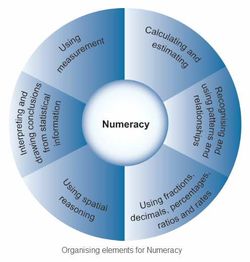 One of the ‘great truths’ I’ve stumbled on over the decades is that social issues owe their prominence and import to the numbers that define them, the numbers that make them significant and worthy of consideration. If such issues are promoted on the basis of other factors, then there’s perfidy afoot and examples of this abound in our public life. And if we don’t understand the underlying numbers of a social issue, then all we are qualified to discuss about it are our feelings and anecdotal experiences.
The corollary to this is that a modicum of numeracy (q.v.) is required to understand and coherently communicate about social problems. And therein hides a greater problem. According to the results presented by the National Center for Education Statistics in its decades-running longitudinal National Assessment of Adult Literacy in America, we are an innumerate nation. Fewer than five adults in a hundred have the skills that comprise numeracy (also known as ‘numerical literacy’) for the non-technically trained adult – arithmetic facility, understand elementary logic, utility, and decision making, structuring simple problems in terms of their components, recognizing elements of taxonomic analysis (this is or is not like that), comprehending simple relationships, especially in the graphic displays of information (charts, graphs, etc) in the public media, … .
Additionally, in this forum the ability to understand and use conditionals (if/then, given that …), the subjunctive case (If the deficit were lower …), and counterfactuals (If China had not bought our Treasuries, then Germany would have) is definitely a plus for the complex stuff that we seek to understand and communicate.
Consider that we are the only developed nation with a culture in which one can declare without shame that ‘I don’t do numbers.’ And we offer almost no educational programs that recognize our deficit in adult numeracy; other advanced nations do recognize this intellectual shortfall in their citizenry and have dedicated courses and programs that teach numeracy to post-schooled adults. We falsely recommend our innumerates to enroll in elementary math classes at community colleges – definitely a wrong approach to addressing the problem. Innumeracy has been treated in many books and essays since John Allen Paulos wrote Innumeracy – Mathematical Illiteracy and Its Consequences (1988), still a classic.
About this volume, Pulitzer prize winning author (Gödel, Escher, Bach) and internationally celebrated cognitive scientist Douglas Hofstedter, who also coined ‘innumeracy’, states unambiguously that “To combat [innumeracy] John Allen Paulos has concocted the perfect vaccine: this book, which is in many ways better than an entire high school math education! Our society would be unimaginably different if the average person truly understood the ideas in this marvelous and important book. It is probably hopelessly optimistic to dream this way, but I hope that Innumeracy might help launch a revolution in math education that would do for innumeracy what Sabin and Salk did for polio.”
Arthur C. Clarke made it more plain when he said, “In today’s world, ‘innumeracy’ is an even greater danger than illiteracy, and is perhaps even more common. Advertisers and politicians exploit it; intellectuals (self-styled) even flaunt it.”
Let me put it more bluntly, numeracy is the essential tool that gives a person the ability to think critically – without it such a pursuit is not possible.
Returning to the technical stuff in RR – it is difficult if not downright futile to discuss the important social issues without resorting to the tools from science and the various fields of engineering that are still accessible to the numerate person with a non-technical background. Some of these tools such as Bayesian reasoning and utility are critical to integrating new information with what is known, and making/understanding decisions in an uncertain environment, especially in public policy. In these pages I will continue to introduce such tools, and show examples of their use and relevance to the questions at hand. As in the past, all such posts will be accessible to readers with a modicum of numeracy, and facility in the algebra that today is taught to eighth graders. But you will have to do some work to slog through the developments; and frankly, readers with adult-onset attention deficit disorders or syndromes of elevated hubris need not apply.
Finally, I sincerely hope that readers who consider themselves astute observers and students of the 21st century human condition – and we all do 😉 – will avail themselves to these ‘technical’ posts so that our deliberations on the issues can proceed apace and systematically to mutually understood if not mutually accepted conclusions.


Leave a Reply