

George Rebane
For the benefit of the undecided reader who is truly puzzled as to the nature and fate of collectivist vs (classical) liberal forms of governance, we will take another lap around the barn. The examination and critique of public policy always circles back to the fundamental arguments between the eternally contending measures of liberty and equality. Equality is easy to attain and maintain, all it takes is ignorance and the gun. Liberty is the more difficult to achieve and keep intact. And that is because ‘equality’ is always arbitrarily defined by the central imposing agency; the definition of liberty is distributed and requires broad consensus among those who are free.
That all forms of collectivism have an intrinsic tendency toward autocracy is an historical truth that is rejected only by the collectivist, no matter what particular mantle – socialist, Marxist, communist, fascist, … – he wears. A favorite argument that works on light thinkers is that liberty and the capitalistic free market societies it gives rise to are only theories that have yet to work anywhere in the real world.
Today Michael Moore and his minions are effective teachers of this thought. Their ancestors would have made the same arguments to our Founders in the aftermath of our Revolution – ‘That man can govern himself is nothing but a theory, show me where in the world we see such form of governance working.’ The intellectual pinnacle of the collectivist seems to be that liberal maxims cannot be trusted to work since nowhere do we see their perfect application, therefore we must only hew to and expand collectivist forms of governance that are observably unsustainable.
 In my readings and studies, I find that all successful liberal societies must base their form of governance on the explicit statement and maintenance of the minimum triangle of rights collected by Frederic Bastiat in his ‘The Law’ (1849). These consist of the rights to private property, security in your person, and individual liberty (see also the Bastiat Triangle). One of the fundamental and minimal functions of the state is to uniformly guarantee these rights, for the weakening of any one of them immediately weakens the other two. And it is upon this stable structure of rights that all other legitimate rights can be constructed into a larger and still stable structure of social governance. Our Constitution prescribes such a structure.
One of the fundamental limitations that government must operate under is a fisc sustained by taxes limited to a specific maximum fraction of the nation’s GDP. I believe the sweet spot for that fraction is in the 15-20% range. And that fraction must be adhered even in times of national emergency when clearly a larger share of GDP is required to maintain public welfare and/or sovereignty. The clarity of such requirement is used by the government to borrow additional monies (e.g. ‘Victory Bonds’, Treasuries) as needed from its citizens and foreign lenders. If its citizens are not voluntarily willing to step up to maintain their nation in time of trouble, then they have collectively decided to let it dissolve and cast their lot for a better future. That is the responsibility of true freedom – you are free to again become a slave.
None of the above is feasible for large, diverse populations. It only works when it is implemented by people who share the necessary commonalities to come together in the attempt to form such a ‘more perfect union’. The dominant commonality is a culture that is sufficiently deep, uniformly honored, and widely celebrated. Such cultures evolve slowly and are necessarily exclusionary. But they do guarantee the maximum liberties with the minimum of formal legislation and its enforcement bureaucracy. The alternatives to this have been presented to us in the 20th century, and new ones are in the construction phase in this century.
Liberal states do not send armies across borders to spread their gospel. But they do jealously guard their own borders, conditionally letting in only those who are judged to serve the interests of the established. A community of such nations would serve as a dynamic laboratory of competing experiments in governance, each free to copy the beneficial discoveries of the other.
The more collectivist states will remain as the biggest threat to world order, since their inability to create sufficient wealth will require the perennial finger-pointing at foreign pariahs who are the propagandized cause of their internal shortcomings and misery. It is they who will have the tendency (requirement?) to send armies instead of trade goods across their frontiers.
Today the EU is the most compelling exhibit of these principles. After decades of socialistic programs which have primarily served to grow usurious governments, the facades of such social engineering are beginning to crumble. But the downfall is not uniform across the continent, and does reflect the cultural propensities of the nations involved. Germany is clearly the richest and most stable of such nations, and it is being studied for emulation by other EU member states like Italy, Spain, and even the Scandinavians.
However, the recent (14-20apr12) issue of The Economist contains analyses concluding that the German model may not be worth copying, primarily because its working owes so much to the culture of the German people, a culture of structured dynamism and “ordered flexibility”. “(T)he essence of (the German) model is rooted too deeply (in its culture) to be copied easily.” This beneficial state of affairs has come about through an aggressive effort by Germans to “liberalize its labor market rules” and broaden its apprentice/academic dual track educational system. Germany realized a long time ago that not all students are prepared to benefit from a college education, especially one that is empty of teaching wealth creation skills.
I don’t want to end this little apology with the implication that Germany is practicing a sustainable form of liberal governance. Along with other Caucasian nation-states of Europe, Germany is headed for a demographic iceberg. Germany, due to its history, is particularly vulnerable to losing its economic primacy as its population ages and workforce shrinks. It cannot convince Germans to make enough little Germans to keep the whole thing going. And thereby hangs another tale.
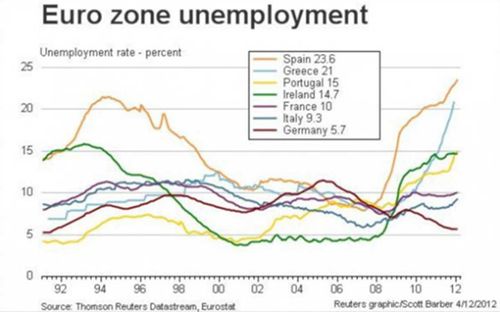
[16apr12 update] H/T to a reader who sent me the revealing graphic below. The reader is invited to note the levels of unemployment BEFORE the Great Depression. That these were outrageously high was somehow missed by our own socialists singing the praises of the ‘European model’ of socialist policies. This is a useful picture of the economies Europe is trying to pull back from, and the ones that Obama and the Dems have been attempting to replicate with some considerable success.
Adding to the current developments in Europe’s pullback from its collectivist policies is this piece in 14apr12 The Spectator on ‘Sweden’s secret recipe’ by Fraser Nelson. There he reports –
… Since becoming Sweden’s finance minister, (Anders Borg’s) mission has been to pare back government. His ‘stimulus’ was a permanent tax cut. To critics, this was fiscal lunacy — the so-called ‘punk tax cutting’ agenda. Borg, on the other hand, thought lunacy meant repeating the economics of the 1970s and expecting a different result.
Three years on, it’s pretty clear who was right. ‘Look at Spain, Portugal or the UK, whose governments were arguing for large temporary stimulus,’ he says. ‘Well, we can see that very little of the stimulus went to the economy. But they are stuck with the debt.’ Tax-cutting Sweden, by contrast, had the fastest growth in Europe last year, when it also celebrated the abolition of its deficit. The recovery started just in time for the 2010 Swedish election, in which the Conservatives were re-elected for the first time in history. …

 rebanesruminations.com
Leave a comment