

George Rebane
[This is the submitted form of my April column that appeared in the online (with figure omitted) and printed versions of the 14apr12 Union.]
By now most of us have heard of Stockton, the next California city teetering on the edge of bankruptcy as a result of a fiscal history that “has eerie similarities to a Ponzi scheme” according to its city manager Bob Deis. The story is common to thousands of cities and counties across the land, and the core of each is years of lavish wage and pension benefits promised and delivered to the public sector employees in all the afflicted jurisdictions.
So now Stockton has already “suspended some payments to bondholders and is negotiating with creditors and unions”. But Stockton, unlike many municipalities still drinking their koolaid, is open about its shortcomings. A recent (1apr12) WSJ article reports that “Stockton admitted that its biggest problem has been a lack of transparency resulting in a host of ‘hidden costs’ in labor agreements for ‘obligations that are often difficult for citizens to identify or understand.’ ”
On the national scale the problem has been most recently researched and reported in the Cato Institute’s ‘State and Local Pension Plans’ by Jagadeesh Gokhale. There we find that the financial health of most plans nosedived during the 2001 to 2009 interval. What kept the apparent ponzi schemes going was that plan managers were allowed by the Governmental Accounting Standards Board (GASB) to discount calculation of future plan liabilities at literally any interest rates which barely allowed them to keep a straight face.
California’s ponzi is still being foisted on the basis of the giant California Public Employees Retirement System projecting payouts and liabilities on the basis of their portfolio earning a now reduced (yes, indeed) rate of 7.5% annually, and that while Governor Moonbeam is going to raise taxes again to rebuild the state’s economy. You can’t make this stuff up.
More sober heads in the Federal Reserve, Bureau of Economic Analysis, and the Congressional Budget Office have finally been forced to acknowledge that liabilities should be computed on “an actuarial basis that reflects the value of benefits promised, regardless of the contributions made by the employers (states, counties, municipalities) today.”
For the folks not keeping up with things financial, 7.5% returns are now in the junk bond category, and no prudent investor today is making plans to earn such high returns in foreseeable markets. But cooking the books with such a discount rate sure lowers the obligated dollar amounts jurisdictions are supposed to pay in to outfits like CalPERS in the coming years. All this paints a very rosy picture of the unfunded pension liabilities that cities and counties should plan for.
Well, that really hasn’t been the case as even some progressives are beginning to admit. The problem has been twofold – first, the electeds have a conflict of interest when negotiating with public service unions. There they often forget on which side of the table they sit; and second, public service pensions have purposely been made so complex, convoluted, full of ‘dependers’ that their true costs have components which are easy to hide from a citizenry seeking to find out the status of when what obligations will burden their city or county.
Ignoring all this, and with straight and stern faces in place, local elected officials and their staffs still maintain to their constituencies that things are well in hand – just keep us in our jobs. Meanwhile the line at the Chapter 9 bankruptcy window is growing longer with cities and counties preparing to face the music as years of political gaming gets trumped by the real world.
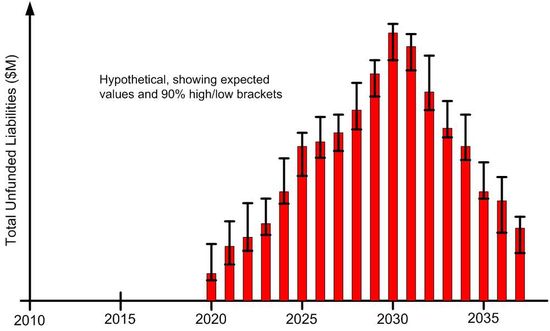
To counter this, local government financial mavens can report such unfunded obligations in a clear graphical format (see figure), that shows how much is due when, along with their uncertainty brackets for their assumed discount rate(s). Our elected officials and voters need such clear and complete information to make decisions about who should be doing what next. Today the electeds either don’t have this information, or simply don’t want to tell us. Instead they prefer to bamboozle voters with powerpoint presentations which send us away with eyes rolling and heads spinning.
Here in Nevada County taxpayers are spared such concerns. We are assured that our city and county jurisdictions are well managed, that the electeds never play hide-and-seek games with the books, and things are well in hand for our fiscal future. Any concerns to the contrary, like those reported problems that waft up from the flatlands, quickly dissipate with the sunrise as if they were some rural myths shrouded in the morning’s mountain mist.
George Rebane is an entrepreneur and a retired systems scientist in Nevada County who regularly expands these and other themes on KVMR and Rebane’s Ruminations (www.georgerebane.com).
[16apr12 update] H/T to RR reader who sent the link to ‘Why Government Pensions Are Goint Broke’ published in the 16apr12 California Political Review. Every day it is harder to find holdout liberals who deny the public service employees unions and their role in the nation’s unfunded liabilities disaster. It wasn’t that long ago that that this ignoramus choir numbered in the tens of millions.

 rebanesruminations.com
Leave a comment