

George Rebane
There is no question that governments at all levels have become less efficient from the taxpayers’ viewpoint. This inefficiency is felt from many quarters and with respect to applied metrics, ranging from ‘bang per buck’, through layers of onerous regulations and mandates, to the ongoing removal of freedoms often through gratuitous criminalizations.
We live in a county that, on the whole, is fiscally well managed. However, in recent years many of us have started to notice some pretty significant lapses in how our elected officials do business. As examples, we may consider the string of bad decisions made during the recent AtPac lawsuit (q.v.), the demonstrated and endured lack of competency in the county counsel’s office, and our county’s official discounting/denial of its unfunded pension obligations. On all of these, the inquiring citizen faces a phalanx of tightly circled wagons, and is ridiculed for bringing up individual issues.
The portent of the county’s unfunded liabilities are undoubtedly the biggest sword hanging over our taxable heads. The amount that the county will have to pay out in the future (the out-years) is actually a complex calculation, and depends on not only the legal obligation to the public service retireds, but also on how much CalPERS will have in our account. We have to remember that PERS is just an investment manager for the retirement funds the county remits to it. PERS has no obligation to do anything except disperse what is in the Nevada County’s account. (And then we are in a risk pool with a couple of hundred other jurisdictions like the profligate City of Bell, which is a whole other dimension of risk.)
This account may go up or down, depending on the vagaries of the securities markets and how astute the PERS portfolio managers are. Their obligation as a fiduciary is only to do their best, come what may, and also to tell us their best estimate of what our unfunded part is when payments come due. And that is where the problems start. Local jurisdictions all over the country are basically in arrears, and many cities and counties are on the brink of Chapter 9 bankruptcy.
In California, Stockton is our next city that is prepared to file. The San Francisco Chronicle has a more complete report on the entire situation in the state, and it isn’t pretty.
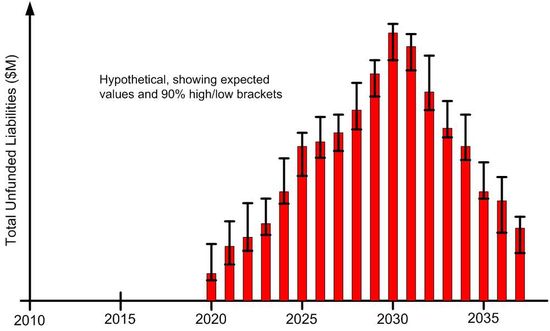
Added to the above calculations we have at least one “side fund” and yet to be explained amounts of monies due that are not shown on the county’s financial statements. The situation is murky indeed, and our electeds are not exactly leaning forward to clear up the obligations that are facing us. What I would like to see is a chart like the one below that shows by year Nevada County’s total known and anticipated obligations with error brackets showing the high-to-low range.
For more a higher level perspective, we recall the 2009 quote by Mr Ron Seeling, Chief Actuary of CalPERS –
“I don’t want to sugarcoat anything. We are facing decades without significant turnarounds in assets, decades of …unsustainable pension costs of between 25 percent of pay for a miscellaneous plan and 40 to 50 percent of pay for a safety plan …unsustainable pension costs. We’ve got to find some other solutions.”
And things have gotten worse since then.
Finally, to put a finer point on it, I am copying an article in yesterday’s 25feb12 Union by Mr Mike McDaniel who was lead author of the 2007 SESF unfunded liabilities report (download) that was given to our Board of Supervisors, and followed up by a 2009 presentation to the BoS. The reception of these by our county government was, let’s just say, less than enthusiastic. And since then the wagons at the Rood Center have circled a bit tighter. Here’s Mike’s article with its included graphic –
Unsustainable public employee pension plan costs will continue to decrease the value provided by government to taxpayers. In 2007, I co-authored a prophetic report titled “Unfunded Liabilities — Our Community’s Fiscal Time Bombs.” The 2007 report highlighted the crisis brewing in relation to public employee pension funds. Less than a year after the report was published, the crisis was exacerbated as the economy and stock market (critical to pension plan health) crashed.
I am of the opinion that decades of failed leadership, overwhelming public employee union power and mismanagement by CalPERS have created a crisis that is too big to solve.
Leadership (on federal, state and local levels) continues to ignore the crisis, public employee unions continue to grow stronger and CalPERS shows no intentions of shifting to a sustainable program.
I don’t expect our politicians (on all levels) to reform public employee pension plans. Instead, I expect the value provided to taxpayers to continue to drop. Accepting that each public employee adds value to taxpayers, we must also accept that paying more for fewer public employees significantly decreases the value to taxpayers.
Though this crisis exists across the United States (and around the globe — see Greece) I will use Nevada County (in my opinion a very well-run county) to support my point:
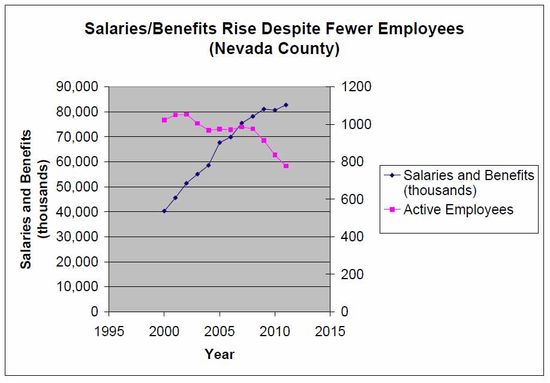
In 2001 “salaries and benefits” were 39 percent of the annual budget. Today “salaries and benefits” equal 47 percent of the annual budget. This increase in cost coincided with a substantial decrease in the number of employees (from 1,055 employees in 2001 to 777 employees today — a drop of 26 percent).
In other words, “salaries and benefits” increased substantially, while the number of active public employees dropped to its lowest point in decades. Consider this, in 2001 the average “salaries and benefits” paid per employed was $127,962. In 2011-12 budget that expense per active employee is expected to grow to over $222,500 — an increase of 73 percent!
Taxpayers should expect a continuation of this trend throughout all levels of the public sector.
The role of government will increasingly be that of a glorified pension plan administrator, existing as a conduit between taxpayers and retired public employees.
As the unsustainable pension plans run their course taxpayers can expect to see less bang for their buck for decades to come.
Michael McDaniel is a sixth-generation Nevada County resident and owner of McDaniel Wealth Management in Nevada City.
But according to some of our electeds all such concerns are just some more of our local “rural myths” – don’t worry, be happy.
[2mar12 update] A reader emailed me the latest report in the WSJ MarketWatch on the happenings in Stockton’s slide toward Chapter Nine (kinda has ring to it), and their clueless citizens wrestling with the ghosts of their imaginings.
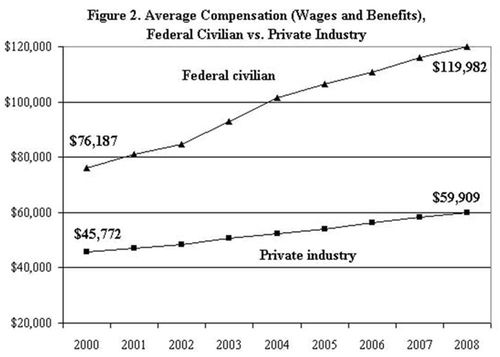
Also, Mike McDaniel, author of the above Union piece, posted a comment below that links to a Cato Institute graph that compares the average of total benefits received by federal and private sector civilian workers. This graph is reproduced below.

 rebanesruminations.com
Leave a comment