

George Rebane
A recent study by Vivek Wadhwa of the Singularity University published in the MIT Technology Review reports that older techies start more successful technology based companies than do those still a little damp behind their ears. This contradicts a long-held myth.
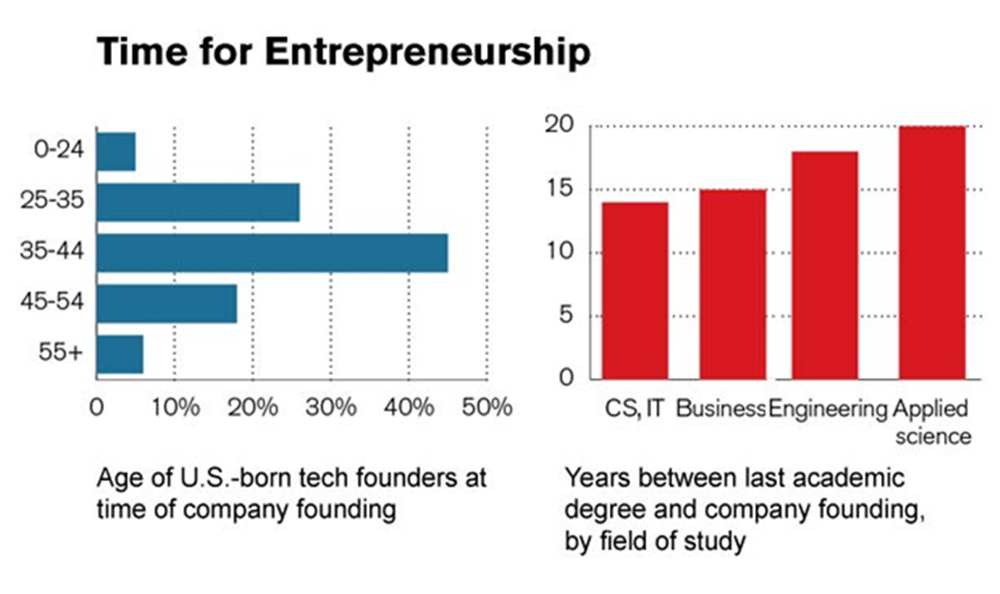
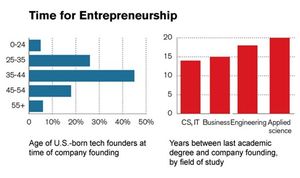 The Kaufman Foundation which gathered data for the study states that a “survey of entrepreneurs found that most started their first company at age 39. People with degrees in computer science started companies much sooner than those with advanced training in other sciences or engineering.” The nearby chart from Wadhwa’s piece summarizes the data.
This ties with my own experience. I co-founded my first company at the age of 43, and my last fling was at 58. Now, in my seventies, I’m still in there wiggling to help another start-up, hopefully on its way to the stars. Wadhwa points out why the mature technical types have had the lion’s share of success. The reasons are not surprising.
Musing over these findings I recall the educational backgrounds of technical workers in technology based start-ups. Having hired many an engineer and programmer in my time, the candidates’ formal credentials were of least interest to me as an entrepreneur and hiring manager. I wanted people who could get the job done, and I have always been sufficiently astute technically (as are most other such technology managers) that I could vet the candidate myself through the interview process.
This is possibly a major advantage that technology has over other ‘soft’ business and professional areas. Government has not yet put its heavy hand into the truly innovative and creative businesses enough to stifle the mobility and access of good talent. Some of my best techies had no college degree at all. This started me thinking on a thread that was piqued by Fay Vincent’s – ‘Price Controls for Harvard’ in today’s (1feb12) WSJ.
Government has wormed itself into so many areas and facets of our lives, and almost always has damaged the fabric of our society by increasing cost, red-tape, and decreasing performance. Of all the things that government does poorly (as I have posted here before), education and training are contending for the top of the list. Only in the military does government excel in these areas. Today they have caused the cost of an undergraduate degree to soar beyond the reach of almost everyone. And then coming in to finance certain areas of education through loans, grants, and other funding subterfuges they have now screwed up the situation so badly that they are considering yet another layer of bureaucracy to inflict price controls on higher education – the socialists seem to never know when enough government is too much.
So I’m suggesting that we separate the teaching (pedagogical) part of undergraduate education from its certification part. Let universities get out of the business of filling lecture halls with students who are taught by discontented professors who would rather do research and/or strive for tenure, or mostly by graduate student teaching assistants who have little choice in the matter. In this new paradigm, teaching would be done by anyone – corporations, consultants, retired professionals, people in the workforce – and the education delivered in a hundred different ways that suits teacher and student. In essence, let’s return education to the Socratic/Platonic approach in which a teacher’s reputation draws to him/her students who buy as much of their education as they want at mutually agreed rates. The material could be delivered in a rented hall, a donated conference room, around someone’s dining room table, or even under a tree in a park. (I had a chance for the latter from historian Dr Page Smith at UCLA, for half the semester we met under a big tree in the music and arts quad.)
These educators could be employees of private education companies or fly solo as consultants. The barriers to entry would be essentially zero. They would teach a course of instruction, test their students, and certify performance through a simple signed letter (and perhaps posting completion and grade on their website). And in an age of accelerating technology, such teachers could adapt and/or change their curriculum instantly instead of submitting such proposals to university department curriculum committees where academic politics rules.
The role of the universities would revert to validation of educational achievement, and recognition of such achievement by the award of the appropriate degree. They would do this by administering one or more exams to any student who is willing to pay the low application fee. The university would grade the exams and award the degrees as appropriate. Past exams would be posted so that students seeking university degrees would know how to design their curriculum and learn under teachers they consider qualified to teach them the material. Word about the success ratios and other performance measures of the teachers would spread rapidly, both virally and via internet.
In this scheme, research universities would still teach certain subject areas that require the financing and amortization of expensive infrastructure and/or equipment. But with the advances in online learning, these subject areas would be encountered in a diminishing number of fields, and almost entirely in graduate studies.
My bet is that the cost of post-secondary education would plummet when teaching and certification are separated. This is demonstrated in one of the few areas where California has its institutional head screwed on right – the certification of lawyers. Here the would-be barrister does not have to get a degree from any law school, or even attend a law school in order to take the state’s bar exam and practice law in California. (Then again, maybe that is why we have so many of them running around and screwing up the works. Let’s rethink about applying this scheme to law.)
And to put a ribbon on it, the actual value of a degree may finally find its correct market price when employers start evaluating a student based on the study areas he mastered as certified by his letters from established instructors, and demonstrated through the interview process. Given that the government is again considering ratcheting up its incompetent involvement in education, I think that this approach of separating instruction from certification is worth a try.
[2feb12 update] Coincidentally the Cato Institute policy analysis piece ‘How Much Ivory Does This Tower Need? What We Spend on, and Get from, Higher Education’ by Neal McCluskey arrived. It sheds light on the cost problems with higher education from another perspective that also reinforces what I have proposed.

 rebanesruminations.com
Leave a comment