

George Rebane
[This is the transcript of my regular KVMR commentary broadcast on 18nov11.
Princeton’s progressive economist Alan Blinder is in the national media again (14nov11 WSJ) arguing against the flat tax. Ignoring all the benefits that flat taxes have brought to post-Soviet eastern European countries, he lambasts America’s reconsideration of the flat tax as the “bouncing back of a bad penny.” Before taking a closer look at Professor Blinder’s arguments against the flat tax, let’s review some basics of the new tax proposals.
 The Flat Tax is often mentioned together with the Fair Tax without many people knowing the difference. A flat tax is computed as a fixed percentage of your taxable income, which according to its promoters, is easily computed with few or no deductions or exemptions. The Fair Tax is actually a federal sales tax imposed in place of the current income tax. Both taxes have provisions for giving some advantage to the poor wage earners and consumers.
The prime criticism against these leveling taxes is that, yes they cause more people to pay taxes on a more even basis, but they both come out being unfair in the sense that they are not as progressive as the current taxing scheme. Progressive is taken to be good in and of itself since it makes the higher earners pay a more disproportionate share of their income in taxes. Today this disproportion has the top 5% of earners paying almost 60% of all federal income taxes, and almost half the workers paying no federal income tax at all.
The flat tax would not tax corporations or capital gains because corporations in reality pay no taxes, they just pass their tax expense on to their customers in the prices they charge. The governments then get to collect even more taxes from the higher sales taxes they get from the subsequently higher prices. Of course, high prices are hardest on the poor and act as a general friction on the economy.
Taxing capital gains is another friction on the economy in that it inhibits investment monies going to the most efficient accelerators of the economy, and in many ways also imposes double taxation on the gained capital.
So Professor Blinder opposes the flat tax claiming that computing taxable income is made no easier than it is now. And since most of the complexity of both tax schemes is involved in computing what can be taxed, there is no gain in going to a flat tax. But this argument is based on the false premise that taxable income will still be computed in the current convoluted way, and then begs the question by using the false premise as the argument for supporting the proposition that a flat tax is no simpler than what we have now.
The good professor then doubles down on his assertion that the flat tax is no good because it is not progressive as is our current tiered-rate system. This again uses the classical logical fallacy of begging the question by using the absence of the premise characterizing the proposition to attack it. Here Blinder wants us to tacitly assume that a progressive tax is better than a flat tax, and then he points out that the flat tax is not progressive. Therefore the flat tax is not better than the current tax system. Got that?
Reduced down, Blinder states progressive taxes are the only good taxes. The flat tax is not progressive, therefore a flat tax is no good. Begging the question is a well-worn and very successful logical fallacy used by debaters, salesmen, and politicians to win arguments with light thinkers.
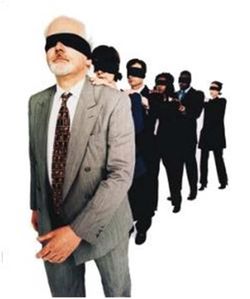
Blinder finally argues that it is politically difficult and dangerous to simplify the existing tax code. Therefore the politicians will not do it. Therefore reality dictates that we should give up working for a simplified tax code. Throughout this Dr Blinder has definitely been leading the blind – I hope that you are not one of them?
My name is Rebane, and I also expand on these and other themes in my Union columns, and on georgerebane.com where this transcript appears. These opinions are not necessarily shared by KVMR. Thank you for listening.


 rebanesruminations.com
Leave a comment