

George Rebane
At the risk of boring the bejeezus out of RR’s readership, here’s a bit of quantitative follow-up for all you investors playing the odds on the approaching collapse of socialist Europe. Well, maybe that’s putting it on a little too strong, but looking at the way sovereign debt is being priced by the bond markets today, you gotta do more than wonder.
My last yawner on this (it got all of 4 reader comments) was ‘Greece and the 100% haircut’ where I showed how to calculate the probability that a borrower (here Greece) would default within a future interval of time, say, in the next year or two years. The probability would be assessed by the world bond markets. I gave the formula for computing that probability on your calculator using your own input values.
The piece also had another formula for computing what minimum interest you should demand from a borrower if you thought he’d go belly up with a certain probability within a given time. Fun stuff if you are an investor playing that great American favorite ‘You Bet Your Ass’.
Anyway, for those who don’t want to mess with their calculator, and still want to keep track of the real shenanigans in Europe (the rest is just BS), I made a plot of default probability as a function of time and the rate difference. The numerate reader will notice that the probability of default (Q) depends on the interest rate spread (rB – rRF) between the current bond rate and the so-called available ‘risk free’ rate – for the faithful, that’s what a 10-year US Treasury pays. The formula for Q is shown in the figure below, and when you use it remember to convert percents into decimals.
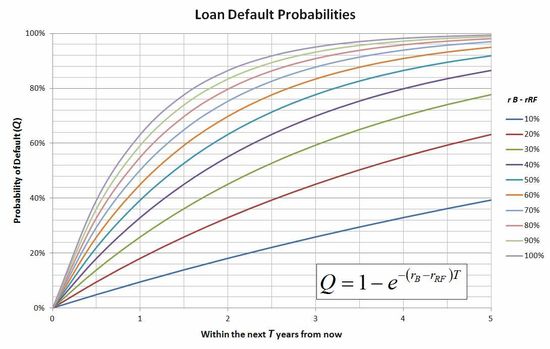
Suppose you hear in the news one morning that some teetering country’s bonds are going for 23% per annum, and US Treasuries are paying 3% – that gives you rB – rRF = 23% – 3% = 20%. And you want to find out what is the probability that said country will default before two years from now (T = 2). Then enter the horizontal T-axis at two, go straight up to the 20% curve, and then left to the vertical Q axis to read off about 33%. The market is saying that there’s a one out of three chance that you’re going to get a haircut if you buy and plan to hold those bonds for two years – that’s the real news. Now is 23% enough of a return for you to take that risk? If your numbers fall between the values given in the figure, you’ll have to remember how to interpolate. See, you’re having fun already.


 rebanesruminations.com
Leave a comment