

George Rebane
We hear that Greece’s financial situation is so dicey that they now have to pay over 270% yearly interest on their bonds. The ten-year US Treasury today closed at 4.88% per annum. Everyone who reads RR knows that Greece is teetering on the edge of default and pulling out of the eurozone. Being prone to financial engineering, this set me thinking about the chance (probability) that Greece will go belly up during a certain future time interval, say, in the next 12 months. The interest yields on the two bonds should contain enough information to tease out this number given that the US Treasury is still considered a safe haven or risk-free investment.
So I pulled out my trusty pencil with the big eraser strapped to one end, and set myself down to push a few squigglies. The question I sought to answer is ‘Given the market interest rate for a risky and a risk-free bond, what probability of default in a specified future interval does the market implicitly assess to a risky borrower?’ Well, it turns out that there is a very definite answer to that question, and the market’s probability of default is given by –
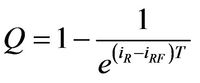
Where Q is the default probability, iR and iRF are risky and risk-free annual interest rates, and T is the interval from the present to some future time expressed in years.
Plugging in the above interest rate numbers and looking out one year, we get 0.93 or 93% as today’s market assessment of Greece defaulting some time during the next twelve months. One can, of course, work the formula backward and answer the question ‘If I believe the probability is X% that Greece will default during the next year, what interest rate should I demand on their bonds?’ The answer to that is computed from –
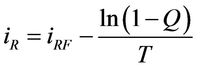
Where the mathematically astute will recognize 1-Q as the probability that the risky borrower will NOT default. ln is the natural logarithm (to the base e = 2.7182… ).
You can now put those formulas into a spreadsheet and have all kinds of fun figuring out how solid a certain corporation is, given the interest they have to pay on their bonds. And you can plot Q, their probability of default, against T, which you would expect to increase over longer periods into the future. Using the above numbers, I’ve done that for Greece.
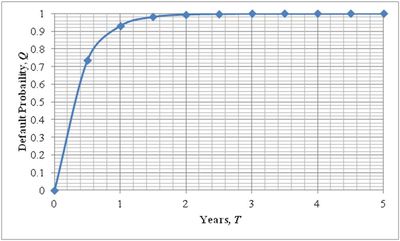
Again, technically inclined investors will recognize that these formulas can now be used in allocating assets and designing a portfolio. If there is qualified interest in their derivation, I’ll write up my scribbles into a readable pdf and attach it as a download to this post. Enjoy.
[5oct2011 update] A reader emailed me that the risk-free rate really closed at 2.04% instead of the 4.88% I used above. My eyes must have been crossed when I looked at that rate to get the example for this post. Nevertheless, I reran the calcs with the 2.04%, and as expected, the results were essentially the same as they were higher only in the third decimal place. This is because the two interest rates enter the formula as a difference, which in this case did not change very much at all. H/T to the attentive reader.


Leave a comment