

George Rebane
The one dimensional political spectrum is of great rhetorical convenience, but absolutely worthless when it comes to correctly summarizing the attributes of ideology that the so-called ‘Right’ is supposed hold dear (more here). The light-minded view is that we start somewhere at the far Left where altruistic collectivism rules the roost under the various labels of communism, socialism, progressivism, and (latter day) liberalism – all various flavors of association that celebrate ‘the people’ over ‘the person’.
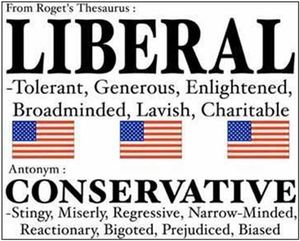 Continuing ‘rightward’, we migrate through a region of ideology inhabited by the ‘moderates’ or ‘the center’, or even the ‘undecideds’ whose ideological make-up is a wavering unknown. From here we keep going until we start getting tinges of ‘the Right’, and press on until we finally arrive at the ‘far Right’. When this expanse is outlined, using these or other similar words, one gets a lot of nods from people all of whom think they know the next level of definition.
The common view from the lamestream media is that both extremes are autocratic and bad – on one end people like Stalin, Mao, Pol Pot, and the other end with characters like Hitler, Mussolini, Franco, Pinochet. This is a nonsensical view of the reality of the American Right under which people who call themselves conservatives, libertarians, free-marketers, and even conservetarians are lumped. The nonsense is that if you fully applied the ideological tenets of these people, then you would return governance and society to what it was under the ‘Rightwing dictators’ listed above, or other knuckle-dragging versions of it.
This is utter bullcrap, for all the above rogue gallery and their lesser ilk were first and foremost collectivists who claimed to benefit “the people” (“der Volk”), and accomplish that through forging the person into a compliant ideal of the state. The only difference these despots had was the advertized scope of their interests – national vs international. This is the exact antithesis of the tenets that conservatives and libertarians hold dear, and are prepared to go to the ramparts to defend.
What it all comes down to is that the Left’s accepted attributes are described existentially through their actions (existing public policies, ongoing grassroots activism) and their own published words. And then the semantic assault is continued in our press and public education, again by the Left, to impose definitions of and impute thoughts by the Right. The result is the current political panoply that is defined solely by the Left, since they dominate in the press and public education. This is the present state of public discourse that I claim is also nowhere better illustrated than in the comment streams of RR.
Examples of the above propositions are legion if we remember not to conflate Republicans and Democrats with Right and Left. A partial collection of the divergent beliefs is –
• The Left sees legislative productivity only in the amount of new laws, regulations, and taxes a government passes. The Right measures legislative productivity by the absence of new laws or the prudent revision and rescinding of existing laws, regulations, and taxes.
• The Left can put no limits on the size and scope of government; the Right attempts continually to limit both the size and scope of government.
• The Left is totally blind to the decay of individual liberties and access to state resources (land, minerals, energy, timber, water, …) a la Agenda 21 (search RR); the Right sees, laments, and documents the continual proscribing of individual liberties and criminalizing of long-legal public behaviors.
• The Right holds that the most good for the most people (Pareto optimality) is achieved through widespread entrepreneurial risk taking in a private sector operating with minimally regulated markets; the Left sees government as the arbiter and generator of zero-sum wealth through a maximally controlled and minimalist private sector.
• The Left sees the individual ideally as a homogenized member of a regulated class; the Right looks at people as free individuals with varying abilities, traits, and circumstances who will necessarily sort themselves into a wide range of earners, consumers, and givers.
• The Left can only assess ‘equal opportunity’ by equal outcome; the Right sees ‘equal opportunity’ in terms of an individual’s unfettered starting line, recognizing that each will bring different resources to that starting line and accepting that each will not finish equally.
• The Right sees private charity as the major contributor to the needy and less fortunate, with the state providing a limited ‘safety net’; the Left sees the state (i.e. collective) as the responsible agent for providing for everyone equally, no matter how low the common denominator of universal service must then become.
• The Left sees no danger in a global government (Agenda 21), instead, viewing it as the necessary structure of governance to bring peace and prosperity to the world; the Right abhors a single government on Earth, and sees in this the final, technology assisted destruction of Man’s finest aspirations and opportunities, the achievement of which would otherwise be promoted by a community of freely trading sovereign nation states.
• In sum, the Left sees Man’s highest social achievement in progressing to centralized control through the installation of compassionate and wise elites who access centralized knowledge bases, all suitable for efficiently and effectively governing humankind; the Right sees this as resulting in a wasteland of devastation and misery, and for enlightened governance believes in imitating the evolutionary paradigms of nature based on widely distributed knowledge, control, and tight feedback in order to achieve Man’s highest goals (for which IMHO the operational objective or litmus question at this point in our history should be ‘How does this help us all go to the stars?’).
Given the above, here are the important exit questions –
1. What is “radical” or historically non-mainstream about these ideological tenets of the Right?
2. Why is it so hard to get people on the Left to answer or even address the substance question #1?


Leave a comment