

George Rebane
[This is the submitted version of my column that was scheduled to appear in the print and online editions of the 10sep11 Union. It was rescheduled and has been printed in the 17sep11 print and online editions (here) due to the Union‘s focus on 9/11 commentaries. This piece clearly would not have fit.]
The election season is here, and the economy is in the tank. America is at a gore point – we can take the left fork and double down on the great mistake of ’08, or we can believe that there is a future for us which rejects the global socialism in UN’s Agenda 21. (Agenda 21? See Judi Caler’s excellent ‘The many tentacles of Agenda 21’ in the 3sep11 Union available online.) But before next November our focus will be on jobs, and which way the electorate will swing and sway.
Readers familiar with my arguments on our workforce and employability know that the recovery, when it comes, will be unique in American history. Comparing all kinds of data and charts on past recessions and depressions shows that we have already tipped into an unknown world. Technology and globalism is obsolescing tens of millions of our workers. And today only 81% of America’s potential workers between 20 and 64 are even in the workforce. From 1948 to 1980, this was 98%. Since then it has been steadily dropping in all worker categories.
We can argue what caused this decline – global competition, technology advances, productivity increases, worker “dumbth”, government friction, transfer payment subsidies, … – but the bottom line is that today the almost 40 million un/under-employed will increase to way over the 70 million that I recently predicted for 2020. These folks will have to be sustained by massive wealth redistribution payments from a government that has no idea how an economy generates the needed wealth.
And now education turns out to not be the automatic cure it once was for getting a job. We have graduated too many young people whose skill sets limit them to competing with computers, changing diapers for the aged, or becoming government counselors who listen to life stories of the desperate, deranged, or delusional. The simple fact is that such jobs cannot command the much-touted ‘living wage’ that progressives demand for everyone.
As an aside, a definite growth industry for jobs is government regulation enforcement. Today, led by the EPA, the number and size of rogue agencies is on the rise. Job intensive businesses from world-famous guitar makers to local auto body shops are being raided by merciless teams of government thugs. These are sent by unelected bureaucrats at all levels to gratuitously enforce regulations that would never be passed as standalone laws by any legislature in the land.
Bureaucrats levy crippling fines, mandate new operating procedures, and order changes in physical plants and equipments that do little or no good, and make less sense. Their devastating impact forces layoffs, delays hiring, and even closes companies.
So instead of doing the obvious things to promote enterprise, build businesses, and create jobs during this recession heading for depression, governments are adding burdens ranging from new rules to new fees and taxes. And while governments claim a shortage of revenues to do things like educate kids or catch criminals, oddly enough, there is still plenty of money to fund hassling recently criminalized taxpayers.
So we may ask, who enables and supports such blatant destruction of our economy and individual liberties. The answer is simply our uninformed and ignorant voters, those whose voices are manipulated and strengthened as we abandon the republic our Founders and forefathers left us, and march toward the new American democracy.
Under the guise of correcting civil rights abuses, the left is now reducing voter qualifications from being able to fog a mirror on election day, to having once been able to do that. Richard Rahn of Cato writes –
Many a democracy has been upended by excessive government spending — and, unfortunately, America, despite the latest budget agreement, is well on its way to fiscal and, perhaps, democratic collapse. The American Founding Fathers well understood that democracy could destroy liberty through both excessive spending and oppressive actions by democratic majorities. This is why the U.S. Constitution creates a federal republic and not a parliamentary democracy.
The Founding Fathers set about to create a government that first of all would ensure liberty and then protect person and property. To ensure against the momentary passions of a democratic majority, including spending others’ money, they deliberately designed a governmental system in which most things cannot be done in a hurry and there are many checks and balances on what can be accomplished. Even so, Benjamin Franklin and other Founders thought it was unlikely the American experiment would last very long. John Adams wrote, “Democracy never lasts very long. It soon wastes, exhausts and murders itself. There was never a democracy that did not commit suicide.”
As if following some agenda, we realize Franklin’s fears.
George Rebane is an entrepreneur and a retired systems scientist in Nevada County who regularly expands these and other themes on KVMR and Rebane’s Ruminations (www.georgerebane.com).
[Addendum] First off, let me say that I don’t have a pat answer for what America’s voter requirements should be, but I do propose that the form of today’s voting franchise is largely the reason for the country’s headlong rush toward autocracy via socialist democracy.
To undertake an exercise in fashioning a ‘better’ voting system I would like to proceed by first framing such an effort in a reasonable manner, and then see where that would take us. And the starting point should be to get a common understanding of ‘better’, or to define a voting franchise utility (VFU) function. I’ll offer that a VFU will highly rate –
• Adherence to the Constitution as amended, specifically excluding strictures based on race, religion, gender, political persuasion, sexual preference, ethnicity, previous condition of servitude, etc.
• Maximize the expected number of franchised voters, but err in the direction of minimizing unqualified voters,
• Pareto-optimality (see below),
• Require some demonstration of minimum cognitive function and relevant knowledge base.
The last bullet, of course, is the tricky one. And in passing, I believe that the several states should each fashion their own voting franchises or VFs that conform to the minimum federal voting rights laws.
I also believe that no one wants to grant the vote to people who are not American citizens and demonstrably do not know what they are voting for, and propose that these considerations should be part of every VF definition across the land. In other words, these conditions may be taken axiomatically to disqualify a person from being granted the franchise.
(As a footnote here, I feel that, in a democracy or republic, voting is the most sacrosanct civic act and duty of a franchised citizen, it is the ‘holy of holies’ of a socially responsible citizen, and the qualifications to exercise the right to vote via a secret ballot should be more stringent than the cognitive (not kinesthetic) requirements for such privileges as obtaining a driver’s license.)
We already have laws that somewhat arbitrarily prevent people under a certain age from voting, and laws that deny the vote to the clinically demented, comatose, or dead.
But now come questions like, ‘Should the person be franchised if s/he –
• Does not comprehend written English?
• Demonstrates no/negligible knowledge of American governance?
• Demonstrates no/negligible knowledge of ballot candidates, propositions, issues?
My own general response to such questions is NO. But defining appropriate tests to allow adjudication of qualified voters is the next task that faces us. And this is where it becomes highly political, since the left’s agenda is arguably promoted by letting more than fewer people vote, and the right’s is promoted by more stringent voting qualifications.
Finally, we may also want to consider voting methods since our current one embodies definite benefits and liabilities, and many others exist. The study of voting systems may be considered to be a special subset of what are known as fair division algorithms. (Part of a system scientist’s toolkit, and one that I used extensively when I was in harness – actually, I still do.) Dr Pierre Lemieux of the University of Quebec has written an excellent, short, and non-technical paper – ‘The Public Choice Revolution’ – wherein he describes the entire field of public choice, various voting schemas, and Pareto optimality. To make progress in this discussion, I offer it as a minimal preparation.
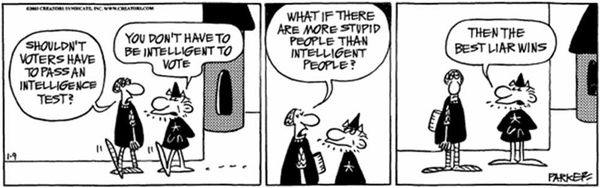
[12sep2011 update] Given the course of the comment thread on voting as it reflects the divergent concerns of the left and right, a Wizard of Id commentary comes to mind that pretty well sums things up.


 rebanesruminations.com
Leave a comment