

George Rebane
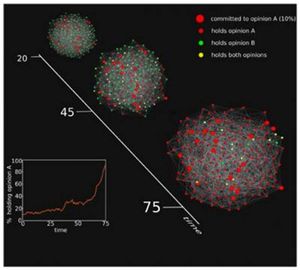 Rensselaer Polytechnic researchers have discovered a dynamic network model that explains how a minority opinion can become a majority opinion when certain tipping point parameters are exceeded. In the internet age this process has also been labeled ‘going viral’, and many of us have seen and studied its technical properties. The RP researchers have been able to identify the tipping point as being somewhere around 10% minority opinion holders when the network of communicants is sufficiently connected. (more here)
With modern media the spread of ideas enjoys a very dense network of connections over which compelling opinions and notions travel and become influential. This would also apply to the spread of memes.
I guess bloggers in some way sense this and keep up their incessant efforts to put out thoughts they hope will gain some traction out there. Of course, many of these thoughts are also re-transmissions of things they heard elsewhere, modified somewhat, and then passed on. Again we come back to the secret life of memes (see also the work of Richard Dawkins and Julian Jaynes).
In sum, the spread of memes is a very non-linear process – hence the notion of a tipping point – and goes a long way to explain why poorly polling politicians keep plugging along, and sometimes even catch a breeze from a seemingly unknown quarter that blows them into office. Now the system sciences are starting to develop explicative models that may some day soon evolve into predictive models (heaven help us then). I look forward to this work being connected to the research reported by Bryan Caplan in The Myth of the Rational Voter.


 rebanesruminations.com
Leave a comment