

George Rebane
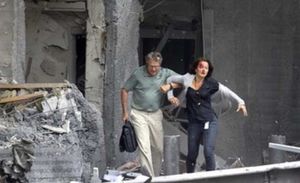 So now Norway has Anders Behring Breivik, its own equivalent of America’s Timothy McVey. We read that the 32 year old farmer has killed almost one hundred people, personally murdering eighty some by shooting each of them at close range. He also posted a YouTube video (now removed) of himself declaring his terror rampage before first setting off a bomb in the center of Oslo, and then going out to a nearby island, disguised as a policeman, to shoot the youth gathered there.
We read that Breivik was a declared Christian “extreme right winger with anti-Muslim sentiments.” He was disturbed by what he saw as the permissive multiculturalism that has given rise to the Islamic enclaves throughout Europe including his native Norway. Apparently this attack was in planning for almost two years, and was to serve as a dramatic call for European “martyrs” to begin some sort of violent pushback of Islam and Marxism that he has described in a long “compendium/book” he titled 2083 – A European Declaration of Independence. I have not read it, but it can be downloaded from google docs here.
What we do know is that he ordered six tons of fertilizer from which he presumably made at least one bomb, and that the island massacre lasted 90 minutes before the Norwegian SWAT team finally arrived after 40 minutes, and then took another 50 minutes to stop the killing. Apparently there was not a single law-abiding gun on the island that could have saved lives during that interminably long killing spree.
It is hard for me to conclude that this was the act of a sane individual. Perhaps he offers an explanation in his compendium as to how he thought that his terror would start some kind of spontaneous attack on people of non-European cultures. But to a sane person, no matter his politics or sentiments about Islam and western culture, this act did nothing to achieve his declared end. In fact, I think, like Timothy McVey, this was the most horrifically inappropriate and misguided use of violence that Breivik could have conceived – an assessment I cannot lay at the feet of Islamic terrorists who have so far used worldwide terror effectively to advance their ends.
Now we await for the investigation to reveal the complete and, perhaps, a different story about Breivik. I am saddened that so many people had to die at the hand of a twisted individual, especially one who claims to be a defender of western culture.
Your thoughts?
[update] One question that occurs during events like these is ‘to what extent is this a canary in the mine?’ It is usually at the edges that society first shows that something with it is awry. The mentally or economically frail begin to visibly protest existing conditions, and then start to act like outlaws. Wealthy and advanced societies usually react positively if not always in a timely manner to such signs.
If shopkeepers begin reporting that bread is being stolen from their shops, and this becomes more widespread, then an enlightened collective would be better served by finding the cause of the problem instead of just hiring more police. If ill-schooled students graduate in greater numbers when more money is put into education, then an enlightened collective would conclude that there might be other factors at work than lack of funds.
But here we come into a conundrum – ascribing cause. Upon reflection philosophers and scientists have come to understand that cause is ascriber-specific. People with different belief systems, knowledge, intelligence, experience, and data can look at an event and ascribe markedly (wildly?) different precursors that were its actual cause. To the extent that a culture and/or ideology are shared by a society, they will tend to interpret things in a more like manner and come to similar conclusions as to cause. And the opposite is also true as we witness every day (and also on these pages).
So, in Norway was this madman a harbinger, a fraying edge that declares existence of a deeper problem in Norway’s European population? What caused him to go on his murderous rampage, and what should the Norwegians do to minimize the likelihood of such future occurrences?
(In a future post I am planning to do a piece on causality that may help in the discussion of events like this and broader aspects of assessing public policy. The effort always is to promote complete, clear, and concise communication on these pages. Hard duty.)


Leave a comment