

George Rebane
Congressman Tom McClintock is a good man, and a politician Jo Ann and I have supported since our SoCal days. We continue to support him.
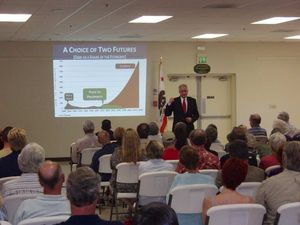 Last Thursday night (30jun11) we were in south (Nevada) county attending a townhall meeting with the congressman at a local Lions Club. The focus of his speech was the country’s financial crisis and the ongoing debt limit negotiations. As expected, Tom was there with a lot of charts and graphs that illustrate his usual substantive presentations. His California District Director Rocky Deal and I estimated that the gathering was just shy of 250 people. It was a good roomful with people of every political coloration in attendance since Tom represents us all. Q&A time produced a lot of excellent ones from all over the map.
Perhaps I asked him the most awkward question of the evening, because Tom answered it as if he had misunderstood me. In his talk the congressman reviewed the loggerheads between the Keynesian and Austrian school positions on government intervening in a nation’s economy and attempting to create jobs. He highlighted FDR Sec Treas Henry Morgenthau’s 1939 testimony to Congress that is now iconic in conservative circles, and still invisible to progressives (search RR, ‘Morgenthau’). RR readers are familiar with the diametric arguments.
My question concerned the Democrats’ eternal silence on Morgenthau’s testimony and if whether in their debt limit negotiations the Republicans ever considered that Team Obama and the Democrats want to purposely weaken America economically so as to have us stand down as one of the world’s hegemons, and put us into a more compliant mood to work as a peer toward a global collective.
 The congressman responded by saying that no one in Washington denies Morgenthau’s assessment of FDR depression era policies; it is a matter of historical record that on the eve of WW2 Morgenthau lamented that Keynesian government spending programs had not worked and had resulted only in increasing the national debt. He also recounted that President Obama, in a meeting with members of Congress, clearly and believably stated that his administration would be judged by how it restored America’s economy to strength, therefore that was the goal and focus of his efforts. And that was that.
Given that the congressman was addressing a room full of people that included his Democratic constituents, perhaps he did not want to be as candid as he could. But that is not the character of Tom McClintock. I walked away from the meeting with the feeling that our congressman (and perhaps others of his Republican colleagues) believe in these past two years that they have been debating the left on ways and means to achieve a common goal. That the immediate and obvious failures of recent progressive policies involving the explosion of government and its commitment to astronomical levels of debt were nothing more than the products of the ongoing historical give and take between the Keynesian and the Austrian approaches to managing the economy.
As these pages show, I join my small voice with the many national commentators who point out that if we look at Obama’s path to the White House, the people he has surrounded himself with, and their written and spoken words, then there is a much simpler explanation for the strivings and accomplishments of this administration. It is not enough to just accuse them of being insane in their reapplication of policies that haven’t worked and this time expect a different result. It is not productive to continue to negotiate with the progressives under the public face of a common goal. Since if such goal does not exist, then the Republicans are doomed to bear the burden of every failure that derives from these negotiations – this is the consistent advice from every theory and handbook on successful negotiations.
Undoubtedly there is political risk in calling out the progressives on their global agenda. But continuing on the current fruitless path under erroneous assumptions is a recipe for a bitter political certainty. Both sides endlessly repeating their mantras of ‘cut spending’ and ‘increase taxes’ spreads a boring fog on an economically threatened electorate that is demonstrably deficient in history, current events, and critical thinking skills. As studies have shown (Bryan Caplan, 2007), in their minds the most oft repeated and simple one-liners will prevail.
I believe that the debt limit debate should be elevated to point out the extent that American liberals in public life have signed up for nudging (a la Cass Sunstein, the administration’s regulatory czar) or precipitously shoving us into their brave new world order. This would not characterize them as being necessarily evil or wishing ill to our citizens. Progressives are zealots of their own stripe who, over the past century, have left a long record of the kind of governance that they believe would most benefit mankind. It is that record which needs to be brought into the debate, and connected to the mandates that Democrats are now spreading across the land.
Putting the progressive future on the table and shining a light on it will make it accessible to at least the voters who are not yet in the grip of transfer payments. When the global future is visible to everyone in all its ‘glory’, it may also motivate the left to reconsider their approach to how fast they want to “fundamentally transform” us.
Believing their own words makes it plain that not everyone on the left wants America to remain a strong and sovereign nation-state. In any case the perennial global goal of the progressives begs to be considered publicly by conservatives, and for critical thinkers Occam demands its place among the explanations for the progressives’ current behavior in the debt limit negotiations.


 rebanesruminations.com

Leave a comment