
Rebane's Ruminations
June 2011
S M T W T F S
 1234
567891011
12131415161718
19202122232425
2627282930  

ARCHIVES


OUR LINKS


YubaNet
White House Blog
Watts Up With That?
The Union
Sierra Thread
RL “Bob” Crabb
Barry Pruett Blog

George Rebane

[This piece is the second of a four part series on taxes, jobs, and income that includes, in order of posting, ‘The Administration Discovers Shortage of Engineers’, ‘Higher Tax Rates = Lower Revenues’‘More Green Companies Heading for Greener Pastures’, ‘Employment and Income Inequality’.]

The progressives’ calcified mindset does not admit to the truth of the title, no matter the data that supports it.  This reconfirms to many conservatives and those of libertarian bent that there is a larger agenda at work here which involves the economic castration of America – they can’t all be that stupid.

An example of the right/left debate that highlights this is found on these pages in the comment stream of ‘The Liberal Mind – Tax Rates Don’t Affect Earnings’.  There we find the tired and well-worn liberal arguments citing Eisenhower era rates and the belief that more taxes on the rich increase government revenues.  Some liberals actually do believe that such higher revenues could then be applied to their conceptions of ‘social justice’.  But I’m afraid that the globalists among them know better, and pursue higher taxes in America under that façade as an effective avenue to their one-world objective.
Taxes&Revenues 

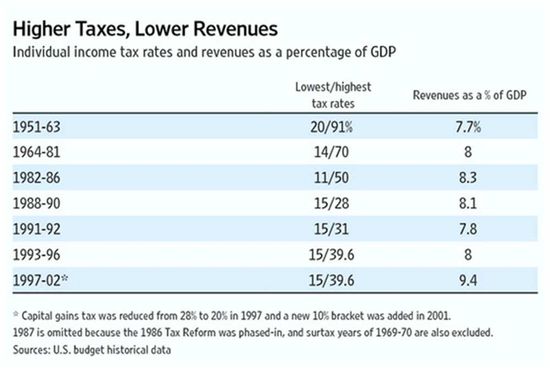
In the 16jun11 WSJ Alan Reynolds of Cato again presents US government data, and argues ‘Why 70% Tax Rates Won’t Work’ with a note to Robert Reich (the ‘70% man’) that says – “The income tax brought in less revenue when the highest rate was 70% to 91% than it did when the highest rate was 28%.”  (see nearby table from the article)

Reynolds goes on to detail the history of revenue production from tax rates reaching back to 1951.  He concludes with –

… the Joint Committee on Taxation recently reported that 51% of Americans no longer pay federal income tax.
 
Since the era of 70% tax rates, the U.S. income tax system has become far more “progressive.” Congressional Budget Office estimates show that from 1979 to 2007 average income tax rates fell by 110% to minus 0.4% from 4.1% for the second-poorest quintile of taxpayers. Average tax rates fell by 56% for the middle quintile and 39% for the fourth, but only 8% at the top. Despite these massive tax cuts for the bottom 80%, overall federal revenues were the same 18.5% share of GDP in 2007 as they were in 1979 and individual tax revenues were nearly the same—8.7% of GDP in 1979 versus 8.4% in 2007.
 
In short, reductions in top tax rates under Presidents Kennedy and Reagan, and reductions in capital gains tax rates under Presidents Clinton and George W. Bush, not only “paid for themselves” but also provided enough extra revenue to finance negative income taxes for the bottom 40% and record-low income taxes at middle incomes.

Of course, none of this will make a dent in the progressive chorus, because they are singing to voters already embracing the Peter/Paul Principle, and those for whom such information is not accessible.

[22jun2011 update – the following letter in the 22jun11 WSJ rebuts Robert Reich’s criticique of Reynold’s analysis, and extends the argument presented.]


In his rebuttal (Letters, June 18) to Alan Reynolds’s June 16 op-ed “Why 70% Tax Rates Won’t Work,” Robert Reich claims that Mr. Reynolds “distorts my proposal and ignores my argument.” And, well he should, because it’s impossible to address Mr. Reich’s “proposal” because it is not based on historical fact and misrepresents today’s reality.

For many of the glory years Mr. Reich celebrates, when tax rates ranged from 70% to 91%, there was no Alternative Minimum Tax and no limit on nearly all deductible expenses including the “three martini lunch.” Consequently “tax shelters” were ubiquitous and used by even the least significant investor. Taxes paid, and even prepaid to state and local governments, were fully deductible along with installment interest on credit cards, personal borrowing and more, including nearly all medical expenses. Even when the AMT was introduced, it only captured a handful of the highest income producers. Today, the AMT has become so oppressive that each year Congress exempts millions of middle-class wage-earning taxpayers from its clutches. It does, however, capture vast sums from the evil “millionaires and billionaires” the left so despises—except when they fund left-wing fantasies.

Very simply, the effective tax rates when marginal rates were stratospheric were not dramatically higher than today.

Mr. Reich proposes further tax reduction for those earning less than $100,000. Today about 22% of those making between $50,000 and $75,000 have no federal income tax liability or “negative liability.” As many as 9% of households with incomes between $75,000 and $100,000 are similarly exempt. His scheme would exempt much of the middle class, which is a disproportionate user of government, reducing its stake in the governance of America even further and making it more vulnerable to the volatility that has so damaged the economy during the Obama presidency.

Mr. Reich is simply proposing a vast expansion of government’s reach into the economy and relies on the premise that high earners aren’t paying their “fair share.” That is flat out false—they pay the vast majority of the costs of government. Further, his proposal assumes that the earnings of despised “millionaires and billionaires” belongs to our government, which will pay us an allowance after its choices of where to spend are honored and the earners’ choices of where not to spend are dismissed. Karl Marx lives.

Royal S. Dellinger, CPA

Posted in , ,

67 responses to “Higher Tax Rates = Lower Revenues (updated 22jun2011)”

  1. Ben Emery Avatar

    More pollution = cleaner air

    Like

  2. Ben Emery Avatar

    George if you extend tax revenue more than a year or two on lowering taxes it almost always results in a recession.
    People who have enough money to spend already don’t spend anymore when given a tax break. They buy off politicians, which then change laws so those who have to much money can gamble/ speculate on commodities that they will never have to own.
    This isn’t a single issue. This has dozens if not hundreds of issues attached to it.

    Like

  3. George Rebane Avatar

    BenE, I think the data will show that marginal earnings retained with lower taxes overwhelmingly go into the starting of new businesses, other investments, and charitable giving. No doubt there are additional political contributions, but they are a miniscule fraction of the total that is left with taxpayers.

    Like

  4. Mikey McD Avatar
    Mikey McD

    Rebane, excellent post. I can assure you that my wife spends anything the taxman permits us to keep (she doesn’t spend a dime “buying off politicians”- usually exotic stuff like food, mortgage, gas…) :).
    This post will either be another ‘preach to the choir’ or emotionally attacked by the logically challenged. Obviously a man has more to spend when less is taken from him. The same emotional group will not see the danger in 51% of Americans not paying any fed income tax (they refuse to see Greece as a foreshadow of the US).

    Like

  5. wmartin Avatar
    wmartin

    BenE believing in simple cause and effect sez:
    “George if you extend tax revenue more than a year or two on lowering taxes it almost always results in a recession. ”
    BenE not believing in simple cause and effect sez:
    “This isn’t a single issue. This has dozens if not hundreds of issues attached to it. ”
    Honestly, how government gets paid for strikes me as a secondary problem. It matters a lot, but whether you use direct taxation, future taxation (ie. borrowing), sales of assets, or inflation, the important matter is what fraction of your national wealth is swept into the thing.
    If you have a strong hankering for monopoly, whether it’s Standard Oil, the federal government, or the UAW, then growth in that area is all good.
    I wonder sometimes if this really isn’t all about DNA. There’s a subset of humanity that very much wants to be part of a larger organism and wants to encourage that organism to be as all-encompassing as possible. One advantage to big groups is that, given human nature, the ability to speak publicly or to give a good interview allows you to leapfrog by all your fellow humans. Political office is like some large corporation executive suites in that it allows the unaccomplished to become important.
    In any case, the thread is about tax rates, probably Laffer curves, and all that. I really have to ask some questions about taxes.
    . Should they be constructed to be ‘fair’? What does that mean?
    . Should they be used to encourage behavior? or just to maximize income for the taxing body?
    . Should government be allowed to bypass tax income via borrowing?

    Like

  6. Todd Juvinall Avatar
    Todd Juvinall

    As we can read from BenE no facts that conflict with his world view are correct. Amazing! I am of the belief that the less government takes the more I have in my pocket. I do not care to enhance the bloated treasuries of government so I would suggest an anti-progressive tax system. The more a person keeps, the less they are taxed. This would give enough money to pay for defense and some things we deem necessary and the rest stays in our pockets. We on the right have been making the argument for 30 years that lower tax rates give government more money. Well, we see what more money gives them when we are more successful(more power over us). Let us throw out the premise and do something different.

    Like

  7. Mikey McD Avatar
    Mikey McD

    wmartin- EXCELLENT questions.
    . Should they be constructed to be ‘fair’? What does that mean? YES, EVERYONE SHOULD PAY THE SAME % OF THERE INCOME TO THE IRS.
    . Should they be used to encourage behavior? or just to maximize income for the taxing body? MAXIMIZE INCOME FOR TAXING BODY- GOV. DOES NOT HAVE THE ABILITY/KNOWLEDGE/RESPECT OF COMPLEX SYSTEMS TO SUCCESSFULLY CHANGE BEHAVIOR VIA TAXES (OR FED POLICY FOR THAT MATTER).
    . Should government be allowed to bypass tax income via borrowing? ONLY IN TIME OF WAR (DECLARED WAR PER CONSTITUTION)
    (AN EXPENSE DISCUSSION SHOULD ACCOMPANY ANY TAX DISCUSSION- WHAT SERVICES SHOULD A GOV BE ASKED TO PROVIDE?)

    Like

  8. Paul Emery Avatar
    Paul Emery

    Well, at last we’ve come to an agreement that the tax rates were higher in the 50’s. If the tax rate reductions were so great for the economy under Reagan and the Bushes why then was there such a huge growth in the deficit during those administrations?
    Mikey
    AN EXPENSE DISCUSSION SHOULD ACCOMPANY ANY TAX DISCUSSION- WHAT SERVICES SHOULD A GOV BE ASKED TO PROVIDE?
    I agree with you on this Mikey. It is with this consensus that we plow forward. You have to realize however that your Libertarian bent is not likely to be the majority. How we come up with that agreement is a big question certainly with this crowd. Since the majority of citizens are of modest or low incomes what they determine to be essential services would be significantly differeent than the affluent. This is where Peter and Paul come marching into the picture.
    Also Mikey
    If a poor person pays 20% of his income in taxes he may not afford a place to live or be able to feed his family. If a rich person pays 20% he’s still rich.

    Like

  9. Mikey McD Avatar
    Mikey McD

    NO WE HAVE NOT! THE LINK YOU YOURSELF PROVIDED IN THE PAST EXPLICITLY STATED THAT THE 91% TAX RATE WAS 1- FOR THOSE MAKING 1.8MILLION IN TODAYS DOLLARS AND 2- ONLY THE FIRST 50% OF ONE’S INCOME IN 1950’S WAS TAXED AT THAT RATE (EFFECTIVELY MAKING THE HIGHEST RATE ON 1.8MILLION 45.5%) 3- DOES NOT REFLECT THE COUNTLESS ADDITIONAL TAXES WE BEAR TODAY 4-DOES NOT INCLUDE THE 750% INCREASE IN SS TAXES.
    “Well, at last we’ve come to an agreement that the tax rates were higher in the 50’s.”

    Like

  10. Mikey McD Avatar
    Mikey McD

    I would not expect the 51% of those whom pay ZERO taxes to side with personal liberty. When I teach high school classes I am amazed (and injected with hope) that most don’t want cradle to grave dependence on government; especially when they understand the cost of such dependence on personal liberty.
    “You have to realize however that your Libertarian bent is not likely to be the majority.”

    Like

  11. Paul Emery Avatar
    Paul Emery

    Well then Mikey, how do you think we should reach the consensus of government services that that you suggest we need? Are you suggesting that only certified tax payers can participate in the democratic process?
    As for tax rates, I was assuming you were in agreement with the chart that GR posted above that showed 21/90% tax rates in the 50’s. It certainly effects the editorial argument expressed by the writer.
    You constantly harp on the loss of personal liberty in what you consider a Socialistic form of government but as I’ve expressed it many times I certainly didn’t see that reflected in the lives of my friends in Western Europe. They at least have the liberty to know that if they suffer from diabetes, for example they have health insurance and don’t have to worry about losing their home and lifetime savings if they become seriously ill.

    Like

  12. Paul Emery Avatar
    Paul Emery

    grammar correction “affects the editorial content” (verb not noun)

    Like

  13. Mikey McD Avatar
    Mikey McD

    This discussion should have taken place in 1913 and again in 1930’s (before our plunge). I believe that we have already passed the tipping point and that we will never revert back to a free/moral country. When you allow mob rule (Peter/Paul) you are destined to failure (that is why we started as a republic -not a democracy). I am more concerned with the disease of government dependence than diabetes. Again, just because a law passes by majority does not make it moral. We have never been taxes as much as today. Ever.
    wmartin’s questions are great.

    Like

  14. Walt Avatar
    Walt

    Nice to meet you in person yesterday Mr. R.,, And thanks.
    DM

    Like

  15. Paul Emery Avatar
    Paul Emery

    Even David Stockton, Reagan’s supply side guru, doesn’t even buy the continuation of the Bush tax cuts. This whole idea is starting to unravel as more and more Conservative economists are speaking out. I don’t understand why the fringe on this blog ignores this? It certainly needs to be part of any intelligent discussion. You can see it in the way good old Grover boy is being pushed aside. Romney knows this and, as the likely Repub pick, he’ll soon become more open to revenue increases. Not renewing a temporary tax cut is not raising taxes it’s only returning to the way things were when we had enough income to cover our commitments without increasing debt, meaning the Clinton-Gingrich formula that produced four years of a balanced budget.
    Here’s the Stockton stuff to check out.
    From 60 minutes Nov 1 2010
    http://www.cbsnews.com/stories/2010/10/28/60minutes/main6999906.shtml
    One Republican brave enough to go public is David Stockman, President Reagan’s budget director. He says all the Bush tax cuts should be eliminated – even those on the middle class.
    And he says his own Republican Party has gone too far with its anti-tax religion.
    “Tax cutting is a religion. What do you mean by that?” correspondent Lesley Stahl asked Stockman.
    “Well it’s become in a sense an absolute. Something that can’t be questioned, something that’s gospel, something that’s sort of embedded into the catechism and so scratch the average Republican today and he’ll say ‘Tax cuts, tax cuts, tax cuts,’” he explained.
    “It’s rank demagoguery,” he added. “We should call it for what it is. If these people were all put into a room on penalty of death to come up with how much they could cut, they couldn’t come up with $50 billion, when the problem is $1.3 trillion. So, to stand before the public and rub raw this anti-tax sentiment, the Republican Party, as much as it pains me to say this, should be ashamed of themselves.”
    These frank words come from Ronald Reagan’s old budget director. Stockman was the architect of the largest tax cut in American history.”

    Like

  16. George Rebane Avatar

    And good also meet you Walt, you do a hell of a nice job moving dirt.

    Like

  17. George Rebane Avatar

    Stockman is going addled or simply changing his ideology. Yes, taxes are necessary, but it has been argued on these pages and in the literature that our problem is not a shortage of revenues, but a surfeit of spending. The only way to stop spending more is to quit feeding the beast more.
    And anyone who believes that the Bush tax cuts were meant to be temporary didn’t pay attention, or worse. Bush and Republicans had every expectation that a future Republican Congress would make them permanent before they expired.
    The question that you PaulE and David Stockman (who’s Stockton?) should be asking is why didn’t Team Obama, that controlled everything in the Beltway, repeal Bush’s tax cuts if more taxes are so good for business and the economy. Occam’s answer would be that the Obama crowd are hypocrites.

    Like

  18. Paul Emery Avatar
    Paul Emery

    That’s a good question that Obama’s supporters are still scratching their heads over. Many on the Progressive left (yes I’m succumbing to stereotyped branding) have distanced themselves from Obama because of the wimp factor in not standing up for progressive ideals such as single payer heath care and nixing the tax cuts to balance the debt. It’s too late now and it will be interesting to see who will march with him when he starts campaigning.
    So it’s likely true that the TP faction of the Republican party would not support Ronald Reagan if he were running for President today. When architects of Reagan’s supply side economics such as David Stockman and Bruce Bartlett says they can’t hang out with this group it means there has been a radical change of players that may not have much historical support to their ideas. It will be tough going once the moderate Republicans take their party back and go for the middle (Romney) that always wins elections.
    And, yes, the Repubs lost the elections so they couldn’t finish the deal on tax cuts. Why then didn’t Bush make them permanent when he had the wheel? Another wimp I guess..
    And by the way, to blame the Dems for No Child Left Behind ignores Bush’s bragging about the program. Sorry Greg, this won’t fly “Sorry, but No Child Left Behind was more Ted Kennedy than George Bush”
    Here’s Bush in 09
    “I’ve come to herald the success of a good piece of legislation. I have come to talk to our citizens about the results that this reform has yielded. And I call upon those who can determine the fate of No Child Left Behind in the future to stay strong in the face of criticism, to not weaken the law — because in weakening the law, you weaken the chance for a child to succeed in America — but to strengthen the law for the sake of every child,” he said.

    Like

  19. George Rebane Avatar

    PaulE – I believe the reason that Bush didn’t make his tax cuts permanent is that he didn’t have a filibuster proof Senate. Recall, that he barely got the tax cuts through on the compromise that they would be temporary.

    Like

  20. Greg Goodknight Avatar
    Greg Goodknight

    Sorry, Paul, you don’t get to rewrite history with this one. Teddy Kennedy was a co-author of NCLB and was widely credited with its success in bringing together a working majority of R’s and D’s. It WAS more Ted Kennedy than George Bush.

    Like

  21. Paul Emery Avatar
    Paul Emery

    Greg
    I will not contest your observation. However Bush certainly regarded it as one of his crowning achievements.
    George
    If you acknowledge that the tax cuts were recognized as being temporary when they were created, what did you mean when you said
    ” anyone who believes that the Bush tax cuts were meant to be temporary didn’t pay attention…”

    Like

  22. J Cutter Avatar
    J Cutter

    “Sorry Paul…
    …Teddy Kennedy was a co-author of NCLB…It WAS more Ted Kennedy than George Bush.”
    “Greg
    I will not contest your observation.”
    I will!
    NCLB was a PR move post general election in the run-up to the midterms by the Bush Admin to appear sympathetic to the concerns of the majority of Americans regarding our troubled ed system. One of the great ironies was that it largely centralized the accountability (the Kennedy kernel), rather than localized; as had been, and remains, the intention of the conservatives.
    http://www.amconmag.com/article/2005/aug/01/00025/
    Kennedy not only did not ‘co-author’ H.R.1, he didn’t he even sponsor it! He began distancing himself from it prior to passage, as he saw it largely as an unfunded mandate that was hijacked through the process by Boehner, et al. Yes, Kennedy was all for more centralized accountability, thus his ‘shepherding’, but the debacle was all Repub-controlled. Kennedy died believing that he was used in the process, and that his vision was distorted (whether you agree or not that his was a solution).
    http://thomas.loc.gov/cgi-bin/bdquery/z?d107:HR1:

    Like

  23. Ben Emery Avatar

    Sorry not having the time to hang out all day but someone around here has to work.
    http://www.vanityfair.com/society/features/2011/05/top-one-percent-201105
    by Joseph Stiglitz
    of the 1% by the 1% for the 1%
    Americans have been watching protests against oppressive regimes that concentrate massive wealth in the hands of an elite few. Yet in our own democracy, 1 percent of the people take nearly a quarter of the nation’s income—an inequality even the wealthy will come to regret
    It’s no use pretending that what has obviously happened has not in fact happened. The upper 1 percent of Americans are now taking in nearly a quarter of the nation’s income every year. In terms of wealth rather than income, the top 1 percent control 40 percent. Their lot in life has improved considerably. Twenty-five years ago, the corresponding figures were 12 percent and 33 percent. One response might be to celebrate the ingenuity and drive that brought good fortune to these people, and to contend that a rising tide lifts all boats. That response would be misguided. While the top 1 percent have seen their incomes rise 18 percent over the past decade, those in the middle have actually seen their incomes fall. For men with only high-school degrees, the decline has been precipitous—12 percent in the last quarter-century alone. All the growth in recent decades—and more—has gone to those at the top. In terms of income equality, America lags behind any country in the old, ossified Europe that President George W. Bush used to deride. Among our closest counterparts are Russia with its oligarchs and Iran. While many of the old centers of inequality in Latin America, such as Brazil, have been striving in recent years, rather successfully, to improve the plight of the poor and reduce gaps in income, America has allowed inequality to grow.

    Like

  24. Paul Emery Avatar
    Paul Emery

    J Cutter
    That makes sense. It’s really notable how far the Republican message has moved to the right, examples being Romney having to justify his own rather successful health plan (Mass has the lowest rate in uninsured in the country) and, from the tone on this blog, the distancing of themselves from Bush’s No Child Left Behind education mandate. They are even turning away from Reagan’s financial guru’s in their rush to what they call the right.

    Like

  25. Scott Obermuller Avatar

    Paul – who on the conservative side in RR has extolled David Stockman? I’ll let you in on a little secret. NONE! David is a failed conservative, a failed investor, and a failure to hold moral views. He is correct, I’m sure, to point out that there are lots of RINOs that he holds court with, that have not the nerve to rock the boat in Foggy Bottom and cut off the money supply to the well-connected high rollers such as are his kind. Witness the failure DECADES ago when he was actually in govt to cut the budget. That’s the whole point of the TP. We are tired of talk. We are tired of RINOs. Let David personally accuse by name who he is talking about now (if the little sh*t has the nerve). If you want to quote Herman Cain or some one current who has a proven track record of conservatism – then fine, let’s talk. To dredge up a worn out nobody that has a track record of “I wanna get rich and I don’t care who loses or has to pick up the tab” then lets have the Dems join in as well. We are so far out beyond our ability to pay our debts it isn’t funny. To say that cutting taxes of all kinds that inhibit business will just result in the money going to political contributions is just fabricated. The vast majority of businesses don’t want to have to give a dime to politics. They want to invest in their growth.

    Like

  26. Paul Emery Avatar
    Paul Emery

    You actually are proving my point here. We;ve all heard the term “eating your young” a rather crude way of describing consumptive politics. This is a case of eating your heritage. If David Stockman, Reagan’s budget director for four years is tossed out like dead flowers where does that leave your respect for the economics of Reagan? Certainly Bill Buckley would have cringed at the concept of solving deficit spending by only cutting spending. Any reasonable economist knows you have to do both to have any chance to succeed. That’s exactly what Oklahoma Senator Tom Coburn meant last week while dishing Grover boy. Here’s text from the article
    http://www.newsmax.com/US/RepublicanSen-FailstoKillTaxPledge/2011/06/17/id/400432
    Sen. Tom Coburn, R-Okla., has abandoned the tea party line and tried to take his colleagues with him by aligning with President Barack Obama in his push for higher taxes, writes Grover Norquist at HumanEvents.com. Coburn sat on an Obama commission that urged $2 trillion in tax increases over the next 10 years.
    “Why will I take on those that are against tax increases for Republicans? Because it’s the right thing to do to save our country,” HumanEvents quotes him as saying during a C-SPAN interview in May.

    Like

  27. Greg Goodknight Avatar
    Greg Goodknight

    Yes, Teddy was pissed that NCLB got shorted, what, $10billion? Pocket change by Spendulus standards.
    JC, of course a Senator wouldn’t be a co-author of a House Resolution. His work was on the Senate version that then was reconciled, and Teddy was credited with being the engine for cooperation. I still remember Kennedy sharing the spotlight with Bush in the PR blitzes. Not that I cared much for Bush II, either.

    Like

  28. Mikey McD Avatar
    Mikey McD

    Paul, your standard is not a meaningful standard. RomneyCare is the biggest reason repubs won’t vote for Mitt.
    “(Mass has the lowest rate in uninsured in the country)”
    If you want to quote Reagan, quote Reagan. Don’t quote failed,wanna-be politicians. Dick Morris was a Clinton advisor!

    Like

  29. George Rebane Avatar

    BenE – It seems you’re beating the dead horse of a fixed pie again (merrily mixing metaphors) with your 1% taking 25% of income (using your stats). That old bolshevik saw assumes that the 24% of income was taken away from some others who could have equally earned it. I’m not saying that America does not have some government mangled markets where taxpayer monies are paid to inept managers. But the overwhelming part of that 24% was created and earned by the 1%.
    And in an age of accelerating technology, what would you expect men with diplomas from dumbell high schools to get for wages? Wouldn’t you expect them to plummet?

    Like

  30. Scott Obermuller Avatar

    Reagan’s economics were low taxes and limited govt. He did what he could with what he had. If Reagan had had the blue pencil, I’m sure he would have cut plenty. David S is a sore loser that wants the taxpayer to pick up the tab for his bad investments. And you quote him as some one we should listen to. Sorry, he’s a typical Country Club Republican. I have no use for him and his sort. He likes big govt as long as the big govt keeps him in his comfort.

    Like

  31. Paul Emery Avatar
    Paul Emery

    Scott, George
    It seems the fundamental issue is whether we can balance the budget and reduce the deficit without raising taxes or increasing the debt ceiling. Will you point me to a couple of credible economists who believe this realistically can be done ?
    George, can you go deeper into this?
    “But the overwhelming part of that 24% was created and earned by the 1%.”
    I don’t have a clue what you’re talking about. Is this just your personal observation or can you give me some substance to support your claim

    Like

  32. George Rebane Avatar

    No PaulE, my numbers derived from the ones you gave in your 17jun11 719pm comment. For equal income distribution, the 1% of people would get 1% of the country’s total income, not 25% as you claimed. So according to most collectivists’ beliefs, they are getting (25-1)% too much. And I’m afraid, you’ll have to give us all the wisdom of your “substance” here why that is ‘socially unjust’.
    Re “credible economists” (an oxymoron if I ever heard one); again, the problem of “whether we can balance the budget and reduce the deficit without raising taxes or increasing the debt ceiling” is not one of economics. Simple arithmetic that a Chinese second grader can do will demonstrate that this is an existentially feasible task. The problem is entirely political – do we have the will to cut entitlements spending enough to achieve it? More has to be bundled into the political solution such as massive tax reform, huge regulatory pullbacks, and, more than likely, a constitutional amendment on spending. So the short answer to the political question is a very probable NO. That is why in these pages I have maintained that we are already past the tipping point toward an historical disaster in our country’s finance and governance.

    Like

  33. Scott Obermuller Avatar

    Paul – We will get out of this mess by first reducing the fed budget back to what the Constitution allows. This won’t cover the entitlement mess, but it will reassure investers and private business the world over that we are finally serious about getting our fiscal house in order. We will need to raise the amount of money going into the treasury. A lot.
    The entitlement bomb is coming fast and we can’t just cut. Trying to do that by soaking the rich will result in less money not more. We need to grow the economy and reducing the taxes and needless regs on businesses of all types will go a long way towards that goal. We need a free market, in other words. No, it won’t be perfect but we can at least move that way. Tort reform is desperately needed. Joint and Several Liability has to go. We need to raise income to the treasury not increase rates. A healthy and growing economy will do that.

    Like

  34. Ben Emery Avatar

    George,
    Just read the last post to Paul E.
    Nobody I know of is claiming the top 1% can max out at 1% of the income. That is in line with Communism, which has proven to be a failed political and economic system on large scales. What is being proposed the the top 1%, three million or less Americans, have the incentive after around $2million to reinvest back into their companies and workers. The choice is theirs, they can earn a $billion but after the $2/3/5/10 million threshold would start paying a drastically higher tax rate. Pay the high rate government is funded. Invest in workers- workers can afford necessities and need for social programs drops- and government is funded. Its about incentives in the health of America and its society.
    People get wealthy at the same time live in healthy strong economy and society. What is wrong with that?

    Like

  35. Paul Emery Avatar
    Paul Emery

    George
    It was the other Emery that posted at 7:19 Friday so I won’t comment on your question to me.
    I must use a quote from the play Marat Sade when the neutral voice in the play responds to the revolutionary priest (french revolution) that “talk is cheap, the price of action is colossal.” What we are starting to see now is that cooler heads in the Republican Party are moving away from the Ryan budget and looking for a soft landing ground where they can not be held responsible for making things worse (ie the collapse or the stock market if the debt limit is capped) and still please the TP’s of various denominations. The TP Expressers will be no problem since they are part of the Republican team but the Patriots may balk and look for higher ground.
    Scott, you’re path that decreased taxes, regulations and legal reform will lead to a increase of taxable income that will make up the deficit, balance the budget and return us to less government and liberty is a grand vision . The path to finding out whether it will work involves a complete change of culture in Washington and I doubt whether the hopeful persuasions that you’ve expressed on these pages will be amplified enough to bring about that change. I do have a respect for your position even though I question the outcome.
    Someone amongst your flock will have to assume the leadership role to herd not only the faithful but a sizable number of new converts to make this happen. Right now Romney is standing alone as a moderate Republican and the rest are trying to out yell each other that they are the true messiah. In the end the chickens will come home to roost and it will likely be Romney who will emerge as a pragmatic choice and most of the TP’s will vote for him and give him money because to them anyone is better than Obama. That’s a far cry from the type of leadership that would inspire the type of change in direction that your path requires.
    It has been a bi-partison effort over 50 years that got us into this mess and it will take a bi-partisan effort top get us out. That’s why the Newt-Clinton eight years stands out. Sure they were riding on a
    tech bubble but they at least balanced the budget, paid off some of the deficit and didn’t cut taxes like Bush with no regard for the consequences if things went bad which of course happened.

    Like

  36. Mikey McD Avatar
    Mikey McD

    No one wants a Vito Corleone government where the gov makes offers we can’t refuse. Ben, don’t stick a gun in our faces and tell us it’s a lollipop.
    “The choice is theirs” Posted by: Ben Emery | 18 June 2011 at 09:01 PM
    With 51%+ of american’s not paying taxes Obama is a shoe in for 2012. See Peter/Paul principal.
    It is not a coincidence that the Obamacare (and tax increases) atrocities do not go into affect until after the elections. 2012/2013 (and beyond) are going to be horribly painful for Americans.

    Like

  37. George Rebane Avatar

    BenE and PaulE – Apologies for the mix-up in attribution.
    BenE, the puzzlement that we conservetarians (a conservative with a good dollop of libertarian thrown yields a conservetarian, that’s the closest label on the box people like to put me in) always run into when responding to your 901pm comment is what do people like you think that other people earning millions annually actually do with their money. The best I can tell that is in your mind are cartoon pictures of Scrooge McDuck, who having converted his ample earnings to gold coins, frollicks in a huge pile of his wealth squirreled away and out of circulation. That image resonated well with people in the late 30s and 40s.
    The truth is a bit more mundane, but nevertheless salutary. Rich folks are investors, and their money goes right back to work in various investments (in fact, most of it is not even taken as ‘income’ which for them is an IRS accounting gimmick). Those investments create companies and jobs. Even a real rich guy like Sen Kerry, when he does take income and upgrades to a bigger yacht, has created/sustained many jobs. In short, rejoice that the wealthy already reinvest almost all of their earnings for profit and to fund the foundations that support so much education, research, and enrichment of our lives.
    Ask not how best to rob the wealthy, but how that you may join them to best spread the blessings of your newfound wealth.
    The least efficient way to reallocate monies in a society is by passing it through government hands first. (That does not say that government doesn’t provide some useful functions that must be funded by taxes.)
    The thesis that you and yours have here underlined multiple times is the thesis of my post – liberals believe tax rates don’t affect earnings. When that core belief has for years successfully explained to you how the world works, there is very little that can be done to disabuse you of the error.
    The rest of us (apparently including Team Obama re Bush2 tax cuts) know that the larger fraction of the pie that the government takes, the smaller will be the next pie. And that is to the detriment of all, especially the poor with their hands out.

    Like

  38. Todd Juvinall Avatar
    Todd Juvinall

    George, you said “Ask not how best to rob the wealthy, but how that you may join them to best spread the blessings of your newfound wealth.” To me that is what America has always been about. Now we have liberals who are simply too lazy to work or too lazy to earn because they are “trust babies” and only need to contemplate their belly buttons. Ever since the caveman ventured out and competed with other cavemen for the lunch-beast or a woman, man has been in constant movement forward for a better life. The problem I see now with the left is the elderberry beetle is now on a par legally with people as is a little flowering plant in the high country so they take up our human time and money to save. One country is actually trying o get their monkeys “human rights”. If it were not for people like you and Russ, the world could be wrecked even faster if the BenE’s were in charge.

    Like

  39. Scott Obermuller Avatar

    My version of how we save the nation from fiscal collapse has to work. There is no other way. What else does one suggest? Soak the rich? Pretty soon the “rich” is anyone with some money in the bank and there still won’t be enough to make the payments. Or cut the bejeebers out of the entitlements? Folks that paid in were precluded from their own solutions because of govt mandated taxes. They will now expect to get the bennies they were promised or we will have social unrest that won’t quit. A monster will arise from that, that no one wants. What is wrong with everyone gets back to work? Why not make it work? What’s the problem? Oh – that’s right – you have to work!

    Like

  40. Paul Emery Avatar
    Paul Emery

    George, Scott
    Thee is no verifiable information that the Reagan and Bush tax cuts led to increased revenue. None period.That’s a total fantasy. In fact they led to increased deficit. Show me one Reagan or Bush adviser or cabinet member that will verify that. The only way we can deal with the national debt is to balance the budget and create a surplus to pay down the balance with a combination of budget cuts and revenue increases. Anyone who has ever been in debt knows that. You’re in debt, you go on a strict budget AND you take on a part time job for more income.
    I’m certainly not saying the Dems have a plan either but certainly anyone running on anything like the Pawlenty fiscal policy will get ripped apart because it has no historical basis and no credible economic experts that will get behind it. Romney will come up with a somewhat balanced plan if he is running to win, which I think he is.

    Like

  41. George Rebane Avatar

    [This comment is actually from RR reader Larry Wirth. TypePad sputtered and wouldn’t let him post it, so he emailed to me for posting.]
    Very interesting topic being discussed here, gentlemen. Before responding, I spent an fascinating afternoon studying the various economic tables in the World Almanac. Unfortunately my edition is 2008, so the latest info in most cases is for 2006, although some information is also included for 2007. Still, a great source for all sorts of information.
    Paul, you’re much too bright to be publically asking why there were large deficits during Reagan/Bush I and Bush II. When you recognize that Congress has ultimate control of spending, the situation straightens itself out with little difficulty
    Reagan took office during a recession and during the recovery, the deficit climbed from a typical Carter-era annual deficit of $60B to 79B in 1981, 128B in ’82, 208B in ’83.
    Thereafter, it plateaued around $200B anually and then, as the Reagan tax cuts took hold sank briefly to the 150B range andd then rose to the 200B range throughout the Bush I years and the first two Clinton years.
    In 1994 Republicans took control in both hourse and after 1995 the deficit declined rapidly, into positive territory in ’98 reaching +236B in 2000, the year Bush II was elected. It was still +128 in 2001. After 9/11 a couple of unanticipated (and unfunded) wars sent it soaring again, peaking at a record 412B in 2004 declining thereafter until 2007 when Democrats again assumed control and has skyrocketed since.
    At the end of 2006, the accumulated National Debt for the first 218 years stood at 8.5 Trillion. Between 2007 and 2010 it climbed to 14.3T, an increase of 40% in just four years. Worse, 2011
    looks like 1.6T in one year, almost 4 times Bush II’s worst showing and 7 times Reagan’s worst. Same as last year, same as the year before…
    So, there’s not a snowball’s chance in Hell of achieving a balanced budget by tax increasea and/or additional borrowing. Only deep cuts will get it done. The problem with borrowing is that the National credit card limit has been reached and raising it will bring anticipated consequences in the form of higher interest and/or a lack of ability to market the debt at any price.
    Raising taxes won’t work for two reasons: First, there isn’t enough money in the World, much less the U.S, and second, everytime taxes are raised, any additional income to the Feds is immediately spent on new entitlements and “worthwhile” programs ranging from
    ethanol, wind and solar subsides to Planned Parenthood, almost never on deficit reduction.
    The only times historically that has happened, Republicans have held Congress or at least the Senate.
    As a footnote, Federal spending as a share of GDP has been in the 18.5% range for most of the past four decades, but has recently risen to 22.5%, funded entirely by borrowing and, obviously, that is the only way to sustain it. Except that it can’t happen.
    Note from George’s essay that Federal Income typically accounts for about 42- 48% of Fed revenues. Where does the other 52 -58%, or so, come from? About 33% is Social Security and Medicare deductions, 12% from Corporation taxes, and 3% from excise taxes. All other sources account for the rest.
    Looking at “the other” briefly, as has been repeatedly described here, corporations do not pay any taxes. They “expense” them and pass along 100% in the form of increased prices. That, friends, is taxation on you. The other revenue sources are all regressive, the excise tax in particular.
    Peering a bit further into economic statistics, we can easily discover that State and Local taxes in 2006 reached a total of 73% of Federal revenue. Of that, the lion’s share consists of sales and property taxes (51% and both highly regressive) and Federal “grants” (25%). Only 17% comes from State and Local Income taxes which, like the Fed’s are “progressive.”
    Combined Federal, State and Local revenues are only 32% derived from “progressive” personal income taxes and doubling Federal income taxes for everyone wouldn’t even cover the current annual deficit.
    So, you might want to look beyond the income tax rates to explain the inequities we see in income levels here. Rest assured that alcohol, tobacco, telephone and gasoline taxes impact the “little guy” far worse than income tax ever could.

    Like

  42. Paul Emery Avatar
    Paul Emery

    The tossed about assumption that revenues doubled under Reagans tax cuts (Pawlenty, Hannity) is generally disputed by economists of all persuasions. It is simply not true and will prove to be a indefensible position in any campaign debate.
    Here are some examples
    http://www.theatlantic.com/business/archive/2011/06/tax-cuts-did-not-pay-for-themselves-under-reagan-and-they-wont-under-pawlenty/240616/
    Bruce Bartlett
    Pawlenty’s statistic is mostly wrong. His conclusion is fully wrong. First, revenue didn’t double during Reagan’s eight years. It increased by 65 percent, from $600 billion in 1981 to $990 billion in 1989 in nominal terms.
    Second, Reagan’s 1981 tax cut didn’t increase tax revenue, explains Bruce Bartlett, a former economist and domestic policy adviser under Reagan. Inflation grew revenue, and population growth grew revenue, and economic expansion grew revenue, and tax increases grew revenue (“Ronald Reagan raised taxes 11 times, increasing revenues by $133 billion per year as of 1988 – about a third of the nominal revenue increase during Reagan’s presidency”).
    http://mediamatters.org/research/200511220007
    Moreover, evidence suggests that the Reagan tax cuts were not the cause of the revenue increases that did occur during the 1980s. As the Center on Budget and Policy Priorities (CBPP) has documented, citing figures from OMB, “Income tax receipts grew noticeably more slowly than usual in the 1980s, after the large cuts in individual and corporate income tax rates in 1981.” By contrast, “income tax collections grew much more rapidly in the 1990s,” when “marginal income tax rates at the top of the income spectrum were raised,” CBPP noted.
    http://www.econdataus.com/taxcuts.html
    EFFECT OF REAGAN TAX CUTS ON REVENUES – SHORT ANALYSIS
    The argument that the near-doubling of revenues during Reagan’s two terms proves the value of tax cuts is an old argument. It’s also extremely flawed. At 99.6 percent, revenues did nearly double during the 80s. However, they had likewise doubled during EVERY SINGLE DECADE SINCE THE GREAT DEPRESSION! They went up 502.4% during the 40’s, 134.5% during the 50’s, 108.5% during the 60’s, and 168.2% during the 70’s. At 96.2 percent, they nearly doubled in the 90s as well. Hence, claiming that the Reagan tax cuts caused the doubling of revenues is like a rooster claiming credit for the dawn
    And former Bush advisor and AEI resident economist warning Bush 2 early on of the dangers of tax cuts in a volatile economy
    “So should the next President aim to enact a tax cut, and if so, what size? This question will dominate the presidential campaign. But it’s not a very relevant one. More vital than choosing a President with the right tax plan is electing a President with the political courage to change course when events demand it. If we have learned anything from the past decade of fiscal history, it’s that we shouldn’t look too hard into any budget forecaster’s crystal ball.”

    Like

  43. Paul Emery Avatar
    Paul Emery

    The last quote is attributed to N. GREGORY MANKIW is an economics professor at Harvard and the author of Principles of Economics and was he was the chairman of President Bush’s Council of Economic Advisors

    Like

  44. Mikey McD Avatar
    Mikey McD

    Paul, I believe Mr. Mankiw was referring to SS and Medicare reform.
    As an entrepreneur I can attest to the fact that I am LESS willing to work, invest or risk more of my property when tax rates rise (as tax rates rise economic activity drops). Even the expectation of higher taxes decreases an entrepreneur’s desire to create wealth. Less wealth creation = less tax revenue.

    Like

  45. Paul Emery Avatar
    Paul Emery

    Mikey
    I’m printing (reprinting) Mankiw’s whole article here. It was published in Fortune Mag in 2000 He was not referring to SS or Medicare. The article was a caution to Bush II about his plans to cut taxes to stimulate the economy. We all know the rest of the story, massive deficits and decline in tax revenues.
    From 2003 to 2005, Mankiw was the chairman of President Bush’s Council of Economic Advisors.
    Candidates Need Clues, Not Tax Plans
    By N. Gregory Mankiw
    What a long, strange trip it’s been. Eight years ago the federal government faced tremendous, mounting deficits, and not even candidate Bill Clinton had the temerity to promise that he would balance the budget. Today the budget is in surplus, and a major campaign issue facing George W. Bush, John McCain, and Al Gore is what to do with all that extra cash. Assuming, of course, the surplus actually materializes. Despite all the talk, we may never actually see it.
    To examine the possible scenarios, it’s important to understand how we got to this happy state. Clinton tries to take credit by saying he’s reduced the size of government. There is, surprisingly, some truth to the claim. Federal outlays as a percentage of GDP have fallen from 21.5% in 1993 to 18.7% in 1999, the lowest level since 1974. This fall of 2.8 points of GDP compares with a drop of only 1.0 point during the eight years of the so-called Reagan revolution. Perhaps we’ve learned an important lesson: A Democratic President with a Republican Congress may be more fiscally conservative than the opposite combination.
    Of course, tax revenue is on the other side of the ledger, and the story there is simple: Federal taxes are now at a historic high as a percent of GDP. This is partly because the elder George Bush broke his campaign promise of no new taxes, and partly because Bill Clinton kept his campaign promise of even more new taxes. But some of the revenue increase is due to forces beyond any policymaker’s control. The booming stock market, for instance, has raised revenue from capital gains taxes. The growing gap between rich and poor, while decried by everyone in Washington, D.C., has also added to government coffers by pushing more income into higher tax brackets.
    Because of all these changes, the next President will take office with something his recent predecessors never imagined–more revenue than needed to cover current spending. The Congressional Budget Office estimates that the surplus over the next decade will total about $2 trillion. (An additional $2 billion surplus is accruing in the Social Security system, which is now off budget.) With this projection, presidential candidates can promise tax cuts with a credibility impossible in previous campaigns. Paying off much of the national debt, now $3.6 trillion, is more than an election-year fantasy.
    But the $2 trillion surplus is not exactly money in the bank. Like all budget projections, it is based on a host of murky answers to key questions. Will Congress stick to the spending caps it has imposed on itself? Will the low unemployment, rapid growth, record-breaking expansion, and booming stock market of the past few years prove sustainable? CBO’s $2 trillion projection is based on reasonable guesses by some of the best, and least partisan, minds in Washington. But they are guesses nonetheless.
    Consider how much the budget changes if you alter a few assumptions. According to an optimistic scenario, Congress lives within the spending caps and the economy continues to boom, resulting in a ten-year budget surplus of more than $5 trillion. In a pessimistic scenario, Congress abandons the caps, and the economy reverts to slower growth. In this case, the surplus quickly dissipates and turns into a ten-year budget deficit of $3 trillion. It’s easy to imagine an even more pessimistic scenario in which–believe it or not–the U.S. economy actually experiences a recession once again, together with the usual adverse effects on the budget. (For more on the recession outlook, see Fortune Investor.)
    So should the next President aim to enact a tax cut, and if so, what size? This question will dominate the presidential campaign. But it’s not a very relevant one. More vital than choosing a President with the right tax plan is electing a President with the political courage to change course when events demand it. If we have learned anything from the past decade of fiscal history, it’s that we shouldn’t look too hard into any budget forecaster’s crystal ball.

    N. GREGORY MANKIW is an economics professor at Harvard and the author of Principles of Economics.

    Like

  46. George Rebane Avatar

    Does Mankiw’s insight in the third paragraph give lie to his “imporatant lesson” of the second paragraph? What is the lesson from this piece?

    Like

  47. George Rebane Avatar

    Under a later post PaulE beseeches readers, “I’m still looking for the one that documents the Reagan era doubling of tax income that does not include population increases and cost of living in it’s calculations. Can anyone help me on this?”
    Does not the revenues/GDP ratio take into account your population and inflation concerns, since GDP in the denominator reflects both?

    Like

  48. Paul Emery Avatar
    Paul Emery

    Sure, Clinton and Newt worked it out. that’s when compromise was still in the toolbox. The TP’s are out to stop that.
    The lesson concluded in the Fortune Magazine article is simply that there were insiders in the Bush economic team that had serious concerns about the volatility of the economy and that, while things looked rosy in 2000, they could change rapidly and the idea of tax cuts may have to be reconsidered by a wise President.
    “More vital than choosing a President with the right tax plan is electing a President with the political courage to change course when events demand it. If we have learned anything from the past decade of fiscal history, it’s that we shouldn’t look too hard into any budget forecaster’s crystal ball.”
    You’re changing the story. The screechings of Pawlenty and Hannity were not about the revenues/GDP ratio but purely income tax revenues. If you can show me where he qualified that to be your suggested formula let me know.
    Pawlenty
    “When Ronald Reagan cut taxes in a significant way,” said Pawlenty, “revenues actually increased by almost 100 percent during his eight years as president. So this idea that significant, big tax cuts necessarily result in lower revenues — history does not [bear] that out.”
    Hannity
    ” HANNITY: Everybody — well, tax breaks actually increase revenues to the government. Reagan doubled revenues by cutting taxes, from $500 billion to over a trillion, and he did it in eight years.”

    Like

  49. George Rebane Avatar

    PaulE, I’m not “changing the story” but simply trying to answer your question. As the data table in this post shows, the rev/GDP ratio rose during Reagan’s years. That means that govt revs in real terms also went up. And this was done with a tax cut and repairing the enormous damage done to our defense establishment during the Carter post-Vietnam years.
    I’m not about to start defending Pawlenty’s, Hannity’s or anyone else’s use of unanchored numbers – that’s nothing but populism for the blindered.

    Like

  50. Paul Emery Avatar
    Paul Emery

    But George. there were tremendous increases in the national debt under Reagan Bush 1 that were paid for by raising the debt ceiling. How do you calculate that into the prosperity scenario of the 80’s that you champion?

    Like

Leave a comment