
Rebane's Ruminations
June 2011
S M T W T F S
 1234
567891011
12131415161718
19202122232425
2627282930  

ARCHIVES


OUR LINKS


YubaNet
White House Blog
Watts Up With That?
The Union
Sierra Thread
RL “Bob” Crabb
Barry Pruett Blog

George Rebane

[This piece is the second of a four part series on taxes, jobs, and income that includes, in order of posting, ‘The Administration Discovers Shortage of Engineers’, ‘Higher Tax Rates = Lower Revenues’‘More Green Companies Heading for Greener Pastures’, ‘Employment and Income Inequality’.]

The progressives’ calcified mindset does not admit to the truth of the title, no matter the data that supports it.  This reconfirms to many conservatives and those of libertarian bent that there is a larger agenda at work here which involves the economic castration of America – they can’t all be that stupid.

An example of the right/left debate that highlights this is found on these pages in the comment stream of ‘The Liberal Mind – Tax Rates Don’t Affect Earnings’.  There we find the tired and well-worn liberal arguments citing Eisenhower era rates and the belief that more taxes on the rich increase government revenues.  Some liberals actually do believe that such higher revenues could then be applied to their conceptions of ‘social justice’.  But I’m afraid that the globalists among them know better, and pursue higher taxes in America under that façade as an effective avenue to their one-world objective.
Taxes&Revenues 

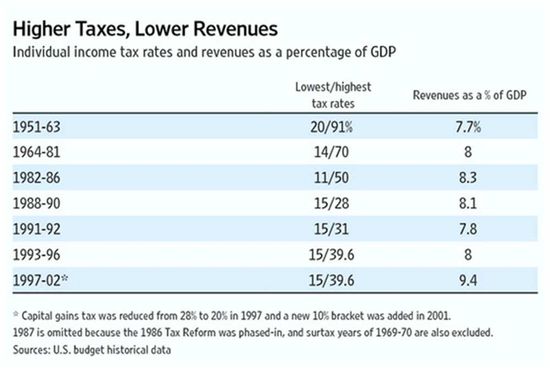
In the 16jun11 WSJ Alan Reynolds of Cato again presents US government data, and argues ‘Why 70% Tax Rates Won’t Work’ with a note to Robert Reich (the ‘70% man’) that says – “The income tax brought in less revenue when the highest rate was 70% to 91% than it did when the highest rate was 28%.”  (see nearby table from the article)

Reynolds goes on to detail the history of revenue production from tax rates reaching back to 1951.  He concludes with –

… the Joint Committee on Taxation recently reported that 51% of Americans no longer pay federal income tax.
 
Since the era of 70% tax rates, the U.S. income tax system has become far more “progressive.” Congressional Budget Office estimates show that from 1979 to 2007 average income tax rates fell by 110% to minus 0.4% from 4.1% for the second-poorest quintile of taxpayers. Average tax rates fell by 56% for the middle quintile and 39% for the fourth, but only 8% at the top. Despite these massive tax cuts for the bottom 80%, overall federal revenues were the same 18.5% share of GDP in 2007 as they were in 1979 and individual tax revenues were nearly the same—8.7% of GDP in 1979 versus 8.4% in 2007.
 
In short, reductions in top tax rates under Presidents Kennedy and Reagan, and reductions in capital gains tax rates under Presidents Clinton and George W. Bush, not only “paid for themselves” but also provided enough extra revenue to finance negative income taxes for the bottom 40% and record-low income taxes at middle incomes.

Of course, none of this will make a dent in the progressive chorus, because they are singing to voters already embracing the Peter/Paul Principle, and those for whom such information is not accessible.

[22jun2011 update – the following letter in the 22jun11 WSJ rebuts Robert Reich’s criticique of Reynold’s analysis, and extends the argument presented.]


In his rebuttal (Letters, June 18) to Alan Reynolds’s June 16 op-ed “Why 70% Tax Rates Won’t Work,” Robert Reich claims that Mr. Reynolds “distorts my proposal and ignores my argument.” And, well he should, because it’s impossible to address Mr. Reich’s “proposal” because it is not based on historical fact and misrepresents today’s reality.

For many of the glory years Mr. Reich celebrates, when tax rates ranged from 70% to 91%, there was no Alternative Minimum Tax and no limit on nearly all deductible expenses including the “three martini lunch.” Consequently “tax shelters” were ubiquitous and used by even the least significant investor. Taxes paid, and even prepaid to state and local governments, were fully deductible along with installment interest on credit cards, personal borrowing and more, including nearly all medical expenses. Even when the AMT was introduced, it only captured a handful of the highest income producers. Today, the AMT has become so oppressive that each year Congress exempts millions of middle-class wage-earning taxpayers from its clutches. It does, however, capture vast sums from the evil “millionaires and billionaires” the left so despises—except when they fund left-wing fantasies.

Very simply, the effective tax rates when marginal rates were stratospheric were not dramatically higher than today.

Mr. Reich proposes further tax reduction for those earning less than $100,000. Today about 22% of those making between $50,000 and $75,000 have no federal income tax liability or “negative liability.” As many as 9% of households with incomes between $75,000 and $100,000 are similarly exempt. His scheme would exempt much of the middle class, which is a disproportionate user of government, reducing its stake in the governance of America even further and making it more vulnerable to the volatility that has so damaged the economy during the Obama presidency.

Mr. Reich is simply proposing a vast expansion of government’s reach into the economy and relies on the premise that high earners aren’t paying their “fair share.” That is flat out false—they pay the vast majority of the costs of government. Further, his proposal assumes that the earnings of despised “millionaires and billionaires” belongs to our government, which will pay us an allowance after its choices of where to spend are honored and the earners’ choices of where not to spend are dismissed. Karl Marx lives.

Royal S. Dellinger, CPA

Posted in , ,

67 responses to “Higher Tax Rates = Lower Revenues (updated 22jun2011)”

  1. George Rebane Avatar

    “… tremendous increases in the national debt …”??; PaulE, I think that you may be using a more than slightly dated definition of such increases. I calculate such deficits in the same way that they have been calculated since WW2 – our national debt has always been an insignificant part of our GDP until the socialist policies of ‘everyone deserves a house independent of their ability to buy it’ kicked in during Bush2 and went into hyper-drive under Chief Community Organizer.

    Like

  2. Paul Emery Avatar
    Paul Emery

    George, the National Debt TRIPPLED from 1980-1990 under Reagan and Bush 1 from 907 million in 1990 to 3.2 billion in 2000. YOU CAN PUT LIPSTICK ON THE PIG ANY WAY YOU LIKE BUT THOSE ARE THE FACTS.
    If that’s not a “tremendous increase” I don’t know what is. Reaganomics was by and large a failure and it was only because he was such a good actor that he pulled it off. Clinton and Newt worked well together and actually paid down the debt before the other Bush got in and got things rolling backwards again. Obama is setting new records which I will not defend. But Reagan is the one that really paved the way.
    Here’s the stats
    http://en.wikipedia.org/wiki/United_States_public_debt#National_debt_for_selected_years

    Like

  3. Todd Juvinall Avatar
    Todd Juvinall

    We on the right are not defending anyone who has raised the debt. You simply cannot accept that because of your prejudice against the republicans. That is why you work the D booth at the Fair and I work the R booth.

    Like

  4. Paul Emery Avatar
    Paul Emery

    Todd
    Come on Todd, when have you ever criticized Reagan for running up the debt?

    Like

  5. Todd Juvinall Avatar
    Todd Juvinall

    Numerous times. I also fought against the taxing of savings accounts and amnesty. You still shining the dems shoes?

    Like

  6. Paul Emery Avatar
    Paul Emery

    Todd
    Where were you when Reagan and Bush(s) were on a spending rampage with the public credit card? FYI I’ve never worked the Dem booth. I find the hypocrisy of both both sides highly entertaining. I wish I could hang with he Libertarians but they are too simplistic. I keep hoping for a Green Libertarian slant to emerge.

    Like

  7. Greg Goodknight Avatar
    Greg Goodknight

    Paul, it’s the Speaker of the House who controls the spending, not the President. Tip O’Neil pronounced each of Reagans budgets as Dead on Arrival. Bush II at first had Dennis Hastert who didn’t want to end up like Gingrich and so, with a backbone of overcooked pasta and a bare majority, decided that both Dem and R spending would prevail, and Bush II’s last two years was when spending went ballistic, with Nancy Pelosi controlling the budget. Pelosi went open loop with spending when Obama was elected and the threat of veto went out the window.
    Say what you will about Bush II, he inherited a recession from Clinton, and was in office when 9/11 hit just as we were beginning to recover from the Clinton bust.

    Like

  8. Greg Goodknight Avatar
    Greg Goodknight

    Clinton and Gingrich did not work well together. Newt dragged Clinton kicking and screaming to a balanced budget.
    I remember when Leon Panetta, then Clinton’s chief of staff, declared early on he couldn’t work with Gingrich because he was too extreme, the latter make a brilliant call to tell the unelected Chief of Staff that if he had a problem working with the elected Speaker of the House, a Constitutional office, he should resign and make way for someone who could. Panetta backed down.

    Like

  9. Paul Emery Avatar
    Paul Emery

    Well then if Reagan and Bush couldn’t deal with the Democrats spending appetites according to you, they were irresponsible in pushing through tax cuts knowing it would cause deficits. They always could use the veto. Remember for the first six years of Bush 2 it was all Republicans and he got us in an unfunded war (Iraq) thinking it would quickly pay for itself. I blame the Dems for that as well because they went along with it.
    If you look at the chart here you will see it’s almost always Republican administrations that run up the national debt, current administration excluded. Even Jimmy Carter decreased the debt.
    http://en.wikipedia.org/wiki/National_debt_by_U.S._presidential_terms

    Like

  10. George Rebane Avatar

    PaulE, re GregG’s point, if you look at the same chart, you see Democrats in full charge of Congress running up the debt most/fastest.

    Like

  11. Paul Emery Avatar
    Paul Emery

    Under that thinking I’m sure you’re willing to give the Democrats full credit for job creation during the Reagan stint.

    Like

  12. Douglas Keachie Avatar

    Nice one, Paul!

    Like

  13. George Rebane Avatar

    PaulE and friends – Attributing credit/blame for the country’s fisc is a tricky matter as I have been trying to point out these last years. No one knows the system’s transfer function (if we do this, the economy will respond like that), multiple agents (President, Congress, bureaus, …) are manipulating different controls, the outputs (results0 are highly dimensioned and arrive with different lags (time delays), and, in the end, everything is interpreted politically.
    During all this, there are some periods where a political leader (President, Speaker, …) can uniquely marshall a general direction for policy, e.g. like FDR during the Depression, and Obama right now.
    And finally, both the system (America) and its environment (other countries, technology) are constantly changing (The techies call this a dynamic system/environment), which renders the application of experience/history even more problematic. This has made predictive arguments (based on intellect, populism, and ideology) the main public policy event for at least a hundred years in America’s body politic. I believe that in these pages we are nobly continuing this tradition. Sally forth!

    Like

  14. Paul Emery Avatar
    Paul Emery

    So George, if the application of experience/history is so problematic how can you make such bold predictions of the inevitable totalitarian “bayonets” in the streets destiny of the Western European countries such as Denmark?

    Like

  15. George Rebane Avatar

    Simple PaulE, I base my arguments on experience and interpretations of historical data which are compelling to me, and then use those to extrapolate likely future scenarios, i.e. I predict. Hopefully, my deductive logic melds appropriately into my inductive efforts, and I’m able to invoke some resonance in the reader.
    New data, of course, forces a constant rethinking which advises corroboration or revision. I am an error prone Bayesian, operating within a possibly unique conservetarian utility, and make no pretensions otherwise.

    Like

  16. George Rebane Avatar

    To put a ribbon on my 0926 comment, yesterday’s statement by the Fed’s Bernanke perfectly illustrates my point about messing with complex dynamic systems.
    “We don’t have a precise read on why this slower pace of growth is persisting,” the Fed chairman, Ben S. Bernanke, said yesterday at a news conference. “Some of the headwinds that have been concerning us, like the weakness in the financial sector, problems in the housing sector, balance sheet and deleveraging issues, may be stronger and more persistent than we thought.”
    “precise read” my @$$, they don’t have a clue on how the system would respond to their machinations. Their only operating policy is ‘Keep a straight face and they’ll believe you.’
    Every day von Mises’ sage advice echoes louder, ‘Do nothing, sooner.’

    Like

  17. Hunter Avatar
    Hunter

    Why does the government collect more revenue when the tax rates are lower? Because people who were not paying will start paying? If you keep more of your money how does the federal government get it? Sales tax from spending is not federal revenues!

    Like

Leave a comment