

George Rebane
That is a thesis put forward in the comment stream of ‘Rightwing Extremism in Action: Tea Party Houston’. And I believe this strong and important statement deserves an examination in its own right. First, let us understand political violence to be the use of force in the pursuit of a political end. What’s a political end? In this case it is clearly a political environment that does not exist at the time that the violence is perpetrated. Else why even give the matter thought, let alone start using force?
 Politics (from Greek πολιτικός, “of, for, or relating to citizens”), is a process by which groups of people make collective decisions. The term is generally applied to the art or science of running governmental or state affairs (an excellent definition from Wikipedia).
So a political end is usually one that specifies a state of governance ranging all the way from the structure of government itself, to one or more policies of such a government that are codified in anything from its constituting documents, through its laws, to regulations made by its departments in pursuit of executing certain laws.
With this groundwork laid, we may profitably contemplate the truth value of the thesis ‘All political violence is wrong.’
To begin, can anyone think of any kind of violence (excluding naked criminality committed within a system of governance) which would not be considered political violence? Political violence is throwing a Molotov cocktail through the window of an abortion clinic; it is blowing up a big government office building; it is also using billy clubs to determine who can or not enter a polling place, to attack commercial establishments in protesting certain meetings or government actions, to commit a suicide bombing, to cause harm to someone for not joining, and so on.
Political violence is also the marshalling of a population to raise an army, and fight for independence from a legally constituted and recognized government that rules the land – this is called a revolution. Political violence is also when one nation decides that its interests are best served through the use of force to weaken another country, sanction it, coerce it into certain concessions, or to invade it and annex it into its sphere of influence either by absorption or installing a new government that serves its needs. In short, it all seems to be political violence.
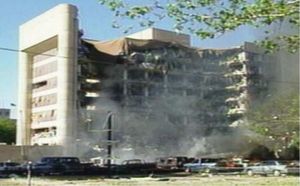 Do we now condemn some of the above, but not all of it? It seems that most people would not condone an individual deciding to blow up a random group of innocent people in pursuit of political ends. Yet if a group of people fill a city square to overturn cars, set fires, and make barricades to protest against their government, then we (in the large) don’t instantly condemn such political violence. Instead, we will take into consideration many factors, and may even go to the aid of those people and abet their violence. This is something that we will most likely not do if the perpetrator of such violence acted alone, or with a comrade, or maybe a cohort of less than ten, or … .
Unavoidably, it seems that numbers have something to do with whether we admit and condone political violence or condemn and resist it. The principles that motivate the ‘lone wolf’ and the mob of thousands may be identical, but somehow here principle is overshadowed by plurality.
If that is true, how do we assign an a priori threshold or rule set (algorithm) to separate ‘good’ political violence from ‘bad’ political violence? Many will immediately respond by saying, ‘Well, that depends on many things.’ And that is point here, what are those many things? How are we – or better, how am I – to judge the acceptability of political violence given that it is one of the most common and enduring expressions of human desperation?


 rebanesruminations.com
Leave a comment