
Rebane's Ruminations
May 2011
S M T W T F S
1234567
891011121314
15161718192021
22232425262728
293031  

ARCHIVES


OUR LINKS


YubaNet
White House Blog
Watts Up With That?
The Union
Sierra Thread
RL “Bob” Crabb
Barry Pruett Blog

George Rebane

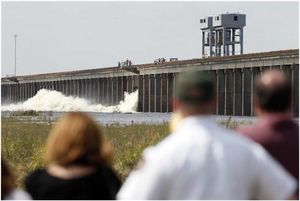
MorganzaSpillway This afternoon the Army Corps of Engineers opened a spillway in a massive containment levee (dam) to flood the few in order to save the many (see nearby AP photo).  From wsj.com

A steel, 10-ton floodgate was slowly raised Saturday for the first time in nearly four decades, unleashing a torrent of water from the Mississippi River, away from heavily populated areas downstream.

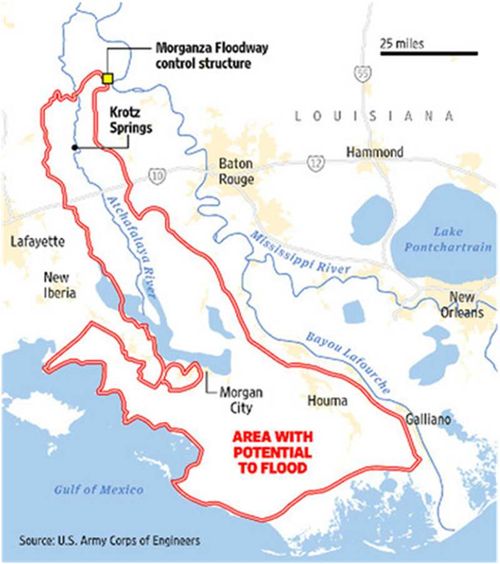
The water spit out slowly at first, then began gushing like a waterfall as it headed to swamp as much as 3,000 square miles (7,770 square kilometers) of Cajun countryside known for small farms and fish camps. Some places could wind up under as much as 25 feet (7.5 meters) of water.

Opening the Morganza spillway diverts water away from Baton Rouge and New Orleans, and the numerous oil refineries and chemical plants along the lower reaches of the Mississippi.

What puzzles me is that this massive piece of flood control infrastructure was built for the precise purpose of saving those 3,000 square miles of Cajun towns and farms from exactly this level of Mississippi flood waters.  It is a fairly simple problem of flood control engineering to calculate that given a so-and-so river level at Morganza will mean that Baton Rouge and New Orleans are going to be flooded.  Yet no appropriate flood control infrastructure has been built to protect those major population areas from flood levels that are provided for at Morganza.

It had to be known that the Morganza levee would never be used for its purported purpose unless and until the Baton Rouge and New Orleans flood control infrastructures were in place to handle the level of floods that Morganza can handle.  Yet the decision was made to build Morganza first, and decades passed without a finger being lifted to protect the cities downstream.

Would it not have been more sane to use the monies to first protect the cities to the extent possible, and let the Cajun countryside suffer what floods may come, because the Morganza spillway, to obviate its purpose, would have to be opened in any case to save the unprotected Baton Rouge and New Orleans?

The media have not picked up on this little question.  Maybe a reader can supply the simple explanation that eludes just me.  Or is this another example of government overwhelmed?

[16may2011 update]  The map below from the 16may11 WSJ gives an idea of the scope of the decision’s effect to flood the Atchafalaya River basin.
MorganzaFloodMap
 

Posted in , , ,

8 responses to “Morganza Spillway Decision (updated 16may2011)”

  1. Russ Steele Avatar

    George, here is part of your answer, pork, pork and more pork, but non-for flood contol.
    Army’s engineers spent millions on Louisiana projects labeled as pork
    WASHINGTON, D.C. — Before Hurricane Katrina breached a levee on the New Orleans Industrial Canal, the Army Corps of Engineers had launched a $748 million construction project at that very location. But the project had nothing to do with flood control. The Corps was building a massive new lock for the canal, an effort to accommodate steadily increasing barge traffic.
    Except barge traffic on the canal has been steadily decreasing.
    In Katrina’s wake, Louisiana politicians and other critics have complained about paltry funding for the Army Corps in general and Louisiana projects in particular. But over the five years of President Bush’s administration, Louisiana has received far more money for Corps civil works projects than any other state, about $1.9 billion; California was a distant second with less than $1.4 billion, even though its population is more than seven times larger.
    Much of that Louisiana money was spent to try to keep low-lying New Orleans dry. But hundreds of millions of dollars have gone to unrelated water projects demanded by the state’s congressional delegation and approved by the Corps, often after economic analyses that turned out to be inaccurate. Despite a series of independent investigations criticizing Army Corps construction projects as wasteful pork-barrel spending, Louisiana’s representatives have kept bringing home the bacon.
    For example, after a $194 million deepening project for the Port of Iberia flunked a Corps cost-benefit analysis, Sen. Mary Landrieu, D-La., [The Pork Princess ed] tucked language into an emergency Iraq spending bill ordering the agency to redo its calculations. The Corps also spends tens of millions of dollars a year dredging little-used waterways like the Mississippi River Gulf Outlet, the Atchafalaya River and the Red River — now known as the J. Bennett Johnston Waterway, in honor of the project’s congressional godfather — for barge traffic that turns out to be less than forecast.

    Like

  2. Michael Anderson Avatar
    Michael Anderson

    If you have spent any time in La. or Ms., or even east Texas, you will know that these states are largely swamp. The towns and cities there have benefited from gov’t pork for at least a century and a half. As a result, they are a few feet higher than the surrounding swamp.
    But unfortunately, the Atchafalaya Basin has always served as the overflow for a high Mississippi. The Morganza Spillway was a way to control the overflow. The last time was 1973. Now it is 2011, and the basin must be used to save Baton Rouge and New Orleans. The amount of water we are talking about–over a million cfs–cannot be controlled by levees downstream.
    The flooding will be a blessing in disguise.

    Like

  3. George Rebane Avatar

    I do understand the role and results of pork spending. But I don’t understand the logic of Michael’s answer about >1M cfs being controlled upstream at Morganza where the flow is narrower and more concentrated, but not downstream closer to the broad delta where the water mass has a larger area over which to distribute itself.

    Like

  4. Dave C Avatar
    Dave C

    Had they just left out the up-river levee system built in the 1920’s and 30’s, the Atchafalaya swamp south of the Interstate 10 corridor would have continued to naturally flood most every year. This also would have resulted in Louisiana from losing their intercoastal water way to Gulf of Mexico coastal erosion.

    Like

  5. Michael Anderson Avatar
    Michael Anderson

    As Steve F. and Dave C. have pointed out, the river wants to naturally flood into swamp above Baton Rouge and New Orleans. Between those two cities, the river is narrow and the levees high. Once past New Orleans, the Mississippi flattens out again.

    Like

  6. Dixon Cruickshank Avatar
    Dixon Cruickshank

    I wonder why it wasn’t open some weeks ago, a little – rather than releasing a torrent, seems like that would have solved the eventual issue without as much damage.

    Like

  7. Michael Anderson Avatar
    Michael Anderson

Leave a comment