

George Rebane
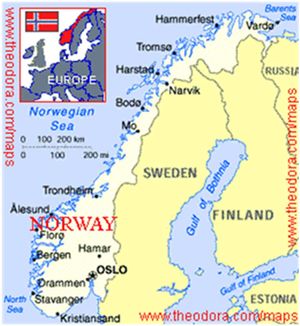 American progressives cum socialists frequently wax eloquent about the Scandinavian forms of governance, and pointedly ask ‘why can’t we be like that?’. What is the ‘that’ that so enamors them to countries like Denmark and Norway? Norway especially is the oft-cited posterchild of “socialist capitalism”. Perhaps this is because we recall the beauty of the country, its music, and enthusiastic fluff pieces that regularly appear in our media. One such offering, published as ‘In Norway Start-ups say Ja to Socialism’ on Inc.com, is typical, and was cited in these pages to underline and give meat to the argument that a more collective America would get us all closer to those pristine landscapes and happy peoples.
Norway is a fully developed first world country, prosperous by most measures, a contributor to America’s northern European stock, and an ally on the world scene. But in comparing it with America, and proposing that its model of social organization is something that would work here is a bit of a stretch as we shall see.
Norway is a culturally and ethnically tight or cohesive country of about 4.6 million souls. People speak the same language, live in low density environments, and share a lot of their double helix with each other. They are close to an ideal in size, distribution, and composition as what sociologists recommend for ideal human communities. We in America are not, and continue to distance ourselves from such an ideal.
Norway is blessed with abundant natural resources that include fishing, forest products, minerals, fossil fuels, and hydro-electric power. About 40% of its national income comes from extractive enterprises. On a per capita basis, Norway is the third largest producer of natural gas, and fourth largest producer of oil. They rank right up there with the Arabs. The country’s countless waterfalls and highland lakes emptying into the sea power hydro-electric generators that produce more cheap and clean electricity than the country can use.
Such abundance of resources bumps up the per capita income of Norwegians to almost $60K/year, compared to our $48K/year. And it also explains how such levels can be maintained with an economy that grows only 1.5%/year compared to our rate that is almost double theirs. They don’t have to do very much more beyond harvesting their natural gifts, and therefore they don’t.
On average, the Norwegians live about 1.6 years longer than Americans. And they enjoy cradle-to-grave nationalized healthcare, state-paid education, and the most generous social welfare system in the world. (However, most of the well-to-do go to private physicians and seek care overseas.) But none of all this really comes ‘free’ as is usually cited by our leftwing advocates. For openers, Norwegians pay over half their earnings to the state in taxes and fees. Additionally, they have a direct assets tax of over 1.1% on their total net worth north of $117K. Consider having to annually pay an extra $5K tax on your total net worth of $500K.
All this brings us down to the bottom line. Norwegians don’t like to make very many new Norwegians. Their fertility rate is currently at 1.85 births per woman. A stable population requires a fertility rate of 2.1. Norway’s population is growing slowly at about 0.33% per year (US grows at just under 1% per year), and that growth is made up of mostly Muslim immigration. Muslims already comprise over 2% of the population and tend to have large families wherever they settle. Islamic militancy is arguably Norway’s biggest and growing social problem today.
Also, what such breathless pieces as published in Inc.com don’t mention is that all this supposed entrepreneurial fervor draws little to no outside investment capital to the country. Norway is no Ireland of a few years back with its low tax rates. In fact Norway’s entrepreneurs quickly leave the country, and renounce their citizenship when their companies really start growing and/or they start successfully marketing to the outside world. You don’t hear of Americans or Germans or Brazilians or … fighting to get into Norway to start or expand their businesses.
So what we see today is a quiet country, primarily in stasis, that is contemplating the depletion of its natural resources, the aging of its population, and the growing Islamic onslaught. It has been blessed by relative isolation, strong cultural norms, a world hungry for its fish, forests, and fuels, and a climate that invites tourism as opposed to residency.
Furthermore, Norway has also been blessed by the security umbrella of the United States. Norway, like so many other seeming socialist utopias of Europe, has not had to field and finance any kind of military that could provide defense against countries coveting its treasures. For small countries such an expense would be a much larger fraction of its GDP than for a big country such as the US (3%). It is clear that Norway’s social programs would all but disappear if it had to put, say, 10% of its GDP into defense.
Suggestions, ranging from the casual to accusing, that the US can adopt any semblance of the Scandinavian socialist models lead to error. These socialistic forms of governance for small, sheltered, and culturally monolithic countries populated by well educated citizens do not scale well. However, they do remain for progressives as beacons and compelling templates for a new and improved America. Sadly, this we cannot change.


 rebanesruminations.com
Leave a comment